
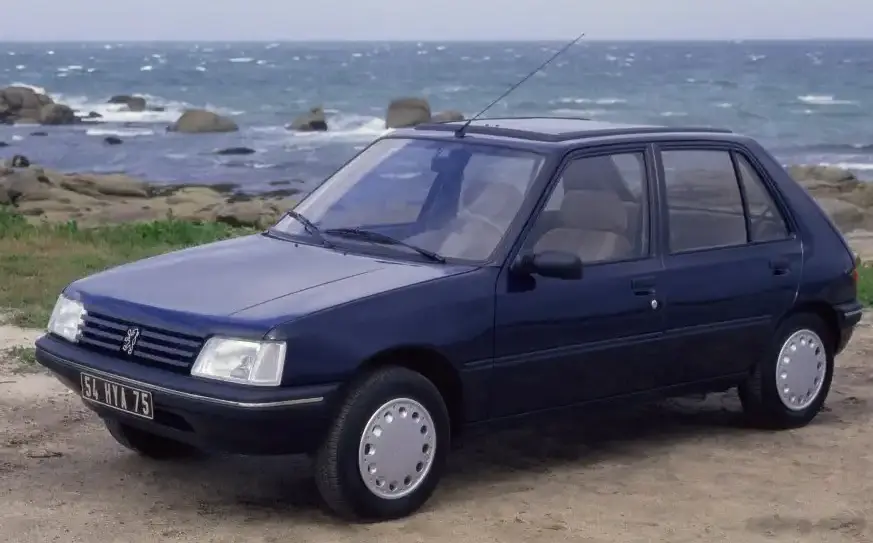
The Peugeot 205 I, specifically the 1.4-liter (84 horsepower) variant produced between 1987 and 1989, represents a significant iteration of Peugeot’s hugely successful supermini. This version, falling within the 20A/C facelifted series, occupied a crucial mid-range position in the 205 lineup, offering a balance between affordability, practicality, and reasonable performance. Introduced after the initial launch of the 205 in 1983, the facelift brought subtle styling updates and refinements to the engine range, solidifying the 205’s position as a class leader in Europe. This particular engine and trim level was aimed at buyers seeking a comfortable and economical daily driver, rather than the more performance-oriented GTI models.
Technical Specifications
| Brand | Peugeot |
| Model | 205 |
| Generation | 205 I (20A/C, facelift 1987) |
| Type (Engine) | 1.4 (84 Hp) |
| Start of production | 1987 |
| End of production | 1989 |
| Powertrain Architecture | Internal Combustion engine |
| Body type | Hatchback |
| Fuel Type | Petrol (Gasoline) |
| Power | 84 Hp |
| Engine Model/Code | K2B TU3S |
| Engine aspiration | Naturally aspirated engine |
| Engine oil capacity | 3.2 l (3.38 US qt | 2.82 UK qt) |
| Coolant capacity | 5.8 l (6.13 US qt | 5.1 UK qt) |
Powertrain & Engine Architecture
The heart of this 205 variant is the Peugeot K2B TU3S engine, a 1.4-liter, naturally aspirated inline-four cylinder unit. This engine is a member of the TU (Technologie Unifiée) family, known for its simplicity and durability. The ‘S’ designation indicates a slightly higher compression ratio and improved cylinder head design compared to earlier TU3 variants. The engine utilizes a single overhead camshaft (SOHC) valvetrain, operating two valves per cylinder. Fuel delivery is managed by a Solex C32 PHH carburetor, a common setup for European vehicles of this era aiming for cost-effectiveness. While not as sophisticated as fuel injection, the carburetor provided adequate fuel atomization for the engine’s output. The engine’s 84 horsepower is achieved at 6000 rpm, with peak torque of approximately 98 lb-ft (133 Nm) at 3500 rpm. The transmission paired with this engine is typically a four-speed manual, though a three-speed automatic transmission was also available, albeit less common. The automatic transmission, while offering convenience, did noticeably impact acceleration and fuel economy.
Driving Characteristics
The 1.4-liter 205 offered a comfortable, if not particularly exhilarating, driving experience. With 84 horsepower propelling a relatively lightweight chassis (around 1,780 lbs or 807 kg), acceleration from 0 to 60 mph (0-97 km/h) took approximately 12-13 seconds. The four-speed manual transmission allowed for reasonable control over the engine’s powerband, while the optional automatic transmission, while smooth, resulted in slower acceleration and a less engaging driving experience. Gear ratios were geared towards economy, with a relatively tall final drive. The engine felt responsive enough for everyday driving, providing sufficient power for overtaking maneuvers on open roads. Compared to the 1.6-liter and especially the 1.9-liter GTI versions, the 1.4 felt noticeably less powerful, but it also offered significantly better fuel economy. The handling was typical of the 205 – nimble and precise, thanks to its torsion bar suspension and relatively short wheelbase.
Equipment & Trim Levels
The 1.4-liter 205 typically came equipped with a fairly basic level of standard features. Interior upholstery was usually cloth, with a simple dashboard layout featuring analog gauges for speed, fuel level, and coolant temperature. Power steering was not standard on this trim level, requiring more effort at low speeds. Optional extras included a sunroof, upgraded stereo system, and central locking. The trim level sat between the base 1.0-liter model and the more luxurious 1.6-liter versions. The interior plastics were durable but utilitarian, reflecting the car’s focus on affordability. The exterior featured steel wheels with hubcaps, and body-colored bumpers were often an optional extra.
Chassis & Braking
The 205’s chassis was a key element of its success. It utilized a torsion bar suspension system at the front, providing a comfortable ride and good handling characteristics. The rear suspension employed a trailing arm setup. Braking on the 1.4-liter model typically consisted of disc brakes at the front and drum brakes at the rear. The braking system was adequate for the car’s performance, but lacked the stopping power of the larger brakes found on the GTI models. Stabilizer bars were often omitted on the base models, further contributing to a softer ride but slightly reduced handling precision. The steering was unassisted on many examples, providing good feedback but requiring more effort, particularly during parking maneuvers.
Market Reception & Comparison
The 1.4-liter 205 was well-received by the motoring press as a practical and affordable supermini. Critics praised its nimble handling, comfortable ride, and fuel efficiency. However, the engine’s lack of outright power was often noted, particularly when compared to the more potent GTI versions. Compared to rivals such as the Renault 5 and the Fiat Uno, the 205 offered a more refined driving experience and a more modern interior. Fuel economy was a strong point, averaging around 45-50 mpg (5.2-5.7 L/100km) in mixed driving conditions. Reliability was generally good, with the TU3S engine proving to be a durable and long-lasting unit. The automatic transmission, however, was sometimes criticized for its sluggishness and reduced fuel economy.
Legacy
The Peugeot 205, in all its variants, remains a highly regarded classic car. The 1.4-liter version, while not as sought-after as the GTI models, offers a more affordable entry point into 205 ownership. The TU3S engine is known for its robustness and relatively simple maintenance requirements. Parts availability is generally good, although some trim-specific components can be difficult to find. Today, these cars are popular with enthusiasts and collectors, offering a nostalgic driving experience and a reminder of a golden age of small, fun-to-drive hatchbacks. Well-maintained examples command reasonable prices in the used car market, and the 205 continues to be a popular choice for classic car rallies and events. The 1.4 automatic, while not the fastest, represents a comfortable and reliable option for those seeking a classic French hatchback.
