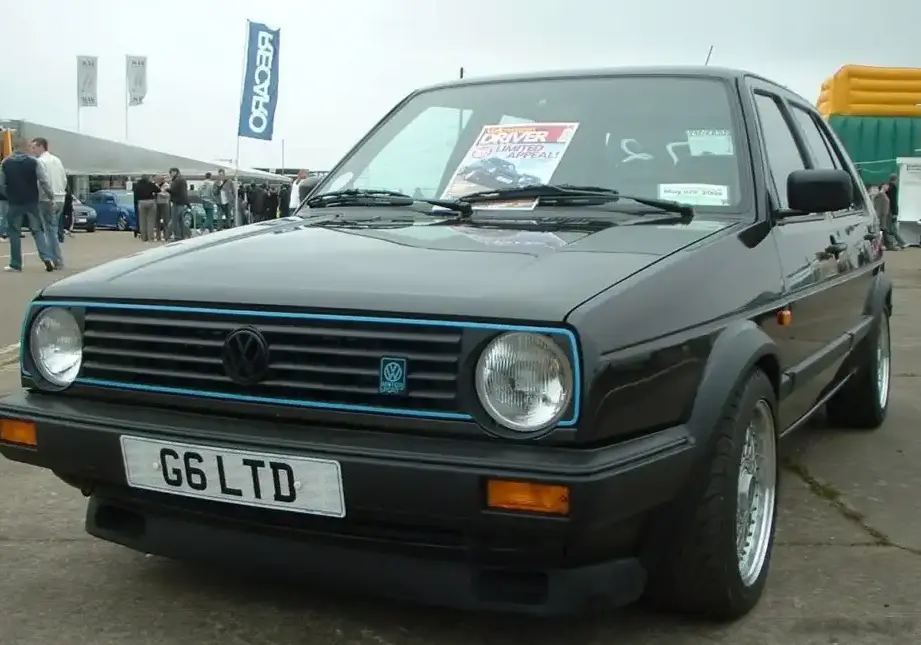
The Volkswagen Golf II 1.8 GTI 8V, produced from 1987 to 1991, represented a significant evolution of the original Golf, building upon its success with refined styling and improved mechanicals. This variant, part of the facelifted second-generation Golf (designated 1HX0/A3 internally), occupied a middle ground within the GTI range, offering a balance between performance and affordability. It served as a popular choice for buyers seeking a sporty hatchback with everyday usability, particularly in European markets where the Golf reigned supreme as a class leader. The 1.8 GTI 8V was positioned below the more potent 16V versions, but above the base-model Golfs, appealing to a broader customer base.
Technical Specifications
| Brand | Volkswagen |
| Model | Golf |
| Generation | Golf II (5-door, facelift 1987) |
| Type (Engine) | 1.8 GTI 8V (107 Hp) |
| Start of production | 1987 |
| End of production | 1991 |
| Powertrain Architecture | Internal Combustion engine |
| Body type | Hatchback |
| Seats | 5 |
| Doors | 5 |
| Fuel consumption (urban) | 10.7 l/100 km (22 US mpg, 26.4 UK mpg, 9.3 km/l) |
| Fuel consumption (extra urban) | 6.4 l/100 km (36.8 US mpg, 44.1 UK mpg, 15.6 km/l) |
| Fuel Type | Petrol (Gasoline) |
| Acceleration 0 – 100 km/h | 10.3 sec |
| Acceleration 0 – 62 mph | 10.3 sec |
| Acceleration 0 – 60 mph | 9.8 sec |
| Maximum speed | 186 km/h (115.58 mph) |
| Weight-to-power ratio | 9.1 kg/Hp, 109.7 Hp/tonne |
| Weight-to-torque ratio | 6.2 kg/Nm, 161 Nm/tonne |
| Power | 107 Hp @ 5400 rpm |
| Power per litre | 60.1 Hp/l |
| Torque | 157 Nm @ 3800 rpm (115.8 lb.-ft. @ 3800 rpm) |
| Engine layout | Front, Transverse |
| Engine Model/Code | PF |
| Engine displacement | 1781 cm3 (108.68 cu. in.) |
| Number of cylinders | 4 |
| Engine configuration | Inline |
| Cylinder Bore | 81 mm (3.19 in.) |
| Piston Stroke | 86.4 mm (3.4 in.) |
| Compression ratio | 10:1 |
| Number of valves per cylinder | 2 |
| Fuel injection system | Multi-port manifold injection |
| Engine aspiration | Naturally aspirated engine |
| Valvetrain | SOHC |
| Engine oil capacity | 4 l (4.23 US qt | 3.52 UK qt) |
| Coolant capacity | 6.3 l (6.66 US qt | 5.54 UK qt) |
| Kerb Weight | 975 kg (2149.51 lbs.) |
| Max. weight | 1465 kg (3229.77 lbs.) |
| Max load | 490 kg (1080.27 lbs.) |
| Trunk (boot) space – minimum | 345 l (12.18 cu. ft.) |
| Trunk (boot) space – maximum | 1145 l (40.44 cu. ft.) |
| Fuel tank capacity | 55 l (14.53 US gal | 12.1 UK gal) |
| Permitted trailer load with brakes (12%) | 1200 kg (2645.55 lbs.) |
| Permitted trailer load without brakes | 490 kg (1080.27 lbs.) |
| Length | 4040 mm (159.06 in.) |
| Width | 1680 mm (66.14 in.) |
| Height | 1405 mm (55.31 in.) |
| Wheelbase | 2475 mm (97.44 in.) |
| Front track | 1427 mm (56.18 in.) |
| Rear (Back) track | 1422 mm (55.98 in.) |
| Drag coefficient (Cd) | 0.34 |
| Minimum turning circle (turning diameter) | 10.5 m (34.45 ft.) |
| Drivetrain Architecture | The Internal combustion engine (ICE) drives the front wheels of the vehicle. |
| Drive wheel | Front wheel drive |
| Number of gears and type of gearbox | 5 gears, manual transmission |
| Front suspension | Independent type McPherson, Transverse stabilizer |
| Rear suspension | Transverse stabilizer, Elastic beam |
| Front brakes | Ventilated discs |
| Rear brakes | Disc |
| Steering type | Steering rack and pinion |
| Tires size | 185/60 R14; 195/50 R15 |
| Wheel rims size | 6J x 14; 6.5J x 15 |
Powertrain & Engine Architecture
The heart of the Golf II 1.8 GTI 8V was the PF engine code, a 1781cc inline-four cylinder gasoline engine. This engine featured a single overhead camshaft (SOHC) valvetrain operating two valves per cylinder. Fuel delivery was managed by Bosch multi-port fuel injection, a significant advancement over earlier carbureted systems, contributing to improved efficiency and responsiveness. The 8-valve configuration, while less sophisticated than the later 16-valve heads, offered a good balance of power and reliability. The engine produced 107 horsepower at 5400 rpm and 157 Nm (115.8 lb-ft) of torque at 3800 rpm. This power was transmitted to the front wheels through a five-speed manual transmission, although a three-speed automatic transmission was also available, albeit less common and impacting performance. The automatic transmission was a conventional hydraulic unit, offering smooth but less engaging shifts compared to the manual.
Driving Characteristics
The 1.8 GTI 8V with the manual transmission provided a reasonably spirited driving experience. Acceleration from 0 to 60 mph took around 9.8 seconds, and it could achieve a top speed of 115.58 mph. While not as quick as the 16V GTI models, the 8V offered a more accessible powerband, making it easier to drive in everyday traffic. The automatic transmission version noticeably dulled performance, adding approximately a second to the 0-60 mph time. Gear ratios were tuned for a balance of acceleration and fuel economy. The chassis, while relatively simple, provided a comfortable ride and predictable handling. The front-wheel-drive layout offered good traction in most conditions, but could exhibit some understeer when pushed hard.
Equipment & Trim Levels
The Golf II 1.8 GTI 8V typically came equipped with features such as power steering, central locking, and electric windows. Interior upholstery was usually cloth, with options for upgraded materials. The dashboard featured a comprehensive instrument cluster with a speedometer, tachometer, fuel gauge, and coolant temperature gauge. Optional extras included a sunroof, alloy wheels, and a more advanced audio system. The GTI trim level also included unique styling cues, such as a red pinstripe on the grille and GTI badging.
Chassis & Braking
The Golf II 1.8 GTI 8V utilized an independent McPherson strut suspension at the front, providing good wheel control and ride comfort. The rear suspension employed a torsion beam setup, which was cost-effective and provided adequate handling characteristics for a front-wheel-drive vehicle. Braking duties were handled by ventilated disc brakes at the front and disc brakes at the rear, offering sufficient stopping power for the car’s weight and performance. Stabilizer bars were fitted to both the front and rear axles to reduce body roll during cornering.
Market Reception & Comparison
The Golf II 1.8 GTI 8V was generally well-received by automotive critics. It was praised for its blend of performance, practicality, and affordability. Compared to the more expensive 16V GTI, the 8V offered a more accessible entry point into the GTI world. Fuel economy was respectable for a performance hatchback of the era, averaging around 22 mpg in urban driving and 36.8 mpg on the highway. Reliability was generally good, although regular maintenance was essential to prevent issues with the fuel injection system and engine cooling. The 1.9 TDI diesel version, while offering superior fuel economy, lacked the GTI’s sporty character.
Legacy
The Volkswagen Golf II 1.8 GTI 8V remains a popular classic car today, appreciated for its timeless design and engaging driving experience. The PF engine, while not the most powerful in the GTI lineup, is known for its durability and relative simplicity, making it easier to maintain than the more complex 16V engines. Well-maintained examples command a reasonable price in the used car market, and parts availability is generally good. The Golf II 1.8 GTI 8V represents a sweet spot in the Golf lineage, offering a compelling combination of performance, practicality, and affordability that continues to appeal to enthusiasts.