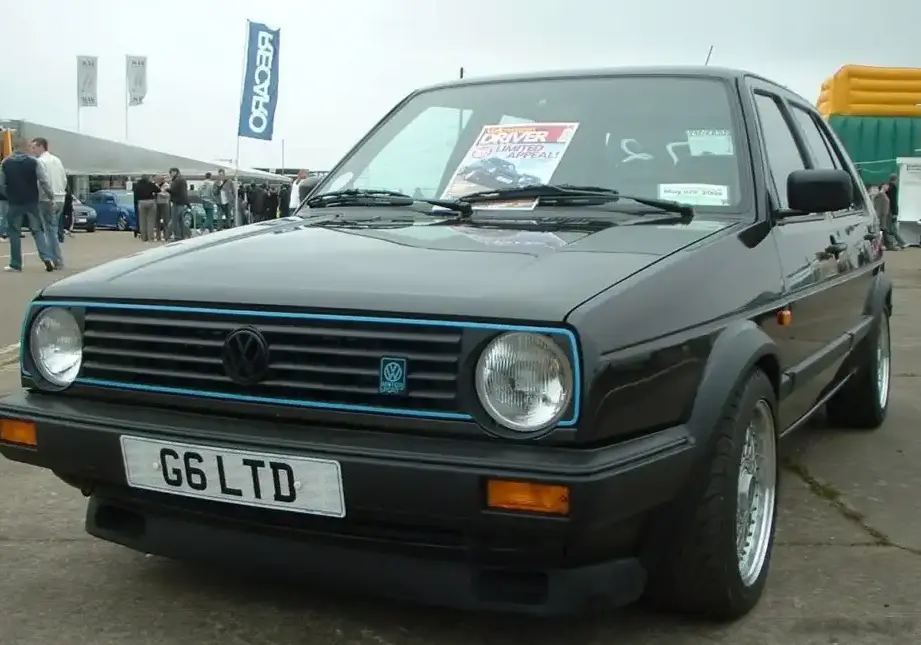
The Volkswagen Golf II 1.8 GTI G60, produced from 1990 to 1991, represents a high-performance variant within the facelifted second-generation Golf (1987-1992) range. Positioned as a premium offering, it distinguished itself from the standard Golf II models through its innovative supercharged engine and sporty enhancements. This model, built on the 1HX0/A3 platform, was a significant step up in performance compared to naturally aspirated Golfs, and served as a precursor to more powerful VW models. The G60 was primarily marketed in Europe, where the demand for compact, yet potent, hatchbacks was strong. It offered a unique blend of everyday usability and engaging driving dynamics.
Technical Specifications
| Brand | Volkswagen |
| Model | Golf |
| Generation | Golf II (5-door, facelift 1987) |
| Type (Engine) | 1.8 GTI G60 (160 Hp) |
| Start of production | 1990 |
| End of production | 1991 |
| Powertrain Architecture | Internal Combustion engine |
| Body type | Hatchback |
| Seats | 5 |
| Doors | 5 |
| Fuel consumption (urban) | 12.1 l/100 km (19.4 US mpg, 23.3 UK mpg, 8.3 km/l) |
| Fuel consumption (extra urban) | 6.9 l/100 km (34.1 US mpg, 40.9 UK mpg, 14.5 km/l) |
| Fuel Type | Petrol (Gasoline) |
| Acceleration 0 – 100 km/h | 8.3 sec |
| Acceleration 0 – 62 mph | 8.3 sec |
| Acceleration 0 – 60 mph | 7.9 sec |
| Maximum speed | 216 km/h (134.22 mph) |
| Weight-to-power ratio | 6.9 kg/Hp, 144.8 Hp/tonne |
| Weight-to-torque ratio | 4.9 kg/Nm, 203.6 Nm/tonne |
| Power | 160 Hp @ 5800 rpm |
| Power per litre | 89.8 Hp/l |
| Torque | 225 Nm @ 3800 rpm (165.95 lb.-ft. @ 3800 rpm) |
| Engine layout | Front, Transverse |
| Engine Model/Code | PG |
| Engine displacement | 1781 cm3 (108.68 cu. in.) |
| Number of cylinders | 4 |
| Engine configuration | Inline |
| Cylinder Bore | 81 mm (3.19 in.) |
| Piston Stroke | 86.4 mm (3.4 in.) |
| Compression ratio | 8:1 |
| Number of valves per cylinder | 2 |
| Fuel injection system | Multi-port manifold injection |
| Engine aspiration | Supercharger, Intercooler |
| Valvetrain | SOHC |
| Engine oil capacity | 4 l (4.23 US qt | 3.52 UK qt) |
| Coolant | 5.5 l (5.81 US qt | 4.84 UK qt) |
| Kerb Weight | 1105 kg (2436.11 lbs.) |
| Max. weight | 1530 kg (3373.07 lbs.) |
| Max load | 425 kg (936.96 lbs.) |
| Trunk (boot) space – minimum | 330 l (11.65 cu. ft.) |
| Trunk (boot) space – maximum | 1145 l (40.44 cu. ft.) |
| Fuel tank capacity | 55 l (14.53 US gal | 12.1 UK gal) |
| Permitted trailer load with brakes (12%) | 1200 kg (2645.55 lbs.) |
| Permitted trailer load without brakes | 510 kg (1124.36 lbs.) |
| Length | 4040 mm (159.06 in.) |
| Width | 1700 mm (66.93 in.) |
| Height | 1405 mm (55.31 in.) |
| Wheelbase | 2475 mm (97.44 in.) |
| Front track | 1437 mm (56.57 in.) |
| Rear (Back) track | 1432 mm (56.38 in.) |
| Drag coefficient (Cd) | 0.34 |
| Minimum turning circle (turning diameter) | 10.5 m (34.45 ft.) |
| Drivetrain Architecture | The Internal combustion engine (ICE) drives the front wheels of the vehicle. |
| Drive wheel | Front wheel drive |
| Number of gears and type of gearbox | 5 gears, manual transmission |
| Front suspension | Independent type McPherson, Transverse stabilizer |
| Rear suspension | Transverse stabilizer, Elastic beam |
| Front brakes | Ventilated discs |
| Rear brakes | Disc |
| Assisting systems | ABS (Anti-lock braking system) |
| Steering type | Steering rack and pinion |
| Power steering | Hydraulic Steering |
| Tires size | 195/50 R15 |
| Wheel rims size | 6.5J x 15 |
Powertrain & Engine Architecture
The heart of the Golf II G60 is the 1.8-liter inline-four cylinder engine, designated PG. What set this engine apart was its roots-type supercharger, a G-Lader in Volkswagen terminology. This supercharger, developed by Kühnle, Kopp & Nolte (KKN), provided instant boost, eliminating much of the turbo lag associated with turbocharged engines of the time. The engine featured multi-port fuel injection and a single overhead camshaft (SOHC) valvetrain. The 8:1 compression ratio was a compromise to accommodate the increased cylinder pressures from the supercharger. The intercooler, mounted prominently at the front of the vehicle, cooled the compressed intake air, further enhancing performance. The G60 engine produced 160 horsepower at 5800 rpm and 225 Nm (166 lb-ft) of torque at 3800 rpm. The engine was paired with a five-speed manual transmission, providing precise control over the power delivery.
Driving Characteristics
The Golf II G60 offered a noticeably different driving experience compared to the standard 1.8-liter Golfs. The supercharger provided strong, linear acceleration from low engine speeds, making it exceptionally responsive in everyday driving situations. While not as peaky as some turbocharged engines, the G60 still encouraged spirited driving. The five-speed manual transmission allowed drivers to keep the engine in its optimal power band. The 0-60 mph time of around 7.9 seconds was impressive for a front-wheel-drive hatchback of that era. Compared to the later VR6 Golf II, the G60 offered a different character – the VR6 was smoother and had a higher redline, while the G60 was more about immediate, accessible power. The G60’s torque delivery made it easier to drive in challenging conditions, and its relatively light weight contributed to its nimble handling.
Equipment & Trim Levels
The Golf II G60 typically came well-equipped, reflecting its position as a premium model. Standard features included power steering, ABS anti-lock brakes, alloy wheels (typically 6J x 15), and a sport-tuned suspension. The interior featured upgraded upholstery, often with GTI-specific seat patterns. Optional extras included a sunroof, central locking, electric windows, and a more sophisticated audio system. The dashboard layout was similar to other Golf II models, but the G60 often featured additional gauges, such as a boost pressure gauge, to monitor the supercharger’s performance.
Chassis & Braking
The Golf II G60 utilized a McPherson strut front suspension with a transverse stabilizer bar, providing responsive steering and good handling. The rear suspension employed a torsion beam setup, which was a cost-effective and space-efficient solution. The braking system featured ventilated discs on the front wheels and discs on the rear, providing adequate stopping power for the car’s performance capabilities. The inclusion of ABS was a significant safety feature for the time.
Market Reception & Comparison
The Golf II G60 was generally well-received by automotive critics. It was praised for its unique engine, strong performance, and engaging driving dynamics. However, some reviewers noted that the supercharger produced a distinctive whine that some found intrusive. Compared to the naturally aspirated Golf GTI, the G60 offered a substantial performance upgrade. Against the more expensive VR6 Golf, the G60 provided a compelling alternative for buyers who prioritized torque and responsiveness over outright horsepower. Fuel economy was reasonable for a performance car of the era, but not as good as the standard Golf models.
Legacy
The Golf II G60 holds a special place in Volkswagen history as a pioneering example of forced induction technology. The G60 engine, while relatively complex, proved to be durable when properly maintained. Today, the Golf II G60 is a sought-after classic car, particularly among enthusiasts who appreciate its unique character and performance. Finding well-maintained examples can be challenging, as some G60s have been modified or neglected over the years. The supercharger itself requires periodic maintenance, including oil changes, to ensure reliable operation. Despite its age, the Golf II G60 remains a capable and enjoyable car, offering a glimpse into Volkswagen’s innovative past.