
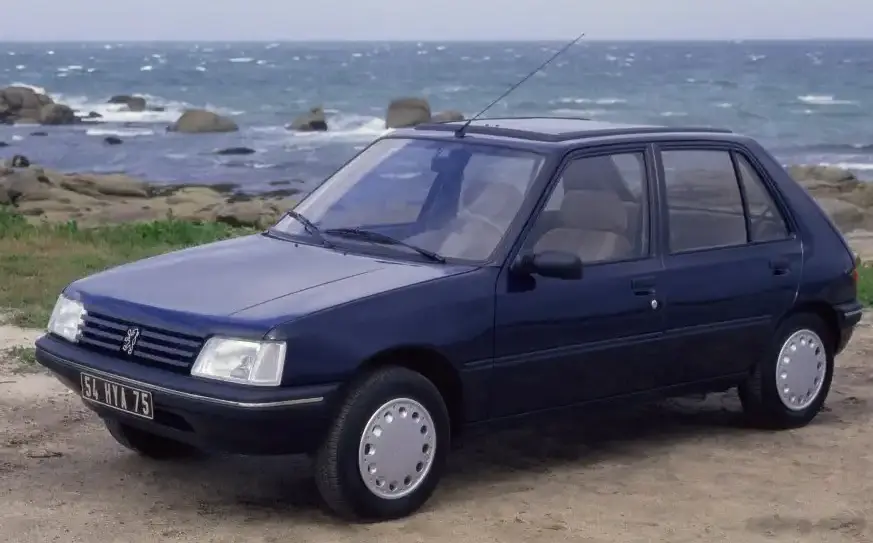
The Peugeot 205, launched in 1983, rapidly became a European automotive icon and a consistent best-seller. The 205 I series, encompassing the original models and a facelifted version introduced in 1987 (designated 20A/C), marked a substantial evolution from its predecessors, offering a modern, sporty, and practical package. The 1.6-liter (75 horsepower) variant, produced from 1987 to 1998, occupied a key mid-range position within the 205 lineup, appealing to buyers seeking a balance between affordability, fuel efficiency, and reasonable performance. This version proved particularly popular in France and across other European markets, serving as a versatile and reliable everyday vehicle.
Technical Specifications
| Brand | Peugeot |
| Model | 205 |
| Generation | 205 I (20A/C, facelift 1987) |
| Type (Engine) | 1.6 (75 Hp) |
| Start of production | 1987 |
| End of production | 1998 |
| Powertrain Architecture | Internal Combustion engine |
| Body type | Hatchback |
| Fuel Type | Petrol (Gasoline) |
| Power | 75 Hp |
| Engine Model/Code | B1A XU51C, BAZ XU5CP |
| Engine aspiration | Naturally aspirated engine |
| Engine oil capacity | 5 l (5.28 US qt | 4.4 UK qt) |
| Coolant capacity | 6.7 l (7.08 US qt | 5.9 UK qt) |
Powertrain & Engine Architecture
The 1.6-liter engine, identified by codes B1A (XU51C) and BAZ (XU5CP), belonged to Peugeot’s XU series, a family of engines known for their robustness. This engine featured a cast iron block and an aluminum cylinder head, a common combination for achieving both durability and weight reduction. It was a naturally aspirated, four-cylinder engine with a displacement of 1580cc. Fuel delivery was managed by a Bosch mechanical fuel injection system, a relatively straightforward but dependable setup for its time. The XU51C engine utilized a single overhead camshaft (SOHC) valvetrain with two valves per cylinder. The later BAZ XU5CP variant, introduced during the latter part of the production run, incorporated minor refinements to the fuel injection system and engine management, resulting in slightly improved emissions and fuel efficiency.
The 1.6-liter engine was typically paired with a three-speed automatic transmission. While offering convenience, this transmission wasn’t particularly renowned for its performance or sophistication. It featured a traditional torque converter and planetary gearsets. The gear ratios were optimized for fuel economy and smooth operation, rather than rapid acceleration. The automatic transmission was a defining characteristic of this trim level, specifically targeting buyers who prioritized ease of driving over a more sporty driving experience.
Driving Characteristics
The 205 1.6 Automatic delivered a comfortable and predictable driving experience. Producing 75 horsepower and approximately 95 lb-ft of torque, acceleration was adequate for everyday driving, but not particularly quick. The automatic transmission contributed to a smoother, though slower, pace compared to the five-speed manual versions. The three-speed automatic meant the engine frequently operated at higher RPMs during highway cruising, potentially impacting both fuel economy and noise levels. Compared to the more powerful 1.9 GTI or even the 1.4-liter manual versions, the 1.6 Automatic lacked the dynamic flair and responsiveness that made the 205 so celebrated. However, it provided a more relaxed and user-friendly experience, especially in urban environments.
The steering was light and precise, a hallmark of the 205, making it easy to maneuver in confined spaces. The suspension, while relatively simple, struck a good balance between ride comfort and handling. The car felt nimble and stable, but wasn’t designed for aggressive cornering.
Equipment & Trim Levels
The 1.6-liter automatic variant generally came equipped with a reasonable level of standard features. These included cloth upholstery, a basic instrument cluster, and manual windows and door locks. Air conditioning was frequently offered as an optional extra, as were features like a radio/cassette player and central locking. Interior trim levels varied depending on the market and production year, but generally, the 1.6 Automatic offered a functional and practical interior without excessive luxury. The dashboard layout was straightforward and user-friendly, prioritizing functionality over aesthetics.
Higher trim levels, often designated as “GR” or “GL”, added features such as upgraded upholstery, alloy wheels, and additional exterior trim. However, the core appeal of the 1.6 Automatic remained its affordability and ease of use.
Chassis & Braking
The 205 I employed a front-engine, front-wheel-drive layout. The suspension consisted of independent front suspension with MacPherson struts and a torsion beam rear axle. This setup provided a good compromise between ride comfort and handling. The braking system on most 1.6 Automatic models featured disc brakes on the front wheels and drum brakes on the rear. This configuration was typical for cars in this price range during the 1980s and 1990s. The brakes were adequate for normal driving conditions, but lacked the stopping power of the larger disc brakes found on higher-performance models.
Stabilizer bars were often included as standard equipment, helping to reduce body roll during cornering. The chassis was relatively lightweight, contributing to the car’s nimble handling characteristics.
Market Reception & Comparison
The Peugeot 205 1.6 Automatic was generally well-received by automotive critics as a practical and affordable small car. It was praised for its fuel efficiency, comfortable ride, and ease of driving. However, it was often criticized for its lack of performance compared to other 205 variants, particularly the GTI models. Compared to competitors like the Renault 5 and Citroën AX, the 205 1.6 Automatic offered a more refined driving experience and a more stylish interior. Fuel economy was competitive for the time, typically ranging from 30 to 35 miles per gallon in mixed driving conditions. Reliability was generally good, although the automatic transmission could be prone to issues if not properly maintained.
Legacy
The Peugeot 205 1.6 Automatic remains a popular choice among classic car enthusiasts and budget-conscious buyers. The XU51C engine is known for its durability and relatively simple maintenance requirements. However, locating well-maintained examples can be challenging, as many cars have suffered from neglect or have accumulated high mileage. Parts availability is generally good, although some specific components may be difficult to source. The 205 1.6 Automatic represents a significant piece of automotive history, embodying the spirit of the 1980s and 1990s small car market. Its enduring appeal lies in its combination of practicality, affordability, and charming French design.
