
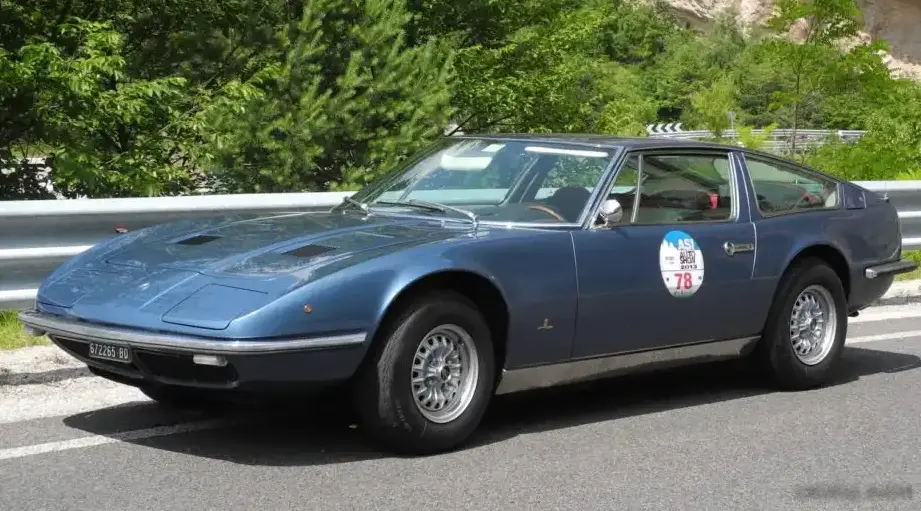
The Maserati Indy 4.2, produced between 1969 and 1974, represents a pivotal moment in the Italian manufacturer’s history. Named after Maserati’s racing successes at the Indianapolis 500, the Indy was designed as a replacement for the aging 3500 GT and 4500 GT. The 4.2-liter variant, producing 260 horsepower, was the most potent engine offered during the Indy’s production run and solidified the car’s position as a grand touring luxury coupe capable of competing with offerings from Ferrari and Porsche. It was a significant evolution in Maserati’s design language, moving towards a more modern and angular aesthetic while retaining the brand’s commitment to performance and craftsmanship. The Indy, particularly the 4.2, remains a highly sought-after classic car, prized for its elegant styling, powerful engine, and relatively comfortable ride.
Technical Specifications
| Brand | Maserati |
| Model | Indy |
| Generation | Indy |
| Type (Engine) | 4.2 (260 Hp) |
| Start of Production | 1969 |
| End of Production | 1974 |
| Powertrain Architecture | Internal Combustion Engine |
| Body Type | Coupe |
| Fuel Type | Petrol (Gasoline) |
| Power | 260 Hp |
| Engine Model/Code | AM116 |
| Engine Aspiration | Naturally Aspirated |
| Engine Oil Capacity | 10 l (10.57 US qt | 8.8 UK qt) |
| Coolant Capacity | 13 l (13.74 US qt | 11.44 UK qt) |
Powertrain & Engine Architecture
The heart of the Indy 4.2 is the AM116 engine, a 4.2-liter, naturally aspirated V8. This engine was a significant upgrade over the earlier 4.1-liter unit, featuring a larger displacement and revised cylinder heads. The AM116 is a 90-degree V8, constructed with a cast iron block and aluminum cylinder heads. It employed a single overhead camshaft per bank, operating two valves per cylinder. Fuel delivery was managed by four Weber 38 DCOE carburetors, contributing to the engine’s responsive throttle behavior and characteristic V8 sound. The engine produced 260 horsepower at 5,800 rpm and 298 lb-ft of torque at 4,000 rpm. The Indy 4.2 was exclusively offered with a ZF 5-speed manual transmission, known for its durability and precise shifting. This transmission was considered a key component in delivering the engine’s power effectively to the rear wheels. While an automatic transmission was available on earlier Indy models, it was not offered with the 4.2-liter engine due to the transmission’s inability to reliably handle the increased power output.
Driving Characteristics
The Maserati Indy 4.2 offered a distinctly grand touring experience. The 4.2-liter V8 provided ample power for effortless cruising at high speeds, as well as brisk acceleration when needed. The car’s relatively long wheelbase and well-tuned suspension contributed to a comfortable ride, even on less-than-perfect road surfaces. The ZF 5-speed manual transmission allowed drivers to fully exploit the engine’s powerband, providing precise control over gear selection. Compared to the earlier 4.1-liter Indy, the 4.2 offered a noticeable improvement in performance, with quicker acceleration and a higher top speed (estimated around 155 mph). The steering was relatively light and precise, although it lacked the directness of some contemporary sports cars. Braking performance was adequate for the era, utilizing disc brakes on all four wheels, but lacked the stopping power of modern systems. The overall driving experience was one of refined power and comfortable luxury, making the Indy 4.2 an ideal choice for long-distance touring.
Equipment & Trim Levels
The Maserati Indy 4.2 was a luxury car, and as such, came standard with a comprehensive list of features. The interior was typically upholstered in high-quality leather, with wood trim adorning the dashboard and door panels. Standard equipment included power windows, power steering, and air conditioning. The instrument panel featured a full complement of gauges, including a speedometer, tachometer, oil pressure gauge, water temperature gauge, and fuel level gauge. Optional extras included a sunroof, Connolly leather upholstery in a wider range of colors, and a premium sound system. The Indy 4.2 did not have distinct “trim levels” in the traditional sense; rather, buyers could customize their cars with a variety of options and accessories. The level of customization often reflected the owner’s personal preferences and budget.
Chassis & Braking
The Maserati Indy 4.2 was built on a steel monocoque chassis, providing a strong and rigid platform. The suspension consisted of independent double wishbones at the front and a De Dion axle with a Watts linkage at the rear. This suspension setup provided a good balance between ride comfort and handling. The car’s track width was relatively wide for the era, contributing to its stability at high speeds. Braking was handled by Girling disc brakes on all four wheels, although the rear brakes were smaller in diameter than the front brakes. Power assistance was provided for the brakes, making them easier to modulate. The steering system was a recirculating ball type, providing relatively light and precise steering feel. The Indy 4.2 did not feature anti-lock brakes or traction control, as these technologies were not widely available at the time.
Market Reception & Comparison
The Maserati Indy 4.2 was generally well-received by automotive critics. It was praised for its elegant styling, powerful engine, and comfortable ride. However, some critics noted that the car’s build quality was not always consistent, and that maintenance costs could be high. Compared to its rivals, such as the Ferrari Daytona and the Porsche 911, the Indy 4.2 offered a more luxurious and comfortable experience, but lacked the outright performance of the Ferrari and the razor-sharp handling of the Porsche. Fuel economy was typical for a large-displacement V8 of the era, averaging around 12-15 mpg. Reliability was generally good, but the car’s complex mechanical systems required regular maintenance and attention. The Indy 4.2 was positioned as a grand touring car, aimed at buyers who prioritized comfort and style over outright performance.
Legacy
The Maserati Indy 4.2 remains a highly collectible classic car today. Its elegant styling and powerful engine continue to appeal to enthusiasts. The AM116 engine is known for its durability and responsiveness, although it requires regular maintenance to keep it running smoothly. Parts availability can be a challenge, but a dedicated network of suppliers and specialists exists to support Indy owners. The Indy 4.2’s influence can be seen in later Maserati models, such as the Khamsin and the Quattroporte. The car represents a high point in Maserati’s design and engineering history, and it continues to be celebrated as a true Italian grand tourer. Well-maintained examples command significant prices in the used car market, reflecting their rarity and desirability. The Indy 4.2 is a testament to Maserati’s commitment to building beautiful, powerful, and luxurious automobiles.
