
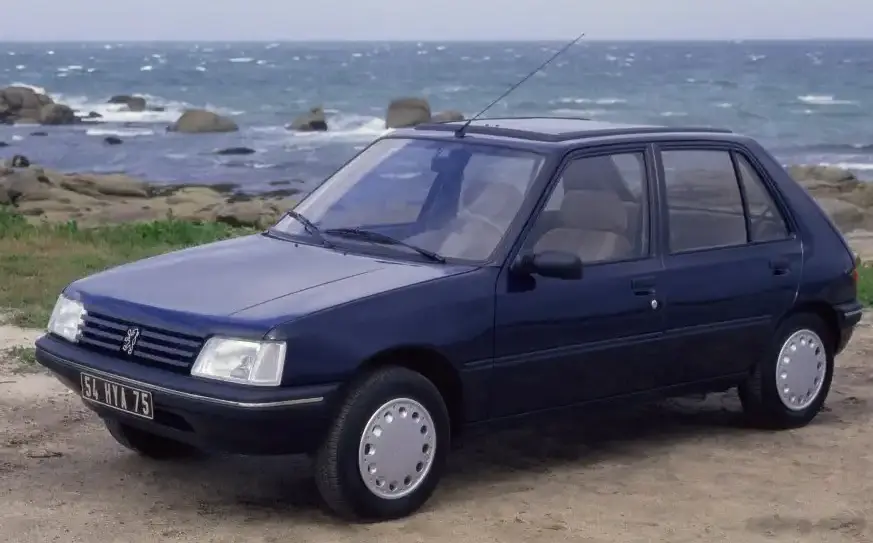
The Peugeot 205 1.6i, produced between 1992 and 1994, represents a mid-range offering within the facelifted (20A/C) first generation of Peugeot’s iconic supermini. Building upon the success of the original 205 launched in 1983, the 1.6i variant aimed to provide a balance between affordability, practicality, and a more spirited driving experience than the base models. It slotted into the lineup above the 1.0 and 1.4-liter versions, but below the performance-oriented GTI models. This version was primarily sold in European markets, where the 205 enjoyed immense popularity as a stylish and economical city car.
Technical Specifications
| Brand | Peugeot |
| Model | 205 |
| Generation | 205 I (20A/C, facelift 1987) |
| Type (Engine) | 1.6 i (89 Hp) |
| Start of production | 1992 |
| End of production | 1994 |
| Powertrain Architecture | Internal Combustion engine |
| Body type | Hatchback |
| Seats | 5 |
| Doors | 3-5 |
| Fuel consumption (urban) | 9.6 l/100 km (24.5 US mpg) |
| Fuel consumption (extra urban) | 5.9 l/100 km (39.9 US mpg) |
| Fuel consumption (combined) | 8 l/100 km (29.4 US mpg) |
| Fuel Type | Petrol (Gasoline) |
| Acceleration 0 – 100 km/h | 13.6 sec |
| Acceleration 0 – 62 mph | 13.6 sec |
| Acceleration 0 – 60 mph | 12.9 sec |
| Maximum speed | 167 km/h (103.77 mph) |
| Weight-to-power ratio | 9.9 kg/Hp |
| Weight-to-torque ratio | 6.9 kg/Nm |
| Power | 89 Hp @ 6400 rpm |
| Torque | 128 Nm @ 3000 rpm (94.41 lb.-ft. @ 3000 rpm) |
| Engine layout | Front, Transverse |
| Engine Model/Code | BDY XU5M3Z |
| Engine displacement | 1580 cm3 (96.42 cu. in.) |
| Number of cylinders | 4 |
| Engine configuration | Inline |
| Cylinder Bore | 83 mm (3.27 in.) |
| Piston Stroke | 73 mm (2.87 in.) |
| Compression ratio | 9.4:1 |
| Fuel injection system | Single-point injection |
| Engine aspiration | Naturally aspirated |
| Engine oil capacity | 4 l (4.23 US qt | 3.52 UK qt) |
| Coolant capacity | 6.6 l (6.97 US qt | 5.81 UK qt) |
| Kerb Weight | 880 kg (1940.07 lbs.) |
| Max. weight | 1300 kg (2866.01 lbs.) |
| Max load | 420 kg (925.94 lbs.) |
| Trunk (boot) space – minimum | 290 l (10.24 cu. ft.) |
| Trunk (boot) space – maximum | 585 l (20.66 cu. ft.) |
| Fuel tank capacity | 50 l (13.21 US gal | 11 UK gal) |
| Length | 3705 mm (145.87 in.) |
| Width | 1560 mm (61.42 in.) |
| Height | 1375 mm (54.13 in.) |
| Wheelbase | 2420 mm (95.28 in.) |
| Front track | 1350 mm (53.15 in.) |
| Rear track | 1300 mm (51.18 in.) |
| Drivetrain Architecture | Front wheel drive |
| Number of gears | 5 |
| Gearbox type | Manual transmission |
| Front suspension | Coil spring |
| Rear suspension | Torsion |
| Front brakes | Disc |
| Rear brakes | Drum |
| Assisting systems | ABS (Anti-lock braking system) |
| Steering type | Steering rack and pinion |
| Power steering | Hydraulic |
| Tires size | 165/70 SR13 |
The 1.6i variant of the Peugeot 205, produced from 1992-1994, was a key component of the 205’s continued success after the 1987 facelift. This update, designated 20A/C, brought subtle styling revisions and improvements to the interior. The 1.6i engine, coded BDY (and sometimes BDZ), offered a noticeable step up in performance compared to the smaller displacement engines, making it a popular choice for drivers who wanted a more engaging driving experience without the higher costs associated with the GTI models. It was available in both three and five-door body styles, catering to a wider range of customer needs.
Powertrain & Engine Architecture
The heart of the 205 1.6i is the XU5M series engine, specifically the BDY variant. This is a naturally aspirated, inline-four cylinder engine displacing 1580cc. It utilizes a single-point fuel injection system, a relatively simple setup for the time, which contributed to its reliability. The engine features a single overhead camshaft (SOHC) operating two valves per cylinder. The BDY engine produced 89 horsepower at 6400 rpm and 128 Nm (94.41 lb-ft) of torque at 3000 rpm. The engine’s design prioritized fuel efficiency and durability over outright performance. The 205 1.6i was typically paired with a five-speed manual transmission, although a three-speed automatic transmission was also available, albeit less common. The automatic gearbox, while offering convenience, did noticeably impact acceleration and fuel economy.
Driving Characteristics
The 205 1.6i offered a reasonably lively driving experience for its class. While not as quick as the GTI models, the 1.6-liter engine provided sufficient power for everyday driving and overtaking maneuvers. The five-speed manual transmission allowed drivers to keep the engine in its optimal power band, resulting in brisk acceleration. The automatic transmission, however, felt somewhat sluggish, with wider gear ratios and a tendency to hunt for gears. The 205’s renowned handling characteristics were still present, thanks to its light weight and well-tuned suspension. The steering was precise and communicative, providing a good level of feedback to the driver. The car felt nimble and responsive, making it enjoyable to drive on both city streets and winding country roads.
Equipment & Trim Levels
The 1.6i trim level generally offered a step up in equipment compared to the base models. Standard features typically included power steering, central locking, and a basic stereo system. Interior upholstery was usually cloth, with a simple but functional dashboard layout. Optional extras included electric windows, a sunroof, and upgraded audio systems. The level of equipment varied slightly depending on the specific market and year of production. The 1.6i was positioned as a comfortable and well-equipped option for buyers who wanted more than just basic transportation.
Chassis & Braking
The 205 1.6i utilized a relatively simple chassis design. The front suspension consisted of coil springs and independent wishbones, while the rear suspension employed a torsion beam. This setup provided a good balance between ride comfort and handling. Braking duties were handled by disc brakes at the front and drum brakes at the rear. ABS (Anti-lock Braking System) was available as an option, enhancing safety in emergency braking situations. The 205’s light weight contributed to its excellent braking performance, even with the drum brakes at the rear.
Market Reception & Comparison
The Peugeot 205 1.6i was generally well-received by automotive critics. It was praised for its blend of practicality, affordability, and enjoyable driving dynamics. Compared to the smaller-engined models, the 1.6i offered a significant improvement in performance. However, it couldn’t match the outright speed and handling of the GTI variants. Fuel economy was respectable for the time, averaging around 29.4 US mpg in combined driving. Reliability was generally good, although the single-point fuel injection system could occasionally require maintenance. Compared to rivals like the Renault Clio and Volkswagen Polo, the 205 1.6i offered a more stylish and engaging driving experience.
Legacy
The Peugeot 205 1.6i remains a popular choice among classic car enthusiasts. The XU5M engine is known for its durability and relative simplicity, making it relatively easy to maintain. Parts availability is generally good, although some components may be becoming increasingly scarce. The 1.6i variant offers a good balance between performance and affordability, making it an accessible entry point into the world of classic Peugeots. Today, well-maintained examples command a reasonable price on the used car market, and the 205 continues to be celebrated as one of the most iconic and influential superminis of all time.
