
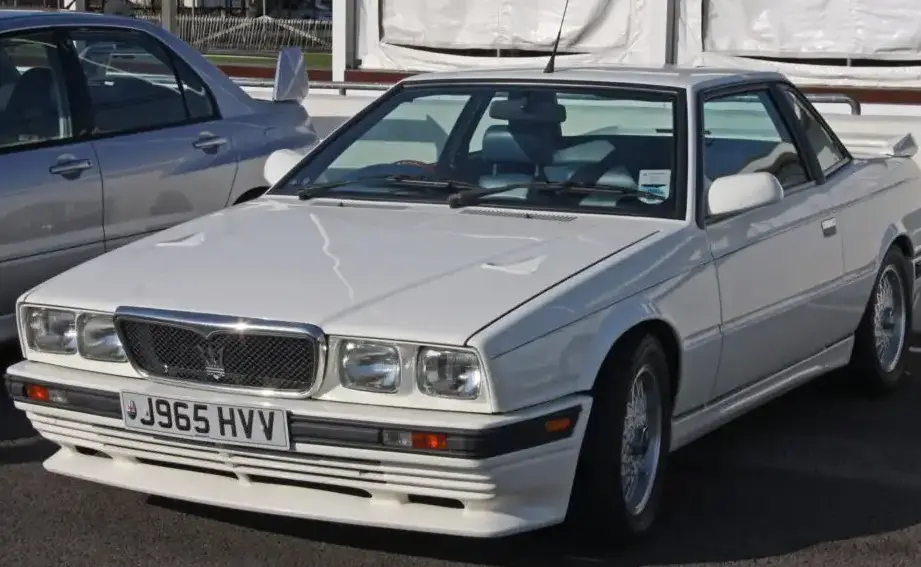
The Maserati Karif 2.8, produced between 1988 and 1991, represents a relatively short-lived but significant chapter in Maserati’s history. Positioned as a more accessible entry point into the Maserati lineup, the Karif aimed to broaden the brand’s appeal beyond its traditional, high-end clientele. Built on a shortened version of the Maserati Biturbo platform (specifically the Type 90 chassis), the Karif was intended to offer a blend of Italian styling, performance, and relative affordability. It was primarily marketed in Europe, with limited imports to the United States, and served as a bridge between the more expensive, hand-built Maseratis and the increasingly competitive grand touring market.
Technical Specifications
| Brand | Maserati |
| Model | Karif |
| Generation | Karif |
| Engine Type | 2.8L Naturally Aspirated V6 |
| Start of Production | 1988 |
| End of Production | 1991 |
| Powertrain Architecture | Internal Combustion Engine |
| Body Type | Coupe |
| Fuel Type | Petrol (Gasoline) |
| Power Output | 285 hp |
| Engine Model/Code | AM339 |
| Engine Aspiration | Naturally Aspirated |
Powertrain & Engine Architecture
The heart of the Karif 2.8 is the AM339 engine, a 2.8-liter (2789 cc) 90-degree V6. This engine is a descendant of the earlier Maserati V6 designs, but with significant revisions. It features a cast-iron block and aluminum cylinder heads, employing a belt-driven double overhead camshaft (DOHC) valvetrain. The engine utilizes Bosch mechanical fuel injection, a system chosen for its reliability and relatively straightforward maintenance compared to more complex electronic systems of the era. The AM339 produces 285 horsepower at 6200 rpm and 272 lb-ft of torque at 4800 rpm. The engine’s layout allows for a relatively compact engine bay, contributing to the Karif’s balanced handling. The Karif exclusively came with a five-speed manual transmission, a testament to Maserati’s focus on the driving experience. The transmission is a robust unit, designed to handle the engine’s power output, and features a dog-leg first gear, a characteristic of many European sports cars of the period.
Driving Characteristics
The Karif 2.8 delivers a distinctly Italian driving experience. The 2.8-liter V6 provides strong acceleration, with the car reaching 60 mph in approximately 5.6 seconds and achieving a top speed of around 155 mph. The five-speed manual transmission allows for precise control over the engine’s power band. The dog-leg first gear requires a slight adjustment for drivers accustomed to the more conventional layout, but it contributes to a more engaging driving experience. The Karif’s handling is generally considered well-balanced, thanks to its relatively lightweight construction and well-tuned suspension. However, the car’s short wheelbase can make it feel slightly twitchy at the limit, requiring attentive driving. The steering is direct and communicative, providing good feedback to the driver. Compared to the Biturbo, the Karif’s shorter wheelbase and lighter weight contribute to a more agile feel, though it lacks the Biturbo’s turbocharged punch.
Equipment & Trim Levels
The Karif 2.8 was relatively well-equipped for its time, though it wasn’t positioned as a luxury flagship. Standard features included leather upholstery, power windows, central locking, and an AM/FM stereo. Air conditioning was typically standard, though some early models may have had it as an option. The interior design is typically Italian, with a focus on style and comfort. The dashboard features a combination of analog gauges and a central digital display. Optional extras included a sunroof, upgraded audio systems, and metallic paint finishes. The interior trim was generally consistent across all Karif 2.8 models, with limited customization options available. The emphasis was on providing a comfortable and stylish environment for both driver and passenger.
Chassis & Braking
The Karif 2.8 utilizes a steel unibody construction, based on the shortened Biturbo chassis. The suspension consists of independent double wishbones at the front and a De Dion axle with a Watts linkage at the rear. This setup provides a good balance between ride comfort and handling performance. The braking system features ventilated disc brakes at all four corners, providing ample stopping power. Anti-lock braking system (ABS) was available as an option, enhancing safety and control in adverse conditions. The Karif’s chassis is relatively lightweight, contributing to its agile handling characteristics. The suspension is tuned to provide a comfortable ride without sacrificing too much handling precision. Stabilizer bars are fitted at both the front and rear to reduce body roll during cornering.
Market Reception & Comparison
The Maserati Karif 2.8 received mixed reviews from automotive critics. While praised for its stylish design, strong engine, and engaging driving experience, it was also criticized for its relatively high price compared to competitors like the Porsche 944 and BMW 6 Series. Some reviewers also noted the Karif’s somewhat limited interior space and occasional build quality issues, common complaints with Italian cars of the era. Fuel economy was also a concern, with the Karif averaging around 18 mpg in city driving and 24 mpg on the highway. Compared to the turbocharged Biturbo models, the Karif offered a more linear power delivery and a slightly more refined driving experience, but it lacked the Biturbo’s outright performance. The Karif was positioned as a more accessible Maserati, but its price still placed it firmly in the premium sports car segment.
Legacy
The Maserati Karif 2.8, despite its short production run, remains a desirable classic car among enthusiasts. The AM339 engine is generally considered to be a robust and reliable unit, though regular maintenance is essential. Parts availability can be a challenge, as the Karif is a relatively rare model. However, a dedicated network of Maserati specialists and aftermarket suppliers exists to support owners. The Karif’s combination of Italian styling, strong performance, and relative affordability has made it a popular choice among collectors. Today, well-maintained examples of the Karif 2.8 can fetch significant prices on the used car market. The Karif represents a unique chapter in Maserati’s history, showcasing the brand’s commitment to performance and style during a period of transition. It’s a reminder of a time when Maserati aimed to offer a more accessible entry point into the world of Italian luxury sports cars.
