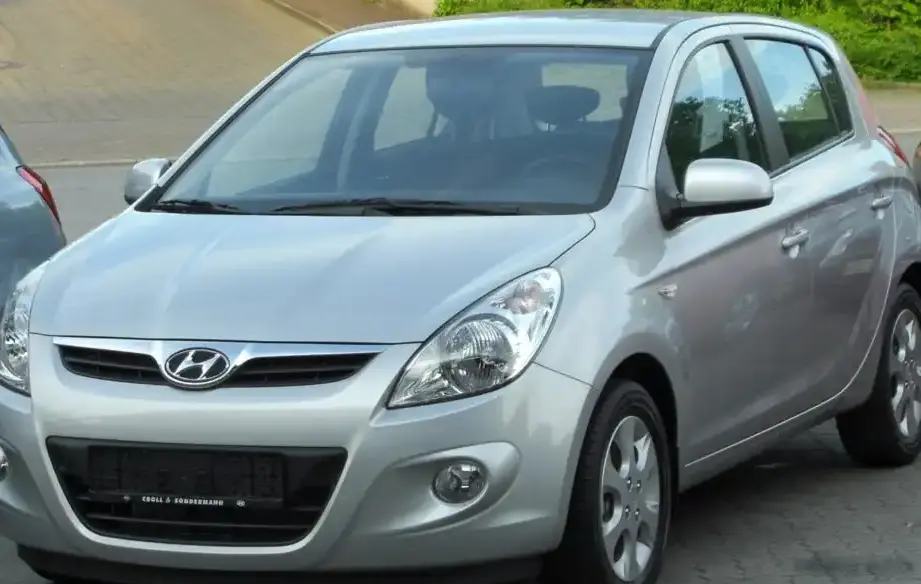
The Hyundai i20 I (PB) 1.4 CRDi 75 hp, produced between 2010 and 2012, represented an entry-level diesel option within the first generation of Hyundai’s subcompact hatchback. Positioned as a fuel-efficient and practical choice, it aimed to appeal to buyers seeking low running costs in the European market, where smaller, economical cars were highly favored. This variant utilized Hyundai’s D4FC engine and a five-speed manual transmission, offering a balance between affordability and usability. It was a key component in Hyundai’s strategy to gain market share in the competitive B-segment.
Technical Specifications
| Brand | Hyundai |
| Model | i20 |
| Generation | i20 I (PB) |
| Type (Engine) | 1.4 CRDi (75 Hp) |
| Start of production | 2010 |
| End of production | 2012 |
| Powertrain Architecture | Internal Combustion engine |
| Body type | Hatchback |
| Seats | 5 |
| Doors | 5 |
| Fuel consumption (urban) | 5.5 l/100 km (42.8 US mpg, 51.4 UK mpg, 18.2 km/l) |
| Fuel consumption (extra urban) | 3.8 l/100 km (61.9 US mpg, 74.3 UK mpg, 26.3 km/l) |
| Fuel consumption (combined) | 4.4 l/100 km (53.5 US mpg, 64.2 UK mpg, 22.7 km/l) |
| Fuel Type | Diesel |
| Acceleration 0 – 100 km/h | 16.2 sec |
| Acceleration 0 – 62 mph | 16.2 sec |
| Acceleration 0 – 60 mph | 15.4 sec |
| Maximum speed | 161 km/h (100.04 mph) |
| Emission standard | Euro 4 |
| Weight-to-power ratio | 14.7 kg/Hp, 68.2 Hp/tonne |
| Weight-to-torque ratio | 5 kg/Nm, 200.2 Nm/tonne |
| Power | 75 Hp @ 4000 rpm |
| Power per litre | 53.7 Hp/l |
| Torque | 220 Nm @ 1750-2350 rpm (162.26 lb.-ft. @ 1750-2350 rpm) |
| Engine layout | Front, Transverse |
| Engine Model/Code | D4FC |
| Engine displacement | 1396 cm3 (85.19 cu. in.) |
| Number of cylinders | 4 |
| Engine configuration | Inline |
| Cylinder Bore | 75 mm (2.95 in.) |
| Piston Stroke | 79 mm (3.11 in.) |
| Compression ratio | 17:1 |
| Number of valves per cylinder | 4 |
| Fuel injection system | Diesel Commonrail |
| Engine aspiration | Turbocharger, Intercooler |
| Valvetrain | DOHC |
| Engine oil capacity | 5.3 l (5.6 US qt | 4.66 UK qt) |
| Coolant capacity | 6.8 l (7.19 US qt | 5.98 UK qt) |
| Kerb Weight | 1099 kg (2422.88 lbs.) |
| Max. weight | 1635 kg (3604.56 lbs.) |
| Max load | 536 kg (1181.68 lbs.) |
| Trunk (boot) space – minimum | 295 l (10.42 cu. ft.) |
| Trunk (boot) space – maximum | 1060 l (37.43 cu. ft.) |
| Fuel tank capacity | 45 l (11.89 US gal | 9.9 UK gal) |
| Length | 3940 mm (155.12 in.) |
| Width | 1710 mm (67.32 in.) |
| Height | 1490 mm (58.66 in.) |
| Wheelbase | 2525 mm (99.41 in.) |
| Front track | 1505 mm (59.25 in.) |
| Rear (Back) track | 1503 mm (59.17 in.) |
| Ride height (ground clearance) | 150 mm (5.91 in.) |
| Drag coefficient (Cd) | 0.32 |
| Minimum turning circle | 10.4 m (34.12 ft.) |
| Drivetrain Architecture | Front wheel drive |
| Number of gears | 5 |
| Gearbox type | Manual transmission |
| Front brakes | Ventilated discs |
| Rear brakes | Disc |
| Assisting systems | ABS (Anti-lock braking system) |
| Steering type | Steering rack and pinion |
| Power steering | Electric Steering |
| Tires size | 175/70 R14 |
| Wheel rims size | 14 |
Powertrain & Engine Architecture
The heart of the i20 1.4 CRDi was the Hyundai D4FC engine, a 1.4-liter inline-four cylinder diesel. This engine was a common sight in various Hyundai and Kia models of the era. It featured a turbocharger with an intercooler to boost power and efficiency. The D4FC utilized a second-generation common rail direct injection system, allowing for precise fuel delivery and contributing to its relatively good fuel economy. The engine employed a double overhead camshaft (DOHC) valvetrain with four valves per cylinder, optimizing gas flow for improved performance. The five-speed manual transmission was a standard offering, chosen for its simplicity and cost-effectiveness. While not known for its blistering acceleration, the D4FC provided adequate power for everyday driving and was designed for durability and low maintenance.
Driving Characteristics
The 75 hp output and 220 Nm of torque delivered by the 1.4 CRDi engine resulted in a driving experience focused on economy rather than outright performance. Acceleration from 0-100 km/h took around 16.2 seconds, making it noticeably slower than higher-powered i20 variants like the 1.6 gasoline engine. However, the engine’s torque peak, available from 1750-2350 rpm, provided reasonable responsiveness in everyday driving situations, such as overtaking on the highway or navigating city traffic. The five-speed manual transmission was well-matched to the engine’s characteristics, with gear ratios optimized for fuel efficiency. Compared to the gasoline versions, the diesel offered superior fuel economy, but at the expense of refinement and responsiveness. The manual transmission also provided a more engaging driving experience than the optional four-speed automatic available on some i20 trims.
Equipment & Trim Levels
The 1.4 CRDi 75 hp typically represented the entry-level diesel trim in the i20 lineup. Standard equipment generally included power steering, central locking, electric front windows, and an audio system with USB connectivity. Safety features such as ABS and front airbags were also standard. Interior upholstery was typically cloth, and the dashboard featured a functional, if somewhat basic, design. Optional extras included air conditioning, alloy wheels, and a more advanced audio system. Higher trim levels added features like rear electric windows, a multi-function steering wheel, and upgraded interior trim.
Chassis & Braking
The i20 I (PB) featured a MacPherson strut front suspension and a torsion beam rear suspension. This setup provided a comfortable ride quality, suitable for everyday driving. The front brakes were ventilated discs, offering good stopping power, while the rear brakes were solid discs. The electric power steering provided light and easy steering, making it maneuverable in urban environments. The relatively lightweight construction of the i20 helped to compensate for the modest engine output, contributing to its overall drivability.
Market Reception & Comparison
The Hyundai i20 1.4 CRDi 75 hp was generally well-received by critics as a practical and economical choice. Its fuel efficiency was a major selling point, particularly in Europe where diesel fuel was often cheaper than gasoline. However, some reviewers noted its lack of performance and refinement compared to competitors like the Volkswagen Polo or Ford Fiesta. Compared to the 1.6 gasoline i20, the 1.4 CRDi offered significantly better fuel economy but slower acceleration. The 1.4 CRDi was also a more sensible choice than the more powerful (and expensive) 1.6 CRDi, appealing to buyers prioritizing running costs over performance.
Legacy
The Hyundai i20 I (PB) 1.4 CRDi 75 hp has proven to be a relatively reliable vehicle in the used car market. The D4FC engine is known for its durability, and routine maintenance is generally straightforward and affordable. While not a performance icon, it remains a popular choice for buyers seeking a fuel-efficient and practical small car. Common issues are typically related to wear and tear, such as turbocharger problems or injector issues, but these are generally manageable with proper maintenance. Today, these i20s represent an affordable entry point into diesel hatchback ownership, offering a blend of economy and practicality.