
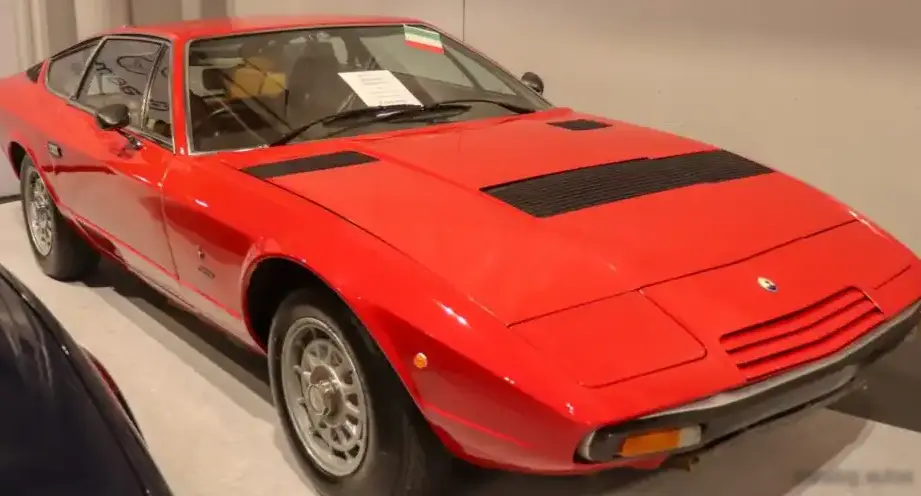
The Maserati Khamsin, produced between 1973 and 1982, represents a pivotal moment in the Italian manufacturer’s history. Named after a hot, dry wind that blows across the Sahara Desert, the Khamsin was Maserati’s attempt to create a more modern, comfortable, and technologically advanced grand touring coupe. It was the successor to the Ghibli, and while sharing some mechanical components, the Khamsin distinguished itself with a more angular, Giorgetto Giugiaro-designed body and a focus on driver comfort. The 4.9-liter V8 variant, producing 320 horsepower, was the flagship model throughout the Khamsin’s production run, embodying the spirit of high-performance Italian motoring of the era.
Technical Specifications
| Brand | Maserati |
| Model | Khamsin |
| Generation | Khamsin |
| Type (Engine) | 4.9 V8 (320 Hp) |
| Start of production | June, 1973 |
| End of production | June, 1982 |
| Powertrain Architecture | Internal Combustion engine |
| Body type | Coupe |
| Seats | 4 |
| Doors | 3 |
| Fuel consumption (combined) | 20-21 l/100 km (11.8 – 11.2 US mpg, 14.1 – 13.5 UK mpg, 5 – 4.8 km/l) |
| Fuel Type | Petrol (Gasoline) |
| Acceleration 0 – 100 km/h | 5.8 sec |
| Acceleration 0 – 62 mph | 5.8 sec |
| Acceleration 0 – 60 mph | 5.5 sec |
| Maximum speed | 275 km/h (170.88 mph) |
| Weight-to-power ratio | 5.3 kg/Hp, 189.3 Hp/tonne |
| Weight-to-torque ratio | 3.5 kg/Nm, 284 Nm/tonne |
| Power | 320 Hp @ 5500 rpm |
| Power per litre | 64.9 Hp/l |
| Torque | 480 Nm @ 4000 rpm (354.03 lb.-ft. @ 4000 rpm) |
| Engine layout | Front, Longitudinal |
| Engine Model/Code | AM 115 |
| Engine displacement | 4930 cm3 (300.85 cu. in.) |
| Number of cylinders | 8 |
| Engine configuration | V-engine |
| Cylinder Bore | 93.9 mm (3.7 in.) |
| Piston Stroke | 89 mm (3.5 in.) |
| Compression ratio | 8.5:1 |
| Number of valves per cylinder | 2 |
| Fuel injection system | Carburettor |
| Engine aspiration | Naturally aspirated engine |
| Valvetrain | DOHC |
| Engine oil capacity | 13 l (13.74 US qt | 11.44 UK qt) |
| Kerb Weight | 1690 kg (3725.81 lbs.) |
| Max. weight | 1965 kg (4332.08 lbs.) |
| Max load | 275 kg (606.27 lbs.) |
| Trunk (boot) space – minimum | 400 l (14.13 cu. ft.) |
| Fuel tank capacity | 90 l (23.78 US gal | 19.8 UK gal) |
| Length | 4400 mm (173.23 in.) |
| Width | 1804 mm (71.02 in.) |
| Height | 1140 mm (44.88 in.) |
| Wheelbase | 2550 mm (100.39 in.) |
| Front track | 1440 mm (56.69 in.) |
| Rear (Back) track | 1468 mm (57.8 in.) |
| Minimum turning circle | 11.9 m (39.04 ft.) |
| Drivetrain Architecture | Rear wheel drive |
| Number of gears and type of gearbox | 5 gears, manual transmission |
| Front suspension | Independent coil spring, Transverse stabilizer |
| Rear suspension | Independent coil spring, Transverse stabilizer |
| Front brakes | Disc |
| Rear brakes | Disc |
| Steering type | Steering rack and pinion |
| Power steering | Hydraulic Steering |
| Wheel rims size | 7.5J x 15 |
Powertrain & Engine Architecture
The heart of the Khamsin 4.9 was the AM115 engine, a 4.9-liter (4930 cc) naturally aspirated V8. This engine, derived from the earlier 4.7-liter unit, featured a 90-degree V-angle, dual overhead camshafts (DOHC) per cylinder bank, and two valves per cylinder. Unlike later Maserati engines, the AM115 utilized three Weber 38 DCOE carburetors for fuel delivery, a somewhat archaic system for the time but one that contributed to the engine’s raw character. The engine produced 320 horsepower at 5500 rpm and 480 Nm (354 lb-ft) of torque at 4000 rpm. The engine was mounted longitudinally in the front of the car, driving the rear wheels. The standard transmission was a ZF five-speed manual, providing precise control over the engine’s power. The engine oil capacity was a substantial 13 liters, reflecting the demands of a high-performance V8.
Driving Characteristics
The Khamsin 4.9 offered a distinctly analog driving experience. The carbureted V8 delivered a strong, linear powerband, with peak torque available relatively low in the rev range. This made the car surprisingly tractable for everyday driving, but it truly came alive when pushed. The five-speed manual transmission allowed drivers to fully exploit the engine’s capabilities, while the rear-wheel-drive layout provided a classic sports car feel. The Khamsin wasn’t a particularly light car, weighing in at around 1690 kg (3726 lbs), but the 320 horsepower was sufficient to deliver a 0-60 mph time of around 5.5 seconds and a top speed of 275 km/h (171 mph). Compared to the later, fuel-injected versions of the engine, the carbureted Khamsin felt more raw and demanding, requiring a skilled driver to extract its full potential. The manual transmission was preferred by enthusiasts, as it offered a more engaging driving experience than the optional three-speed automatic.
Equipment & Trim Levels
The Khamsin was positioned as a luxury grand tourer, and as such, it came well-equipped even in its base form. Standard features included leather upholstery, power windows, and air conditioning. The interior design was distinctly Italian, with a focus on elegance and comfort. The dashboard featured a full complement of gauges, including a speedometer, tachometer, oil pressure gauge, and water temperature gauge. Optional extras included a sunroof, Connolly leather upholstery in a wider range of colors, and a premium sound system. The Khamsin’s interior was designed to be a comfortable and refined space for long-distance travel, reflecting its grand touring aspirations.
Chassis & Braking
The Khamsin featured an independent suspension system all around, with coil springs and anti-roll bars. This provided a comfortable ride while maintaining good handling characteristics. The front suspension utilized a double-wishbone design, while the rear suspension employed a trailing arm setup. Braking was handled by disc brakes on all four wheels, providing ample stopping power. Power-assisted steering was standard, making the car relatively easy to maneuver at low speeds. The chassis was a steel monocoque construction, providing a good balance of strength and rigidity.
Market Reception & Comparison
The Khamsin was generally well-received by critics, who praised its stylish design, powerful engine, and comfortable interior. However, it was also criticized for its relatively high price and its somewhat temperamental nature. Compared to its rivals, such as the Ferrari Daytona and the Lamborghini Espada, the Khamsin offered a more comfortable and refined driving experience, but it lacked the outright performance of the Ferrari. The Khamsin’s fuel economy was also relatively poor, averaging around 11.8-11.2 US mpg. The manual transmission version was generally preferred by enthusiasts, while the automatic version appealed to buyers who prioritized comfort and ease of use.
Legacy
The Maserati Khamsin, despite its relatively short production run, remains a highly sought-after classic car. The AM115 V8 engine is known for its durability and its distinctive sound. However, maintaining a Khamsin can be challenging, as parts availability can be limited. The carbureted engine requires regular tuning and maintenance to ensure optimal performance. Today, the Khamsin represents a unique chapter in Maserati’s history, a time when the company was striving to blend Italian style and performance with modern technology. Well-maintained examples command high prices in the collector car market, reflecting their rarity and their enduring appeal.
