Technical Specifications
| Brand | Volkswagen |
| Model | Golf |
| Generation | Golf III |
| Type (Engine) | 1.8 (75 Hp) |
| Start of production | 1991 |
| End of production | 1997 |
| Powertrain Architecture | Internal Combustion engine |
| Body type | Hatchback |
| Seats | 5 |
| Doors | 3-5 |
| Fuel consumption (urban) | 9.5 l/100 km (24.8 US mpg) |
| Fuel consumption (extra urban) | 5.5 l/100 km (42.8 US mpg) |
| Fuel consumption (combined) | 7.5 l/100 km (31.4 US mpg) |
| Fuel Type | Petrol (Gasoline) |
| Acceleration 0 – 100 km/h | 14.3 sec |
| Acceleration 0 – 62 mph | 14.3 sec |
| Acceleration 0 – 60 mph | 13.6 sec |
| Maximum speed | 168 km/h (104.39 mph) |
| Weight-to-power ratio | 15.3 kg/Hp |
| Weight-to-torque ratio | 8.2 kg/Nm |
| Power | 75 Hp @ 5000 rpm |
| Torque | 140 Nm @ 2500 rpm (103.26 lb.-ft. @ 2500 rpm) |
| Engine layout | Front, Transverse |
| Engine Model/Code | AAM |
| Engine displacement | 1781 cm3 (108.68 cu. in.) |
| Number of cylinders | 4 |
| Engine configuration | Inline |
| Cylinder Bore | 81 mm (3.19 in.) |
| Piston Stroke | 86.4 mm (3.4 in.) |
| Compression ratio | 9:1 |
| Number of valves per cylinder | 2 |
| Fuel injection system | Single-point injection |
| Engine aspiration | Naturally aspirated |
| Valvetrain | OHC |
| Engine oil capacity | 3.8 l (4.02 US qt | 3.34 UK qt) |
| Coolant capacity | 5.5 l (5.81 US qt | 4.84 UK qt) |
| Kerb Weight | 1150 kg (2535.32 lbs.) |
| Max. weight | 1580 kg (3483.3 lbs.) |
| Max load | 430 kg (947.99 lbs.) |
| Trunk (boot) space – minimum | 330 l (11.65 cu. ft.) |
| Trunk (boot) space – maximum | 687 l (24.26 cu. ft.) |
| Fuel tank capacity | 55 l (14.53 US gal | 12.1 UK gal) |
| Length | 4020 mm (158.27 in.) |
| Width | 1695 mm (66.73 in.) |
| Height | 1425 mm (56.1 in.) |
| Wheelbase | 2475 mm (97.44 in.) |
| Front track | 1478 mm (58.19 in.) |
| Rear track | 1448 mm (57.01 in.) |
| Drivetrain Architecture | Front wheel drive |
| Number of gears | 4 (Automatic) |
| Front suspension | Trailing arm |
| Rear suspension | Rigid axle |
| Front brakes | Disc |
| Rear brakes | Drum |
| Assisting systems | ABS |
| Steering type | Steering rack and pinion |
| Power steering | Hydraulic |
| Tires size | 175/65 R14 |
| Wheel rims size | 14 |
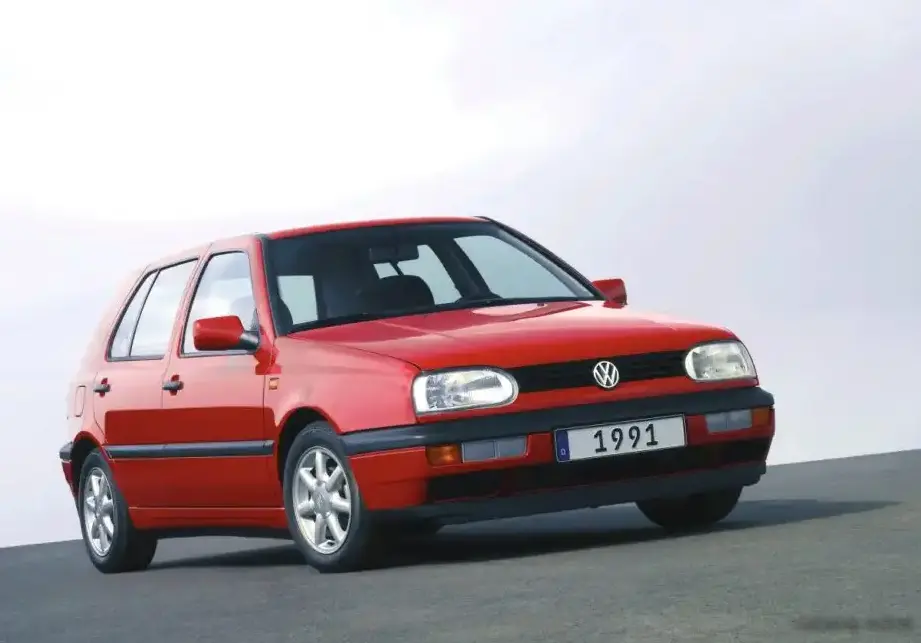
The Volkswagen Golf Mk3 1.8 (75 hp) was a mainstay of the Golf lineup from 1991 to 1997, representing an entry-level offering within the broader Mk3 generation (Typ 1H1). Built on the A3 platform, this variant aimed to provide affordable and practical transportation, appealing to a wide range of buyers. It was available in both 3-door and 5-door hatchback configurations, becoming a common sight on European roads. In the US market, the Golf Mk3 was often sold as the Volkswagen Jetta, and the 1.8L engine was available, though often with slightly different specifications and trim levels. This particular 75 hp version, paired with a 4-speed automatic transmission, was positioned as the most accessible option, prioritizing fuel economy and ease of use over outright performance.
Powertrain & Engine Architecture
The heart of the Golf Mk3 1.8 was the AAM engine code, a 1.8-liter inline-four cylinder gasoline engine. This engine utilized a single-point fuel injection system (also known as throttle body injection), a relatively simple and cost-effective technology for the time. The engine featured an overhead camshaft (OHC) valvetrain with two valves per cylinder. The 75 horsepower output was achieved at 5000 rpm, with a torque figure of 140 Nm (103 lb-ft) available at 2500 rpm. Paired with a 4-speed automatic transmission, the powertrain was designed for smooth, if not particularly brisk, acceleration. The automatic transmission was a conventional hydraulic unit, offering a comfortable driving experience but lacking the efficiency and responsiveness of more modern transmissions.
Driving Characteristics
The 1.8L automatic Golf Mk3 offered a comfortable and predictable driving experience. Acceleration was modest, taking around 14.3 seconds to reach 62 mph. The automatic transmission’s gear ratios were optimized for fuel economy rather than performance, resulting in a somewhat leisurely pace. Compared to the 1.8L versions equipped with a 5-speed manual transmission, the automatic version felt noticeably slower. Higher-spec Golfs, such as those with the 1.9 TDI diesel or the 2.0L 16V gasoline engine, offered significantly more power and a more engaging driving experience. However, the 1.8 automatic excelled in urban environments, providing smooth and effortless cruising.
Equipment & Trim Levels
The 1.8 automatic Golf Mk3 typically came with a basic level of equipment. Standard features generally included power steering, central locking, and a basic stereo system. Interior upholstery was typically cloth, and the dashboard featured a simple, functional design. Optional extras included power windows, a sunroof, and upgraded stereo systems. Trim levels varied depending on the market, but the 1.8 automatic generally represented the entry point to the Mk3 Golf range. It was often marketed towards buyers prioritizing affordability and practicality over luxury features.
Chassis & Braking
The Golf Mk3 1.8 utilized a relatively simple chassis design. Front suspension consisted of trailing arms, while the rear suspension employed a rigid axle. This setup provided a comfortable ride, but handling was not as precise as that of more sophisticated suspension systems. Brakes were disc brakes on the front wheels and drum brakes on the rear. Anti-lock Braking System (ABS) was often included as standard equipment, enhancing safety. The relatively light weight of the 1.8 model (around 1150 kg or 2535 lbs) helped to compensate for the modest power output.
Market Reception & Comparison
The Golf Mk3 1.8 automatic was generally well-received as an affordable and practical family car. Critics praised its fuel economy and comfortable ride, but noted its lack of performance. Compared to other trims in the Golf lineup, the 1.8 automatic offered the lowest price point but also the least amount of power. The 1.9 TDI diesel, for example, offered superior fuel economy and more torque, while the 2.0L 16V gasoline engine provided significantly more power and a more engaging driving experience. However, the 1.8 automatic remained a popular choice for buyers seeking a reliable and economical hatchback.
Legacy
The Golf Mk3 1.8 automatic has proven to be a relatively reliable powertrain. The AAM engine is known for its durability, and the 4-speed automatic transmission, while not particularly sophisticated, is generally robust. Today, these cars are increasingly sought after by classic car enthusiasts and collectors. While not the most desirable variant in the Mk3 Golf lineup, the 1.8 automatic offers a unique blend of affordability, practicality, and retro charm. Well-maintained examples can still provide years of reliable service, and parts availability remains relatively good, making them a viable option for those seeking a classic European hatchback.