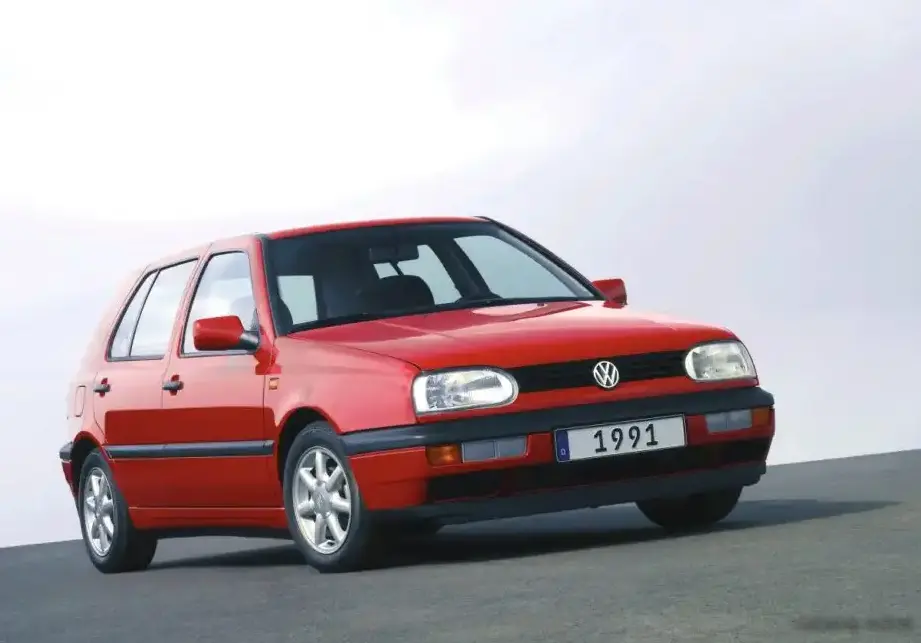
The Volkswagen Golf III 1.8 Syncro (90 hp) was a variant produced between 1993 and 1997, representing a unique offering within the broader Golf Mk3 range. Positioned as a mid-range option, it combined the practicality of the Golf hatchback with Volkswagen’s Syncro all-wheel-drive system and a relatively economical 1.8-liter engine. This model was primarily sold in Europe, where demand for all-wheel-drive vehicles, particularly in regions with inclement weather, was significant. The Golf III, built on the A3 platform (also known as the 1HX0/A3 platform), was a significant evolution of the Golf lineage, offering improved refinement, safety, and technology compared to its predecessor.
Technical Specifications
| Brand | Volkswagen |
| Model | Golf |
| Generation | Golf III |
| Type (Engine) | 1.8 Syncro (90 Hp) |
| Start of production | 1993 |
| End of production | 1997 |
| Powertrain Architecture | Internal Combustion engine |
| Body type | Hatchback |
| Seats | 5 |
| Doors | 3-5 |
| Fuel consumption (economy) – extra urban | 6.2 l/100 km (37.9 US mpg, 45.6 UK mpg, 16.1 km/l) |
| Fuel consumption (economy) – combined | 9.7 l/100 km (24.2 US mpg, 29.1 UK mpg, 10.3 km/l) |
| Fuel Type | Petrol (Gasoline) |
| Acceleration 0 – 100 km/h | 12.6 sec |
| Acceleration 0 – 62 mph | 12.6 sec |
| Acceleration 0 – 60 mph | 12 sec |
| Maximum speed | 175 km/h (108.74 mph) |
| Emission standard | Euro 3 |
| Weight-to-power ratio | 13.1 kg/Hp, 76.6 Hp/tonne |
| Weight-to-torque ratio | 8.1 kg/Nm, 123.4 Nm/tonne |
| Power | 90 Hp @ 5500 rpm |
| Power per litre | 50.5 Hp/l |
| Torque | 145 Nm @ 2500 rpm (106.95 lb.-ft. @ 2500 rpm) |
| Engine layout | Front, Transverse |
| Engine Model/Code | ABS, ADZ |
| Engine displacement | 1781 cm3 (108.68 cu. in.) |
| Number of cylinders | 4 |
| Engine configuration | Inline |
| Cylinder Bore | 81 mm (3.19 in.) |
| Piston Stroke | 86.4 mm (3.4 in.) |
| Compression ratio | 10:1 |
| Number of valves per cylinder | 2 |
| Fuel injection system | Multi-port manifold injection |
| Engine aspiration | Naturally aspirated engine |
| Valvetrain | OHC |
| Engine oil capacity | 3.8 l (4.02 US qt | 3.34 UK qt) |
| Coolant | 5.5 l (5.81 US qt | 4.84 UK qt) |
| Kerb Weight | 1175 kg (2590.43 lbs.) |
| Max. weight | 1655 kg (3648.65 lbs.) |
| Max load | 480 kg (1058.22 lbs.) |
| Trunk (boot) space – minimum | 330 l (11.65 cu. ft.) |
| Trunk (boot) space – maximum | 1160 l (40.97 cu. ft.) |
| Fuel tank capacity | 55 l (14.53 US gal | 12.1 UK gal) |
| Length | 4020 mm (158.27 in.) |
| Width | 1695 mm (66.73 in.) |
| Height | 1425 mm (56.1 in.) |
| Wheelbase | 2475 mm (97.44 in.) |
| Front track | 1464 mm (57.64 in.) |
| Rear (Back) track | 1438 mm (56.61 in.) |
| Drive wheel | All wheel drive (4×4) |
| Number of gears and type of gearbox | 5 gears, manual transmission |
| Front suspension | Wishbone |
| Rear suspension | Suspension with traction connecting levers |
| Front brakes | Ventilated discs |
| Rear brakes | Disc |
| Assisting systems | ABS (Anti-lock braking system) |
| Steering type | Steering rack and pinion |
| Power steering | Hydraulic Steering |
| Tires size | 195/50 R15 |
| Wheel rims size | 15 |
Powertrain & Engine Architecture
The Golf III 1.8 Syncro utilized either the ABS or ADZ engine code, both representing 1.8-liter, inline-four cylinder gasoline engines. These engines were naturally aspirated and featured a single overhead camshaft (OHC) design with two valves per cylinder. The multi-port fuel injection system delivered fuel directly into the intake ports, optimizing combustion efficiency. The ABS engine generally produced slightly more power than the ADZ, but both were tuned for a balance of fuel economy and reasonable performance. The engine’s 81mm bore and 86.4mm stroke contributed to its relatively long-stroke design, favoring torque production at lower RPMs. The 1.8L engine was paired with a 5-speed manual transmission, delivering power to all four wheels via Volkswagen’s Syncro system. The Syncro system employed a viscous coupling to distribute torque between the front and rear axles, providing enhanced traction in slippery conditions.
Driving Characteristics
The 90 hp output and the all-wheel-drive system resulted in a driving experience that prioritized stability and usability over outright speed. Acceleration from 0-60 mph took around 12 seconds, and the top speed was approximately 108.74 mph. While not particularly quick, the Syncro system provided confident handling in adverse weather conditions. The 5-speed manual transmission offered a reasonable spread of gear ratios, allowing the engine to operate efficiently at highway speeds. Compared to the more powerful Golf III variants, such as the VR6, the 1.8 Syncro felt noticeably less responsive. However, it offered a more economical and accessible entry point into the all-wheel-drive Golf range. The torque delivery was relatively smooth, making it a comfortable daily driver, but it lacked the punch of higher-output engines.
Equipment & Trim Levels
The 1.8 Syncro typically came with a moderate level of standard equipment. Interior features generally included cloth upholstery, a basic stereo system, and manual windows and door locks. Air conditioning was often an optional extra, as were power windows and central locking. Trim levels varied depending on the market, but generally, the 1.8 Syncro occupied a mid-range position in the Golf III lineup. Optional extras could include alloy wheels, a sunroof, and upgraded audio systems. The dashboard layout was typical of the Golf III, featuring a functional and straightforward design.
Chassis & Braking
The Golf III 1.8 Syncro utilized a MacPherson strut front suspension and a torsion beam rear suspension. The Syncro models often featured slightly stiffer suspension components compared to standard Golf III models to compensate for the added weight of the all-wheel-drive system. Braking consisted of ventilated discs on the front wheels and solid discs on the rear. Anti-lock braking system (ABS) was standard, enhancing braking performance and stability. The chassis was designed to provide a comfortable ride while maintaining reasonable handling characteristics.
Market Reception & Comparison
The Golf III 1.8 Syncro was generally well-received by automotive critics as a practical and capable all-wheel-drive hatchback. It was praised for its stability in challenging conditions and its relatively fuel-efficient engine. However, some critics noted its lack of outright performance compared to other Golf III variants. Compared to the 1.9 TDI diesel, the 1.8 Syncro offered less fuel economy but more power. Against the VR6, it was significantly less powerful but more affordable and economical. The 1.8 Syncro appealed to buyers who prioritized all-weather capability and practicality over sporty performance.
Legacy
The Golf III 1.8 Syncro, while not the most sought-after variant, has developed a loyal following among enthusiasts. The engine, while not particularly high-strung, is known for its reliability when properly maintained. The Syncro all-wheel-drive system remains a desirable feature, particularly in regions with harsh winters. Today, well-maintained examples of the Golf III 1.8 Syncro are becoming increasingly collectible. Common issues include wear and tear on the Syncro system’s viscous coupling and potential corrosion, particularly in areas exposed to road salt. However, with regular maintenance and care, these cars can continue to provide reliable and enjoyable transportation for years to come.