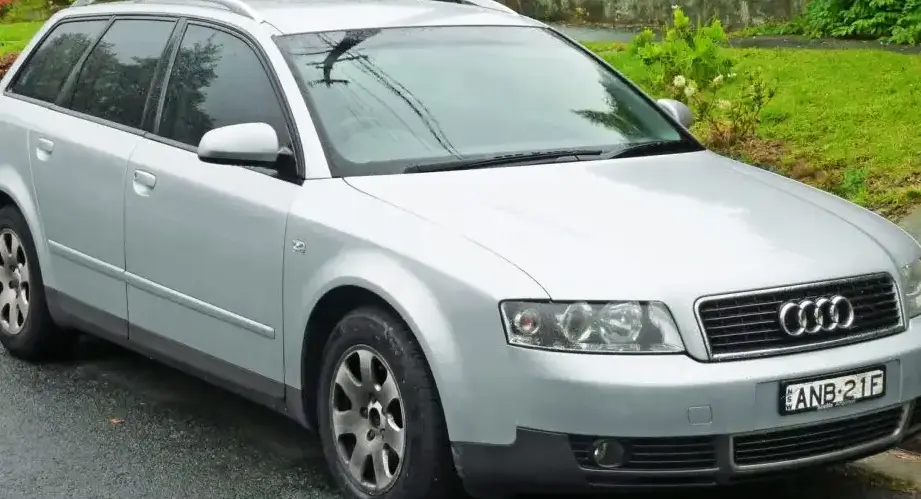
The Audi A4 Avant (B6 8E) 2.0 FSI, produced from July 2002 to December 2004, represented a significant step forward for Audi’s compact executive wagon. Positioned as a mid-range offering within the B6 A4 Avant lineup, it bridged the gap between the more economical 1.8T models and the performance-oriented 3.0 V6. This variant was primarily aimed at European markets, where the demand for practical, yet refined, wagons was high. The 2.0 FSI engine, coupled with a five-speed manual transmission, offered a blend of fuel efficiency and respectable performance, making it a popular choice for families and individuals seeking a versatile vehicle. It was built on the Volkswagen Group’s B6 platform (also known as the PL46), shared with models like the Volkswagen Passat and Škoda Superb.
Technical Specifications
| Brand | Audi |
| Model | A4 |
| Generation | A4 Avant (B6 8E) |
| Type (Engine) | 2.0 FSI (150 Hp) |
| Start of production | July, 2002 |
| End of production | December, 2004 |
| Powertrain Architecture | Internal Combustion engine |
| Body type | Station wagon (estate) |
| Seats | 5 |
| Doors | 5 |
| Fuel consumption (economy) – urban | 9.9 l/100 km (23.8 US mpg, 28.5 UK mpg, 10.1 km/l) |
| Fuel consumption (economy) – extra urban | 5.4 l/100 km (43.6 US mpg, 52.3 UK mpg, 18.5 km/l) |
| Fuel consumption (economy) – combined | 7.1 l/100 km (33.1 US mpg, 39.8 UK mpg, 14.1 km/l) |
| Fuel Type | Petrol (Gasoline) |
| Acceleration 0 – 100 km/h | 9.9 sec |
| Acceleration 0 – 62 mph | 9.9 sec |
| Acceleration 0 – 60 mph | 9.4 sec |
| Maximum speed | 214 km/h (132.97 mph) |
| Weight-to-power ratio | 9.4 kg/Hp, 106.8 Hp/tonne |
| Weight-to-torque ratio | 7 kg/Nm, 142.3 Nm/tonne |
| Power | 150 Hp @ 6000 rpm |
| Power per litre | 75.6 Hp/l |
| Torque | 200 Nm @ 3250-4250 rpm (147.51 lb.-ft. @ 3250-4250 rpm) |
| Engine layout | Front, Longitudinal |
| Engine Model/Code | AWA |
| Engine displacement | 1984 cm3 (121.07 cu. in.) |
| Number of cylinders | 4 |
| Engine configuration | Inline |
| Cylinder Bore | 82.5 mm (3.25 in.) |
| Piston Stroke | 92.8 mm (3.65 in.) |
| Compression ratio | 11.5:1 |
| Number of valves per cylinder | 4 |
| Fuel injection system | Direct injection |
| Engine aspiration | Naturally aspirated engine |
| Valvetrain | DOHC |
| Engine oil capacity | 4.2 l (4.44 US qt | 3.7 UK qt) |
| Coolant | 7 l (7.4 US qt | 6.16 UK qt) |
| Kerb Weight | 1405 kg (3097.49 lbs.) |
| Max. weight | 1955 kg (4310.04 lbs.) |
| Max load | 550 kg (1212.54 lbs.) |
| Trunk (boot) space – minimum | 442 l (15.61 cu. ft.) |
| Trunk (boot) space – maximum | 1184 l (41.81 cu. ft.) |
| Fuel tank capacity | 70 l (18.49 US gal | 15.4 UK gal) |
| Length | 4548 mm (179.06 in.) |
| Width | 1772 mm (69.76 in.) |
| Height | 1428 mm (56.22 in.) |
| Wheelbase | 2650 mm (104.33 in.) |
| Front track | 1528 mm (60.16 in.) |
| Rear (Back) track | 1526 mm (60.08 in.) |
| Drag coefficient (Cd) | 0.32 |
| Minimum turning circle | 11.1 m (36.42 ft.) |
| Drivetrain Architecture | The Internal combustion engine (ICE) drives the front wheels of the vehicle. |
| Drive wheel | Front wheel drive |
| Number of gears and type of gearbox | 5 gears, manual transmission |
| Front suspension | Independent multi-link suspension |
| Rear suspension | Independent multi-link suspension |
| Front brakes | Ventilated discs |
| Rear brakes | Disc |
| Assisting systems | ABS (Anti-lock braking system) |
| Steering type | Steering rack and pinion |
| Power steering | Hydraulic Steering |
| Tires size | 205/55 R16 |
| Wheel rims size | 7J x 16 |
Powertrain & Engine Architecture
The heart of the A4 Avant 2.0 FSI is the AWA engine code, a 1.984-liter (121.07 cubic inches) inline-four cylinder gasoline engine. This engine was a key component of Audi’s move towards direct fuel injection (FSI – Fuel Stratified Injection) technology. Unlike traditional port fuel injection, FSI injects fuel directly into the combustion chamber, allowing for more precise fuel metering, improved combustion efficiency, and increased power output. The engine utilizes a double VANOS-style variable valve timing system on both the intake and exhaust camshafts, further optimizing performance across the rev range. The 2.0 FSI produces 150 horsepower at 6000 rpm and 200 Nm (147.51 lb-ft) of torque between 3250 and 4250 rpm. The five-speed manual transmission was the standard offering, providing a relatively direct connection to the engine and contributing to the car’s engaging driving experience.
Driving Characteristics
The 2.0 FSI-equipped A4 Avant offered a balanced driving experience. While not as overtly sporty as the higher-output models, it provided sufficient power for everyday driving and comfortable highway cruising. Acceleration from 0 to 60 mph took approximately 9.4 seconds, and the top speed was rated at 214 km/h (132.97 mph). The five-speed manual transmission’s gear ratios were well-matched to the engine’s torque curve, providing adequate acceleration in most situations. Compared to the 1.8T models, the 2.0 FSI offered a noticeable improvement in responsiveness, particularly at higher engine speeds. However, it lacked the outright punch of the 3.0 V6. The front-wheel-drive configuration provided good traction in most conditions, but could exhibit some torque steer under hard acceleration.
Equipment & Trim Levels
The A4 Avant 2.0 FSI typically came equipped with a respectable level of standard features. These included power windows, power locks, air conditioning, and an AM/FM radio with CD player. Interior upholstery was typically cloth, although leather options were available. Dashboard trim was often finished in wood or aluminum. Optional extras included a sunroof, automatic climate control, premium sound system, and parking sensors. The specific trim level could vary depending on the market, but generally, the 2.0 FSI sat in the middle of the A4 Avant range, offering a good balance of features and price.
Chassis & Braking
The B6 A4 Avant featured a fully independent suspension system, with multi-link setups at both the front and rear. This provided a comfortable ride and good handling characteristics. The front suspension utilized coil springs and shock absorbers, while the rear suspension incorporated a separate spring and damper arrangement. Brakes were ventilated discs at the front and solid discs at the rear. Anti-lock braking system (ABS) was standard. The steering was a rack-and-pinion system with hydraulic power assistance, providing precise and responsive steering feel. The car rode on 205/55 R16 tires mounted on 7J x 16 inch alloy wheels.
Market Reception & Comparison
The Audi A4 Avant 2.0 FSI was generally well-received by automotive critics. It was praised for its refined engine, comfortable ride, and practical wagon body style. Fuel economy was considered to be good for its class, with combined fuel consumption figures around 7.1 l/100 km (33.1 US mpg). Compared to the 1.8T models, the 2.0 FSI offered a more engaging driving experience, but at a slightly higher price point. The 3.0 V6 offered significantly more power, but came with a higher price tag and increased fuel consumption. Reliability was generally good, although some owners reported issues with the FSI fuel injection system, which could be sensitive to fuel quality.
Legacy
The Audi A4 Avant (B6 8E) 2.0 FSI remains a popular choice in the used car market today. The FSI engine, while requiring careful maintenance, offers a good balance of performance and efficiency. The car’s robust build quality and comfortable ride contribute to its enduring appeal. However, potential buyers should be aware of the potential for issues with the fuel injection system and ensure that the car has been properly maintained. The B6 A4 Avant, particularly the 2.0 FSI variant, represents a sweet spot in terms of value, practicality, and driving enjoyment, making it a desirable option for those seeking a refined and versatile wagon.