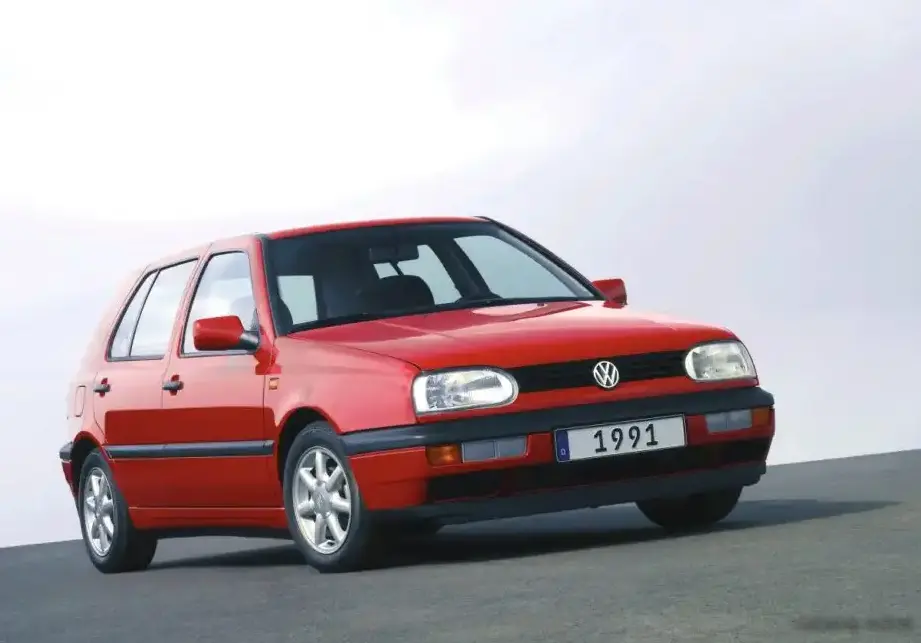
The Volkswagen Golf III 1.9 SDI, produced primarily in 1997, represented an economy-focused variant within the highly successful Golf Mk3 range (1HX0/A3 platform). Positioned as an entry-level diesel option, it catered to buyers prioritizing fuel efficiency and practicality over outright performance. While the Golf III was a mainstay in European markets, its appeal in North America was limited, with the Mk3 generation seeing reduced sales compared to its predecessors. The 1.9 SDI model specifically targeted drivers seeking a durable, low-maintenance vehicle for daily commuting and long-distance travel. This variant offered a cost-effective entry point into the Golf III lineup, undercutting the more powerful TDI and gasoline-powered models.
Technical Specifications
| Brand | Volkswagen |
| Model | Golf |
| Generation | Golf III |
| Type (Engine) | 1.9 SDI (64 Hp) |
| Start of production | 1997 |
| End of production | 1997 |
| Powertrain Architecture | Internal Combustion engine |
| Body type | Hatchback |
| Seats | 5 |
| Doors | 3-5 |
| Fuel consumption (combined) | 4.9 l/100 km (48 US mpg, 57.6 UK mpg, 20.4 km/l) |
| Fuel Type | Diesel |
| Acceleration 0 – 100 km/h | 17.6 sec |
| Acceleration 0 – 62 mph | 17.6 sec |
| Acceleration 0 – 60 mph | 16.7 sec |
| Maximum speed | 156 km/h (96.93 mph) |
| Weight-to-power ratio | 18.1 kg/Hp, 55.2 Hp/tonne |
| Weight-to-torque ratio | 9.3 kg/Nm, 107.8 Nm/tonne |
| Power | 64 Hp @ 4400 rpm |
| Power per litre | 33.8 Hp/l |
| Torque | 125 Nm @ 2000 rpm (92.2 lb.-ft. @ 2000 rpm) |
| Engine layout | Front, Transverse |
| Engine Model/Code | AEY |
| Engine displacement | 1896 cm3 (115.7 cu. in.) |
| Number of cylinders | 4 |
| Engine configuration | Inline |
| Cylinder Bore | 79.5 mm (3.13 in.) |
| Piston Stroke | 95.5 mm (3.76 in.) |
| Compression ratio | 19.5:1 |
| Number of valves per cylinder | 2 |
| Fuel injection system | Direct injection |
| Engine aspiration | Naturally aspirated engine |
| Valvetrain | OHC |
| Engine oil capacity | 4.3 l (4.54 US qt | 3.78 UK qt) |
| Coolant | 6.5 l (6.87 US qt | 5.72 UK qt) |
| Kerb Weight | 1160 kg (2557.36 lbs.) |
| Max. weight | 1595 kg (3516.37 lbs.) |
| Max load | 435 kg (959.01 lbs.) |
| Trunk (boot) space – minimum | 330 l (11.65 cu. ft.) |
| Trunk (boot) space – maximum | 685 l (24.19 cu. ft.) |
| Fuel tank capacity | 55 l (14.53 US gal | 12.1 UK gal) |
| Length | 4020 mm (158.27 in.) |
| Width | 1695 mm (66.73 in.) |
| Height | 1425 mm (56.1 in.) |
| Wheelbase | 2475 mm (97.44 in.) |
| Front track | 1478 mm (58.19 in.) |
| Rear (Back) track | 1462 mm (57.56 in.) |
| Drivetrain Architecture | The Internal combustion engine (ICE) drives the front wheels of the vehicle. |
| Drive wheel | Front wheel drive |
| Number of gears and type of gearbox | 5 gears, manual transmission |
| Front suspension | Wishbone |
| Rear suspension | Suspension with traction connecting levers |
| Front brakes | Disc |
| Rear brakes | Drum |
| Assisting systems | ABS (Anti-lock braking system) |
| Steering type | Steering rack and pinion |
| Power steering | Hydraulic Steering |
| Tires size | 175/70 R13 |
| Wheel rims size | 13 |
Powertrain & Engine Architecture
The Golf III 1.9 SDI utilized the AEY engine code, a 1.9-liter inline four-cylinder diesel engine. This engine employed a direct injection (DI) system, a relatively advanced technology for its time, which injected fuel directly into the combustion chamber, improving efficiency and reducing emissions compared to indirect injection systems. The engine featured an overhead camshaft (OHC) valvetrain with two valves per cylinder. The SDI system, while not as sophisticated as the later TDI common rail systems, offered improved fuel economy and torque delivery at lower engine speeds. The five-speed manual transmission was standard, providing a relatively long-geared setup optimized for fuel efficiency rather than rapid acceleration. The engine’s robust construction and relatively simple design contributed to its reputation for reliability.
Driving Characteristics
The 1.9 SDI with the five-speed manual transmission delivered modest performance. With 64 horsepower and 92 lb-ft of torque, acceleration was leisurely, taking approximately 17.6 seconds to reach 60 mph. The engine’s strength lay in its low-end torque, making it reasonably capable for everyday driving and overtaking maneuvers on highways. The long gear ratios further emphasized fuel economy, but also meant the engine often felt strained when pushed hard. Compared to the more powerful gasoline variants or the later TDI models, the SDI felt significantly slower. However, its simplicity and durability made it a practical choice for drivers prioritizing reliability and low running costs.
Equipment & Trim Levels
The 1.9 SDI typically represented the base trim level in the Golf III range. Standard equipment generally included power steering, central locking, and basic instrumentation. Interior upholstery was typically cloth, and the dashboard featured a functional, if somewhat spartan, design. Optional extras included power windows, a sunroof, and upgraded audio systems. The focus was on providing essential features at an affordable price point. Air conditioning was often an optional extra, and not always fitted as standard.
Chassis & Braking
The Golf III 1.9 SDI utilized a MacPherson strut front suspension and a torsion beam rear suspension. The braking system featured disc brakes on the front wheels and drum brakes on the rear. ABS (Anti-lock Braking System) was often included as standard equipment, enhancing safety. The suspension setup was tuned for comfort and stability, providing a reasonably compliant ride. The rear drum brakes were a cost-saving measure typical of entry-level models.
Market Reception & Comparison
The Golf III 1.9 SDI was generally well-received as a practical and economical option. Critics praised its fuel efficiency and durability, but noted its lack of performance. Compared to the more powerful gasoline and TDI variants, the SDI offered a significantly different driving experience. The TDI models, with their common rail injection and higher power outputs, were favored by drivers seeking more performance and refinement. However, the SDI’s lower purchase price and simpler mechanicals made it an attractive option for budget-conscious buyers. Fuel economy figures of around 48 US mpg were a major selling point.
Legacy
The Volkswagen Golf III 1.9 SDI powertrain has proven to be remarkably durable over the long term. Many examples remain on the road today, testament to the engine’s robust construction and relatively simple design. While parts availability may be becoming more challenging, the engine is generally considered to be reliable and relatively easy to maintain. In the used car market, these models are often sought after by those looking for a simple, affordable, and fuel-efficient vehicle. The 1.9 SDI engine, while not a performance icon, holds a respected place in the Golf III lineage as a dependable and economical workhorse.