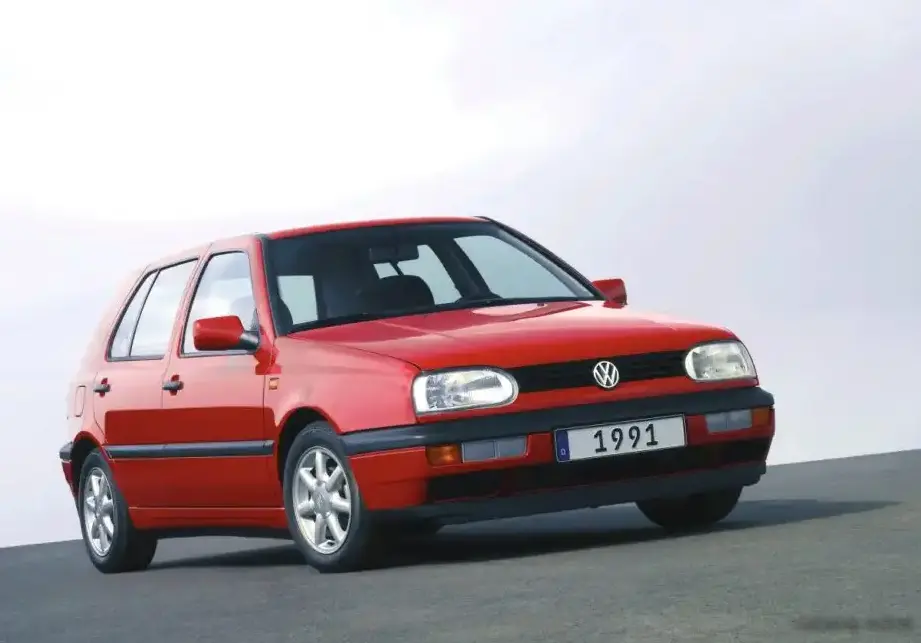
The Volkswagen Golf III 1.9 TD GTD, produced between 1991 and 1997, represented a popular diesel offering within the Mk3 Golf range. Positioned as a fuel-efficient and practical variant, the GTD (Gran Turismo Diesel) trim aimed to provide a balance between performance and economy. This model utilized Volkswagen’s well-regarded 1.9-liter turbocharged diesel engine, delivering 75 horsepower, and was typically paired with a five-speed manual transmission, though automatic options were available in some markets. The Golf III, built on the A3 platform, was a significant evolution from the Mk2, offering improved refinement, safety features, and a more spacious interior. The 1.9 TD GTD specifically catered to drivers seeking a durable, economical vehicle suitable for both daily commuting and longer journeys.
Technical Specifications
| Brand | Volkswagen |
| Model | Golf |
| Generation | Golf III |
| Type (Engine) | 1.9 TD GTD (75 Hp) |
| Start of production | 1991 |
| End of production | 1997 |
| Powertrain Architecture | Internal Combustion engine |
| Body type | Hatchback |
| Seats | 5 |
| Doors | 3-5 |
| Fuel consumption (combined) | 6.2 l/100 km (37.9 US mpg, 45.6 UK mpg, 16.1 km/l) |
| Fuel Type | Diesel |
| Acceleration 0 – 100 km/h | 15.1 sec |
| Acceleration 0 – 62 mph | 15.1 sec |
| Acceleration 0 – 60 mph | 14.3 sec |
| Maximum speed | 165 km/h (102.53 mph) |
| Weight-to-power ratio | 15.6 kg/Hp, 64.1 Hp/tonne |
| Weight-to-torque ratio | 8.4 kg/Nm, 119.7 Nm/tonne |
| Power | 75 Hp @ 4400 rpm |
| Power per litre | 39.6 Hp/l |
| Torque | 140 Nm @ 2400 rpm (103.26 lb.-ft. @ 2400 rpm) |
| Engine layout | Front, Transverse |
| Engine Model/Code | AAZ |
| Engine displacement | 1896 cm3 (115.7 cu. in.) |
| Number of cylinders | 4 |
| Engine configuration | Inline |
| Cylinder Bore | 79.5 mm (3.13 in.) |
| Piston Stroke | 95.5 mm (3.76 in.) |
| Compression ratio | 22.5:1 |
| Number of valves per cylinder | 2 |
| Fuel injection system | Precombustion chamber injection |
| Engine aspiration | Turbocharger |
| Valvetrain | OHC |
| Engine oil capacity | 4.3 l (4.54 US qt | 3.78 UK qt) |
| Coolant | 6.3 l (6.66 US qt | 5.54 UK qt) |
| Kerb Weight | 1170 kg (2579.41 lbs.) |
| Max. weight | 1605 kg (3538.42 lbs.) |
| Max load | 435 kg (959.01 lbs.) |
| Trunk (boot) space – minimum | 330 l (11.65 cu. ft.) |
| Trunk (boot) space – maximum | 687 l (24.26 cu. ft.) |
| Fuel tank capacity | 55 l (14.53 US gal | 12.1 UK gal) |
| Length | 4020 mm (158.27 in.) |
| Width | 1695 mm (66.73 in.) |
| Height | 1425 mm (56.1 in.) |
| Wheelbase | 2475 mm (97.44 in.) |
| Front track | 1478 mm (58.19 in.) |
| Rear (Back) track | 1462 mm (57.56 in.) |
| Drivetrain Architecture | The Internal combustion engine (ICE) drives the front wheels of the vehicle. |
| Drive wheel | Front wheel drive |
| Number of gears and type of gearbox | 5 gears, manual transmission |
| Front suspension | Wishbone |
| Rear suspension | Suspension with traction connecting levers |
| Front brakes | Disc |
| Rear brakes | Drum |
| Assisting systems | ABS (Anti-lock braking system) |
| Steering type | Steering rack and pinion |
| Power steering | Hydraulic Steering |
| Tires size | 175/70 R13 |
| Wheel rims size | 13 |
Powertrain & Engine Architecture
The heart of the Golf III 1.9 TD GTD was the AAZ engine, a 1.9-liter inline four-cylinder diesel. This engine utilized a precombustion chamber injection system, a common design for diesel engines of the era. This system involved injecting fuel into a precombustion chamber connected to the main cylinder, promoting more complete combustion and reducing noise. The addition of a turbocharger significantly boosted power output compared to naturally aspirated diesel versions. The turbocharger, typically a Garrett unit, provided approximately 7.5 psi of boost. The engine featured an overhead camshaft (OHC) valvetrain operating two valves per cylinder. While not particularly high-revving, the AAZ engine was known for its durability and relatively low maintenance requirements. The five-speed manual transmission was the most common pairing, offering a good balance of fuel economy and usability. An optional four-speed automatic transmission was available, but it generally detracted from both performance and fuel efficiency.
Driving Characteristics
The 1.9 TD GTD, with its 75 horsepower and 140 Nm (103 lb-ft) of torque, offered modest but adequate performance. Acceleration from 0-60 mph took around 14.3 seconds, and top speed was approximately 102.5 mph. The engine’s torque curve was relatively flat, providing usable power across a wide rev range. This made it well-suited for everyday driving and overtaking maneuvers, although it lacked the outright punch of the gasoline-powered Golf variants. The manual transmission allowed for precise control, while the automatic, though convenient, felt sluggish in comparison. The gearing was optimized for fuel economy, meaning the engine often operated at lower RPMs during cruising. Compared to the more powerful VR6 or even the 1.8 gasoline models, the 1.9 TD GTD prioritized efficiency over outright speed.
Equipment & Trim Levels
The GTD trim level offered a reasonable level of equipment for the time. Standard features typically included central locking, power steering, and an upgraded interior trim compared to base models. The interior usually featured cloth upholstery, and a basic stereo system. Optional extras included power windows, sunroof, alloy wheels, and upgraded audio systems. The GTD also often featured a sportier steering wheel and unique badging. The dashboard layout was typical of the Golf III, with a clear instrument cluster and logically arranged controls.
Chassis & Braking
The Golf III 1.9 TD GTD utilized a MacPherson strut front suspension and a torsion beam rear suspension. This setup provided a comfortable ride and predictable handling. The front brakes were typically ventilated discs, while the rear brakes were drum brakes. ABS (Anti-lock Braking System) was often included as standard equipment, enhancing safety. The suspension was tuned for a balance between comfort and handling, leaning towards the former. Stabilizer bars were fitted to both the front and rear axles to reduce body roll during cornering.
Market Reception & Comparison
The Golf III 1.9 TD GTD was well-received in Europe as a practical and economical choice. Critics praised its fuel efficiency and durability, but noted its relatively modest performance. Compared to the gasoline-powered Golfs, the 1.9 TD GTD offered significantly better fuel economy, making it a popular choice for high-mileage drivers. However, it lacked the refinement and responsiveness of the more powerful gasoline engines. Against competitors like the Ford Escort Diesel and Opel Astra Diesel, the Golf III 1.9 TD GTD offered a compelling combination of features, build quality, and fuel efficiency.
Legacy
The AAZ engine, found in the Golf III 1.9 TD GTD, is renowned for its robustness and longevity. Many examples have surpassed 200,000 miles with proper maintenance. Today, the Golf III 1.9 TD GTD remains a relatively affordable and reliable classic car. Parts availability is generally good, and the simple mechanical design makes it relatively easy to maintain. While not a performance icon, the 1.9 TD GTD represents a practical and durable era of automotive engineering, and continues to be appreciated by enthusiasts seeking a fuel-efficient and dependable vehicle.