
Technical Specifications
| Brand | DS |
| Model | 5 |
| Generation | 5 |
| Type (Engine) | 2.0 BlueHDi (150 Hp) Stop&Start |
| Start of production | 2015 |
| End of production | 2018 |
| Powertrain Architecture | Internal Combustion engine |
| Body type | Hatchback |
| Seats | 5 |
| Doors | 5 |
| Fuel consumption (urban) | 5.1-5.2 l/100 km (46.1 – 45.2 US mpg) |
| Fuel consumption (extra urban) | 3.8 l/100 km (61.9 US mpg) |
| Fuel consumption (combined) | 4.3 l/100 km (54.7 US mpg) |
| CO2 emissions | 110-113 g/km |
| Fuel Type | Diesel |
| Acceleration 0 – 100 km/h | 10.6 sec |
| Acceleration 0 – 62 mph | 10.6 sec |
| Acceleration 0 – 60 mph | 10.1 sec |
| Maximum speed | 210 km/h (130.49 mph) |
| Emission standard | Euro 6 |
| Weight-to-power ratio | 10.2 kg/Hp |
| Weight-to-torque ratio | 4.2 kg/Nm |
| Power | 150 Hp @ 4000 rpm |
| Torque | 370 Nm @ 2000 rpm (272.9 lb.-ft. @ 2000 rpm) |
| Engine layout | Front, Transverse |
| Engine Model/Code | AHR DW10FD |
| Engine displacement | 1997 cm3 (121.86 cu. in.) |
| Number of cylinders | 4 |
| Engine configuration | Inline |
| Cylinder Bore | 85 mm (3.35 in.) |
| Piston Stroke | 88 mm (3.46 in.) |
| Number of valves per cylinder | 4 |
| Fuel injection system | Diesel Commonrail |
| Engine aspiration | Turbocharger, Intercooler |
| Engine oil capacity | 6 l (6.34 US qt | 5.28 UK qt) |
| Kerb Weight | 1537-1660 kg (3388.5 – 3659.67 lbs.) |
| Max. weight | 2130 kg (4695.85 lbs.) |
| Max load | 470-593 kg (1036.17 – 1307.34 lbs.) |
| Trunk (boot) space – minimum | 468 l (16.53 cu. ft.) |
| Trunk (boot) space – maximum | 1288 l (45.49 cu. ft.) |
| Fuel tank capacity | 60 l (15.85 US gal | 13.2 UK gal) |
| Permitted trailer load with brakes (12%) | 1500 kg (3306.93 lbs.) |
| Permitted trailer load without brakes | 750 kg (1653.47 lbs.) |
| Permitted towbar download | 75 kg (165.35 lbs.) |
| Length | 4530 mm (178.35 in.) |
| Width | 1871-2128 mm (73.66 – 83.78 in.) |
| Height | 1505-1539 mm (59.25 – 60.59 in.) |
| Wheelbase | 2727 mm (107.36 in.) |
| Front track | 1575-1582 mm (62.01 – 62.28 in.) |
| Rear (Back) track | 1599-1609 mm (62.95 – 63.35 in.) |
| Front overhang | 996 mm (39.21 in.) |
| Rear overhang | 807 mm (31.77 in.) |
| Minimum turning circle | 11.2 m (36.75 ft.) |
| Drivetrain Architecture | Front wheel drive |
| Number of gears and type of gearbox | 6 gears, manual transmission |
| Front suspension | Independent, type McPherson with coil spring and anti-roll bar |
| Rear suspension | Semi-independent, coil spring |
| Front brakes | Ventilated discs |
| Rear brakes | Disc |
| Assisting systems | ABS (Anti-lock braking system) |
| Steering type | Steering rack and pinion |
| Power steering | Electric Steering |
| Tires size | 215/55 R17; 225/45 R18; 225/40 R19 |
| Wheel rims size | 17; 18; 19 |
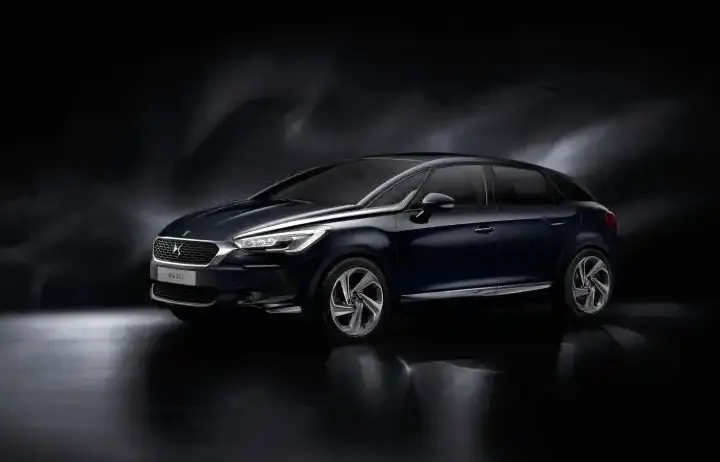
The DS 5 2.0 BlueHDi 150 Stop&Start, launched in 2015, was a key component of DS Automobiles’ initial model range. It represented a move upmarket from Citroën, emphasizing style, comfort, and advanced technology. The “BlueHDi” designation signified the use of Peugeot-Citroën’s advanced diesel technology, designed to reduce emissions and improve fuel economy. The Stop&Start system further enhanced efficiency by automatically shutting off the engine when the vehicle was stationary. This variant occupied a sweet spot in the DS 5 lineup, offering a balance between performance, economy, and equipment levels, appealing to buyers seeking a refined and practical vehicle.
Powertrain & Engine Architecture
At the heart of the DS 5 2.0 BlueHDi 150 was the DW10FD engine, a 2.0-liter inline-four cylinder diesel engine. This engine, commonly found in PSA Group vehicles, utilized a common-rail direct injection system, delivering fuel at extremely high pressure for optimized combustion. The AHR engine code specifically denotes a version tuned to produce 150 horsepower at 4000 rpm and 370 Nm (272.9 lb-ft) of torque at 2000 rpm. A turbocharger with an intercooler was employed to boost power and efficiency. The engine also featured a particulate filter to minimize emissions, complying with stringent Euro 6 standards. The Stop&Start system, integrated into the engine management system, automatically shut down the engine when idling, restarting it instantly upon depressing the clutch or brake pedal. This model was paired with a 6-speed manual transmission, delivering power to the front wheels.
Driving Characteristics
The DS 5 2.0 BlueHDi 150 offered a comfortable and refined driving experience. While not overtly sporty, the engine provided ample torque for everyday driving and overtaking maneuvers. The 6-speed manual transmission allowed for precise control, although the gear ratios were tuned more for fuel efficiency than outright acceleration. Acceleration from 0-100 km/h (0-62 mph) took approximately 10.6 seconds. The engine’s peak torque, available from 2000 rpm, meant that strong pulling power was readily accessible without needing to rev the engine excessively. Compared to the more powerful DS 5 variants, such as those with higher-output diesel engines, this 150 hp version prioritized fuel economy and relaxed cruising. The suspension, tuned for comfort, absorbed bumps and imperfections in the road effectively, contributing to a smooth ride.
Equipment & Trim Levels
The DS 5 2.0 BlueHDi 150 typically came well-equipped, reflecting its positioning as a premium vehicle. Standard features often included automatic climate control, a touchscreen infotainment system with navigation, Bluetooth connectivity, and rear parking sensors. Interior upholstery was typically a combination of cloth and leather, with options for full leather trim. Higher trim levels offered additional features such as panoramic sunroof, heated front seats, and advanced driver-assistance systems like adaptive cruise control and lane departure warning. The DS 5’s distinctive interior design, with its aviation-inspired switchgear, added to its unique character.
Chassis & Braking
The DS 5 utilized a McPherson strut front suspension and a semi-independent coil spring rear suspension. This setup provided a good balance between ride comfort and handling. The front brakes were ventilated discs, offering strong stopping power, while the rear brakes were solid discs. Anti-lock Braking System (ABS) was standard, enhancing safety. The chassis was designed to minimize noise, vibration, and harshness, contributing to a refined driving experience. Stabilizer bars were fitted to both the front and rear axles to reduce body roll during cornering.
Market Reception & Comparison
The DS 5 2.0 BlueHDi 150 was generally well-received by automotive critics. It was praised for its stylish design, comfortable ride, and fuel-efficient engine. However, some reviewers noted that the interior, while distinctive, could feel somewhat cluttered. Compared to other diesel-powered hatchbacks and crossovers in its class, the DS 5 offered a unique blend of French flair and practicality. Its fuel economy was competitive, typically achieving around 4.3 l/100 km (54.7 US mpg) in combined driving. Reliability was generally good, although some owners reported minor issues with the infotainment system.
Legacy
The DS 5 2.0 BlueHDi 150, while no longer in production, remains a popular choice in the used car market. The DW10FD engine is known for its durability and relatively low maintenance costs, provided it is properly serviced. The Stop&Start system, while contributing to fuel savings, can be a potential source of issues if not maintained correctly. Overall, the DS 5 2.0 BlueHDi 150 represents a well-rounded and stylish vehicle that continues to offer a compelling combination of comfort, efficiency, and practicality for discerning buyers.
