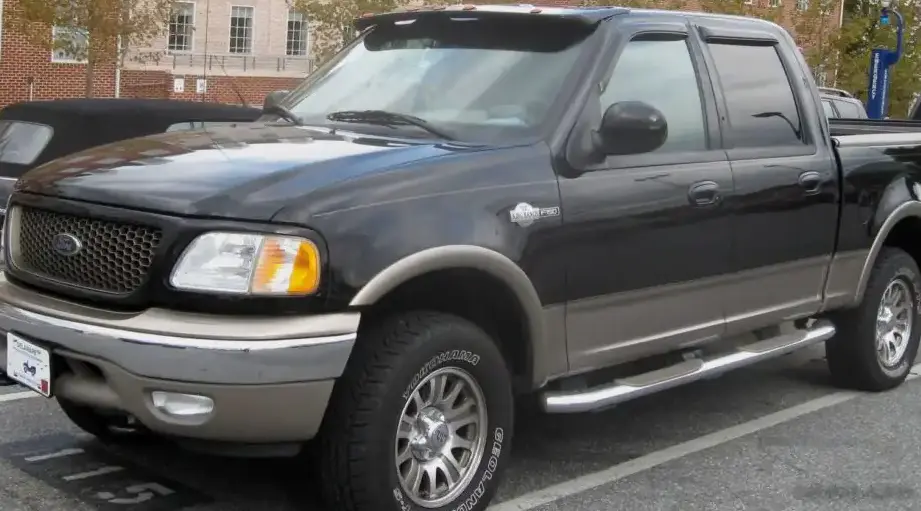
The Ford F-Series F-150 X SuperCrew, equipped with the 4.6-liter V8 Triton engine and a four-speed automatic transmission, was a significant offering in the American full-size pickup truck market from 1999 to 2004. This variant represented a blend of capability and comfort, aimed at buyers needing a versatile vehicle for both work and family use. It was part of the tenth generation of the F-Series (1997-2003), a generation that introduced the SuperCrew body style, offering a larger rear passenger area than traditional extended cab pickups. The 4.6L engine and automatic transmission combination positioned this trim as a mid-range option within the F-150 lineup, slotting below the more powerful 5.4-liter V8 and above the base 4.2-liter V6.
Technical Specifications
| Brand | Ford |
| Model | F-Series F-150 |
| Generation | F-Series F-150 X SuperCrew |
| Type (Engine) | 4.6 V8 Triton (231 Hp) Automatic |
| Start of production | 1999 |
| End of production | 2004 |
| Powertrain Architecture | Internal Combustion engine |
| Body type | Pick-up |
| Seats | 5-6 |
| Doors | 4 |
| Fuel Type | Petrol (Gasoline) |
| Power | 231 Hp @ 4750 rpm |
| Power per litre | 50.2 Hp/l |
| Torque | 397 Nm @ 3500 rpm / 292.81 lb.-ft. @ 3500 rpm |
| Engine layout | Front, Longitudinal |
| Engine displacement | 4605 cm3 / 281.01 cu. in. |
| Number of cylinders | 8 |
| Engine configuration | V-engine |
| Cylinder Bore | 90.17 mm / 3.55 in. |
| Piston Stroke | 89.92 mm / 3.54 in. |
| Compression ratio | 9.3:1 |
| Number of valves per cylinder | 2 |
| Fuel injection system | Multi-port manifold injection |
| Engine aspiration | Naturally aspirated engine |
| Valvetrain | SOHC |
| Engine oil capacity | 5.7 l / 6.02 US qt | 5.02 UK qt |
| Coolant | 19.5 l / 20.61 US qt | 17.16 UK qt |
| Max. weight | 2880 kg / 6349.31 lbs |
| Trunk (boot) space – minimum | 1252 l / 44.21 cu. ft |
| Fuel tank capacity | 95 l / 25.1 US gal | 20.9 UK gal |
| Permitted trailer load with brakes (12%) | 2948 kg / 6499.23 lbs |
| Length | 5738 mm / 225.91 in |
| Width | 2009 mm / 79.09 in |
| Height | 1877 mm / 73.9 in |
| Wheelbase | 3518 mm / 138.5 in |
| Front overhang | 983 mm / 38.7 in |
| Rear overhang | 1237 mm / 48.7 in |
| Ride height (ground clearance) | 203 mm / 7.99 in |
| Approach angle | 21.6° |
| Departure angle | 17° |
| Ramp-over (brakeover) angle | 14.7° |
| Wading depth | 813 mm / 32.01 in |
| Drivetrain Architecture | The Internal combustion engine (ICE) drives the rear wheels of the vehicle. |
| Drive wheel | Rear wheel drive |
| Number of gears and type of gearbox | 4 gears, automatic transmission |
| Front suspension | Independent coil spring, Transverse stabilizer |
| Rear suspension | Leaf spring |
| Front brakes | Ventilated discs, 308 mm |
| Rear brakes | Ventilated discs, 335 mm |
| Assisting systems | ABS (Anti-lock braking system) |
| Steering type | Cone worm with recirculation balls |
| Power steering | Electric Steering |
| Tires size | 255/70 R16 |
| Wheel rims size | 16 |
Powertrain & Engine Architecture
The heart of this F-150 variant was the 4.6-liter Triton V8 engine. This engine, part of Ford’s modular engine family, featured a single overhead camshaft (SOHC) design with two valves per cylinder. The engine utilized a multi-port fuel injection system, delivering fuel directly to each intake port for improved efficiency and power delivery. The 4.6L Triton was known for its relatively smooth operation and decent power output for its displacement. The engine code varied slightly depending on the year, but generally fell within the range of earlier Triton designs. Paired with the engine was a four-speed automatic transmission. This transmission, while reliable, was a somewhat dated design by the early 2000s, lacking the efficiency and smoothness of newer transmissions with more gears. The transmission was electronically controlled, offering adaptive shift patterns based on driving conditions.
Driving Characteristics
The 4.6-liter V8 and four-speed automatic combination provided adequate performance for most everyday driving situations. Acceleration was reasonable, but not particularly brisk, with 0-60 mph times typically in the 7.5-8.5 second range. The automatic transmission’s gear ratios were tuned for a balance of fuel economy and towing capability. While it wasn’t a performance-oriented setup, the powertrain offered sufficient torque for hauling moderate loads and navigating varied terrain. Compared to the 5.4-liter V8, the 4.6L felt noticeably less powerful, especially when fully loaded or towing. However, it offered better fuel economy. The four-speed automatic, while functional, lacked the responsiveness of the manual transmission option or the more advanced transmissions found in later F-150 models.
Equipment & Trim Levels
The F-150 X SuperCrew 4.6L Automatic typically came standard with features like air conditioning, power windows and locks, an AM/FM stereo, and cloth upholstery. The SuperCrew configuration offered a significantly larger rear seat than traditional extended cab models, making it a more comfortable option for families or passengers. Optional extras included power seats, a premium sound system, alloy wheels, a towing package, and various convenience features. The “X” trim level generally represented a step up from the base XL trim, offering a slightly more refined interior and additional standard features.
Chassis & Braking
The F-150 X SuperCrew utilized a body-on-frame construction, providing a robust and durable platform. The front suspension featured independent coil springs and a transverse stabilizer bar, while the rear suspension employed leaf springs. This setup provided a comfortable ride quality, although it could feel somewhat bouncy when unloaded. Braking duties were handled by ventilated disc brakes on all four wheels, with ABS (Anti-lock Braking System) as standard equipment. The braking system was adequate for the vehicle’s weight and intended use, but lacked the stopping power of more modern braking systems.
Market Reception & Comparison
The F-150 X SuperCrew 4.6L Automatic was generally well-received by critics and consumers alike. It offered a compelling combination of space, comfort, and capability at a reasonable price point. Compared to the 5.4-liter V8 models, the 4.6L offered better fuel economy, making it a more attractive option for buyers who didn’t require the extra power. However, the 5.4L was preferred by those who frequently towed heavy loads or desired quicker acceleration. The 4.6L also offered a more affordable entry point into the SuperCrew body style, making it accessible to a wider range of buyers. Reliability was generally good, although some owners reported issues with the automatic transmission and the Triton engine’s timing chain guides over the long term.
Legacy
The Ford F-150 X SuperCrew 4.6L Automatic remains a popular choice in the used truck market today. Its spacious interior, decent power, and relatively affordable price make it an attractive option for buyers seeking a capable and versatile pickup truck. While the four-speed automatic transmission is dated by modern standards, it has proven to be reasonably durable. The 4.6-liter Triton engine, while prone to some common issues like timing chain wear, can provide many years of reliable service with proper maintenance. These trucks are often sought after for their practicality and affordability, representing a solid value in the used truck market.