
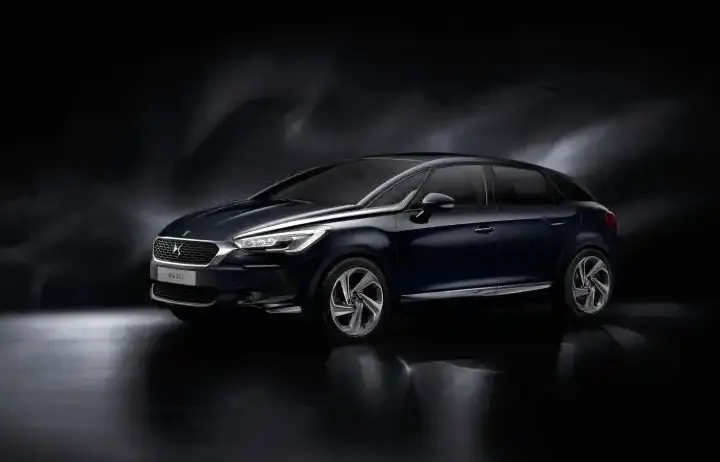
The DS 5 2.0 BlueHDi 180 Stop&Start Automatic was a premium compact hatchback produced by the French manufacturer DS Automobiles between 2015 and 2018. Positioned as a mid-to-high trim level within the DS 5 range, it offered a blend of performance, fuel efficiency, and distinctive styling. The DS 5 itself was originally developed under Citroën, but was repositioned as a standalone luxury brand, DS Automobiles, in 2014. This variant aimed to appeal to buyers seeking a sophisticated and economical diesel-powered vehicle with the convenience of an automatic transmission. It was primarily sold in European markets, where diesel engines held a significant share of the automotive landscape.
Technical Specifications
| Brand | DS |
| Model | 5 |
| Generation | 5 |
| Type (Engine) | 2.0 BlueHDi (180 Hp) Stop&Start Automatic |
| Start of production | 2015 |
| End of production | 2018 |
| Powertrain Architecture | Internal Combustion engine |
| Body type | Hatchback |
| Seats | 5 |
| Doors | 5 |
| Fuel consumption (urban) | 5.1 l/100 km (46.1 US mpg, 55.4 UK mpg, 19.6 km/l) |
| Fuel consumption (extra urban) | 3.8-4.1 l/100 km (61.9 – 57.4 US mpg, 74.3 – 68.9 UK mpg, 26.3 – 24.4 km/l) |
| Fuel consumption (combined) | 4.3-4.4 l/100 km (54.7 – 53.5 US mpg, 65.7 – 64.2 UK mpg, 23.3 – 22.7 km/l) |
| CO2 emissions | 110-113 g/km |
| Fuel Type | Diesel |
| Acceleration 0 – 100 km/h | 9.2 sec |
| Acceleration 0 – 62 mph | 9.2 sec |
| Acceleration 0 – 60 mph | 8.7 sec |
| Maximum speed | 220 km/h (136.7 mph) |
| Emission standard | Euro 6 |
| Weight-to-power ratio | 8.6 kg/Hp, 116.9 Hp/tonne |
| Weight-to-torque ratio | 3.9 kg/Nm, 259.7 Nm/tonne |
| Power | 180 Hp @ 3750 rpm |
| Torque | 400 Nm @ 2000 rpm (295.02 lb.-ft. @ 2000 rpm) |
| Engine layout | Front, Transverse |
| Engine Model/Code | AHW DW10FC |
| Engine displacement | 1997 cm3 (121.86 cu. in.) |
| Number of cylinders | 4 |
| Engine configuration | Inline |
| Cylinder Bore | 85 mm (3.35 in.) |
| Piston Stroke | 88 mm (3.46 in.) |
| Number of valves per cylinder | 4 |
| Fuel injection system | Diesel Commonrail |
| Engine aspiration | Turbocharger, Intercooler |
| Engine oil capacity | 5 l (5.28 US qt | 4.4 UK qt) |
| Kerb Weight | 1540-1679 kg (3395.12 – 3701.56 lbs.) |
| Max. weight | 2125 kg (4684.82 lbs.) |
| Max load | 446-585 kg (983.26 – 1289.7 lbs.) |
| Trunk (boot) space – minimum | 468 l (16.53 cu. ft.) |
| Trunk (boot) space – maximum | 1288 l (45.49 cu. ft.) |
| Fuel tank capacity | 60 l (15.85 US gal | 13.2 UK gal) |
| Permitted trailer load with brakes (12%) | 1500 kg (3306.93 lbs.) |
| Permitted trailer load without brakes | 750 kg (1653.47 lbs.) |
| Permitted towbar download | 75 kg (165.35 lbs.) |
| Length | 4530 mm (178.35 in.) |
| Width | 1871-2128 mm (73.66 – 83.78 in.) |
| Height | 1505-1539 mm (59.25 – 60.59 in.) |
| Wheelbase | 2727 mm (107.36 in.) |
| Front track | 1575-1582 mm (62.01 – 62.28 in.) |
| Rear (Back) track | 1599-1609 mm (62.95 – 63.35 in.) |
| Front overhang | 996 mm (39.21 in.) |
| Rear overhang | 807 mm (31.77 in.) |
| Minimum turning circle | 11.2 m (36.75 ft.) |
| Drivetrain Architecture | Front wheel drive |
| Number of gears and type of gearbox | 6 gears, automatic transmission |
| Front suspension | Independent, type McPherson with coil spring and anti-roll bar |
| Rear suspension | Semi-independent, coil spring |
| Front brakes | Ventilated discs |
| Rear brakes | Disc |
| Assisting systems | ABS (Anti-lock braking system) |
| Steering type | Steering rack and pinion |
| Power steering | Electric Steering |
| Tires size | 215/55 R17; 225/45 R18; 225/40 R19 |
| Wheel rims size | 17; 18; 19 |
Powertrain & Engine Architecture
The DS 5 2.0 BlueHDi 180 utilized the DW10FC engine family, a 2.0-liter inline-four cylinder diesel engine developed by PSA Peugeot Citroën (later Groupe PSA, now Stellantis). The ‘AHW’ engine code specifically denotes a variant tuned to produce 180 horsepower at 3750 rpm and 400 Nm (295 lb-ft) of torque at 2000 rpm. This engine featured a common rail direct fuel injection system, delivering fuel at extremely high pressure for optimized combustion. A turbocharger with an intercooler was employed to boost power and efficiency. The engine also incorporated a Diesel Particulate Filter (DPF) and a Stop & Start system to reduce emissions and improve fuel economy. The automatic transmission was a six-speed torque converter unit, chosen for its smoothness and refinement, although it wasn’t as fuel-efficient as some newer dual-clutch transmissions.
Driving Characteristics
The 2.0 BlueHDi 180 Automatic offered a comfortable and relaxed driving experience. Acceleration to 60 mph took approximately 8.7 seconds, and the car had a top speed of 136.7 mph. While not overtly sporty, the engine provided ample torque for everyday driving and overtaking maneuvers. The automatic transmission generally shifted smoothly, but could occasionally feel hesitant during quick downshifts. Compared to the lower-powered 1.6 BlueHDi variants, the 2.0-liter engine offered significantly more performance. It also felt more refined and less strained, particularly when fully loaded or tackling inclines. Compared to the manual transmission versions, the automatic sacrificed some fuel economy but provided greater convenience, especially in urban environments.
Equipment & Trim Levels
The DS 5 2.0 BlueHDi 180 Automatic typically came well-equipped, reflecting its position as a mid-to-high trim level. Standard features often included leather upholstery, automatic climate control, a touchscreen infotainment system with navigation, rear parking sensors, and alloy wheels. Higher trim levels offered additional features such as panoramic sunroof, premium audio systems, and advanced driver-assistance systems like adaptive cruise control and blind-spot monitoring. Interior materials were generally of high quality, with a focus on creating a luxurious and comfortable cabin environment. The distinctive dashboard design, featuring a unique ‘watch strap’ stitching pattern, was a hallmark of the DS 5.
Chassis & Braking
The DS 5 featured a McPherson strut front suspension and a semi-independent coil spring rear suspension. This setup provided a good balance between ride comfort and handling. The front brakes were ventilated discs, while the rear brakes were solid discs. ABS (Anti-lock Braking System) was standard. The suspension was tuned to prioritize comfort, resulting in a relatively soft ride. Stabilizer bars were fitted to both the front and rear axles to reduce body roll during cornering. The steering was electrically assisted, providing light and precise control.
Market Reception & Comparison
The DS 5 2.0 BlueHDi 180 Automatic was generally well-received by automotive critics. It was praised for its comfortable ride, refined engine, and stylish interior. However, some reviewers noted that the infotainment system could be complex to use and that the automatic transmission wasn’t always as responsive as some competitors. Compared to rivals like the Audi A3 and BMW 1 Series, the DS 5 offered a more distinctive design and a more comfortable ride, but lacked the same level of brand prestige. Fuel economy was a strong point, with combined figures ranging from 53.5 to 54.7 US mpg, making it an attractive option for drivers covering long distances.
Legacy
The DS 5, and specifically the 2.0 BlueHDi 180 Automatic variant, has proven to be a relatively reliable vehicle. The DW10FC engine is known for its durability, although the Diesel Particulate Filter (DPF) can be prone to clogging if the vehicle is primarily used for short journeys. On the used car market, the DS 5 2.0 BlueHDi 180 Automatic represents a good value proposition for buyers seeking a comfortable, economical, and stylish hatchback. Its distinctive design and well-equipped interior continue to appeal to those looking for something different from the mainstream German brands. Maintenance costs are generally reasonable, and parts availability is good.
