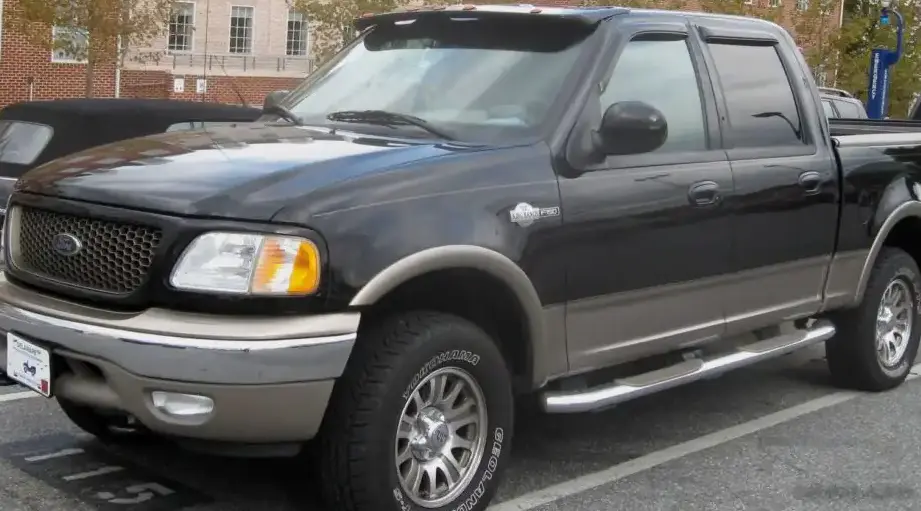
The Ford F-Series F-150 X SuperCrew, equipped with the 5.4-liter V8 Triton engine producing 260 horsepower and paired with a four-speed automatic transmission and a 4×4 drivetrain, represents a significant iteration of Ford’s long-running and immensely popular full-size pickup truck. Produced from 1999 through 2004, this variant occupied a middle ground within the F-150 lineup, offering a balance between capability, comfort, and affordability. It was part of the tenth generation of the F-Series (1997-2003), a generation that introduced the SuperCrew body style – a four-door cab configuration that dramatically increased rear passenger space and usability compared to the standard SuperCab extended cab.
Technical Specifications
| Brand | Ford |
| Model | F-Series F-150 |
| Generation | F-Series F-150 X SuperCrew |
| Type (Engine) | 5.4 V8 Triton (260 Hp) 4×4 Automatic |
| Start of production | 1999 |
| End of production | 2004 |
| Powertrain Architecture | Internal Combustion engine |
| Body type | Pick-up |
| Seats | 5-6 |
| Doors | 4 |
| Fuel Type | Petrol (Gasoline) |
| Power | 260 Hp @ 4500 rpm |
| Power per litre | 48.1 Hp/l |
| Torque | 475 Nm @ 2500 rpm / 350.34 lb.-ft. @ 2500 rpm |
| Engine layout | Front, Longitudinal |
| Engine displacement | 5408 cm3 / 330.02 cu. in. |
| Number of cylinders | 8 |
| Engine configuration | V-engine |
| Cylinder Bore | 90.17 mm / 3.55 in. |
| Piston Stroke | 105.66 mm / 4.16 in. |
| Compression ratio | 9:1 |
| Number of valves per cylinder | 2 |
| Fuel injection system | Multi-port manifold injection |
| Engine aspiration | Naturally aspirated engine |
| Valvetrain | SOHC |
| Engine oil capacity | 5.7 l / 6.02 US qt | 5.02 UK qt |
| Coolant | 22.6 l / 23.88 US qt | 19.89 UK qt |
| Max. weight | 3062 kg / 6750.55 lbs |
| Trunk (boot) space – minimum | 1252 l / 44.21 cu. ft |
| Fuel tank capacity | 95 l / 25.1 US gal | 20.9 UK gal |
| Permitted trailer load with brakes (12%) | 3447 kg / 7599.33 lbs |
| Length | 5745 mm / 226.18 in |
| Width | 2029 mm / 79.88 in |
| Height | 1953 mm / 76.89 in |
| Wheelbase | 3525 mm / 138.78 in |
| Front overhang | 983 mm / 38.7 in |
| Rear overhang | 1237 mm / 48.7 in |
| Ride height (ground clearance) | 203 mm / 7.99 in |
| Approach angle | 28.4° |
| Departure angle | 21.7° |
| Ramp-over (brakeover) angle | 18.7° |
| Wading depth | 889 mm / 35 in |
| Drivetrain Architecture | The Internal combustion engine (ICE) drives the rear wheels permanently, and the front wheels are driven through an electrically or mechanically operated clutch if necessary. |
| Drive wheel | All wheel drive (4×4) |
| Number of gears and type of gearbox | 4 gears, automatic transmission |
| Front suspension | Torsion |
| Rear suspension | Leaf spring |
| Front brakes | Ventilated discs, 308 mm |
| Rear brakes | Ventilated discs, 335 mm |
| Assisting systems | ABS (Anti-lock braking system) |
| Steering type | Cone worm with recirculation balls |
| Power steering | Electric Steering |
| Tires size | 255/70 R16 |
| Wheel rims size | 16 |
Powertrain & Engine Architecture
The heart of this F-150 variant is the 5.4-liter Triton V8 engine. This engine, part of Ford’s modular engine family, featured a single overhead camshaft (SOHC) design with two valves per cylinder. The 9:1 compression ratio and multi-port fuel injection contributed to its 260 horsepower output at 4500 rpm and 475 Nm (350.34 lb-ft) of torque at 2500 rpm. The engine’s architecture was designed for durability and relatively low-cost maintenance, although it did become known for potential spark plug issues in some model years. The four-speed automatic transmission (typically the 4R70W) was chosen for its balance of simplicity and capability. While not as refined as some newer automatic transmissions, it provided adequate performance for typical truck duties and towing. The 4×4 system utilized an electronically controlled transfer case, allowing the driver to switch between 2WD, 4WD High, and 4WD Low for varying terrain and conditions.
Driving Characteristics
The 5.4-liter V8 and four-speed automatic combination delivered a respectable, if not exhilarating, driving experience. Acceleration was adequate for everyday driving and hauling moderate loads. The automatic transmission’s gear ratios were tuned for torque multiplication, prioritizing towing and hauling capability over outright speed. Compared to the smaller 4.6-liter V8 or the manual transmission options, this variant offered more power and a smoother driving experience, particularly when carrying a load or towing a trailer. However, it wasn’t as fuel-efficient as the smaller engine, and the four-speed automatic lacked the responsiveness and efficiency of more modern transmissions. The 4×4 system provided confident traction in slippery conditions, making it a capable work truck and recreational vehicle.
Equipment & Trim Levels
The F-150 X SuperCrew with the 5.4-liter engine typically came standard with features like air conditioning, power windows and locks, an AM/FM radio, and cloth upholstery. The “X” trim level represented a step up from the base XL trim, offering additional convenience features and a slightly more refined interior. Optional extras included a CD player, upgraded sound system, power seats, a sliding rear window, and various towing packages. The SuperCrew cab provided significantly more rear passenger space than the standard cab or even the SuperCab, making it a popular choice for families and those who frequently carried passengers.
Chassis & Braking
The F-150’s chassis was a traditional body-on-frame construction, providing a robust and durable platform for heavy-duty use. The front suspension utilized torsion bars, while the rear suspension employed leaf springs. This setup prioritized load-carrying capacity and durability over ride comfort. Braking duties were handled by ventilated disc brakes on all four wheels, with ABS (Anti-lock Braking System) as standard equipment. The rear discs were slightly larger (335mm) than the front (308mm) to better manage braking forces when hauling heavy loads. Steering was accomplished via a recirculating ball steering system, which provided a solid feel but lacked the precision of more modern rack-and-pinion systems.
Market Reception & Comparison
The F-150 SuperCrew was widely praised for its spacious interior and increased practicality. The 5.4-liter V8 engine was generally well-regarded for its power and torque, although fuel economy was a common criticism. Compared to the 4.6-liter V8, the 5.4-liter offered a noticeable performance advantage, particularly when towing or hauling. However, the 5.4-liter was also more expensive to purchase and maintain. Critics noted that the four-speed automatic transmission felt dated compared to the five-speed automatics offered by some competitors. Overall, the F-150 SuperCrew with the 5.4-liter engine was considered a solid and capable truck that offered a good balance of features and performance.
Legacy
The 5.4-liter Triton V8 engine, while generally reliable, did develop a reputation for spark plug issues, particularly in earlier model years. Broken spark plugs or seized spark plug threads could require expensive repairs. However, with proper maintenance and preventative measures, these engines could provide many years of service. Today, these F-150 SuperCrews are relatively affordable on the used car market and remain popular among those seeking a capable and spacious pickup truck. Their robust construction and readily available parts make them relatively easy to maintain and repair. The introduction of the SuperCrew cab configuration was a pivotal moment in pickup truck design, and this variant represents a key step in the evolution of the modern full-size pickup.