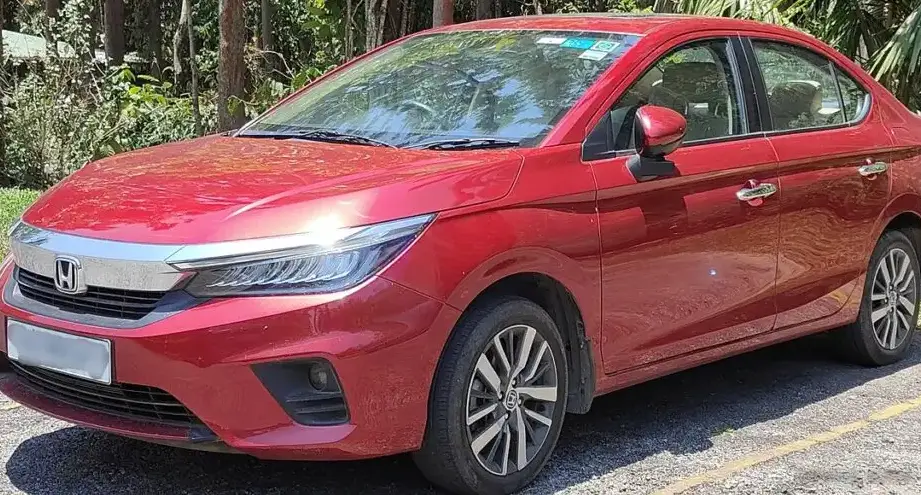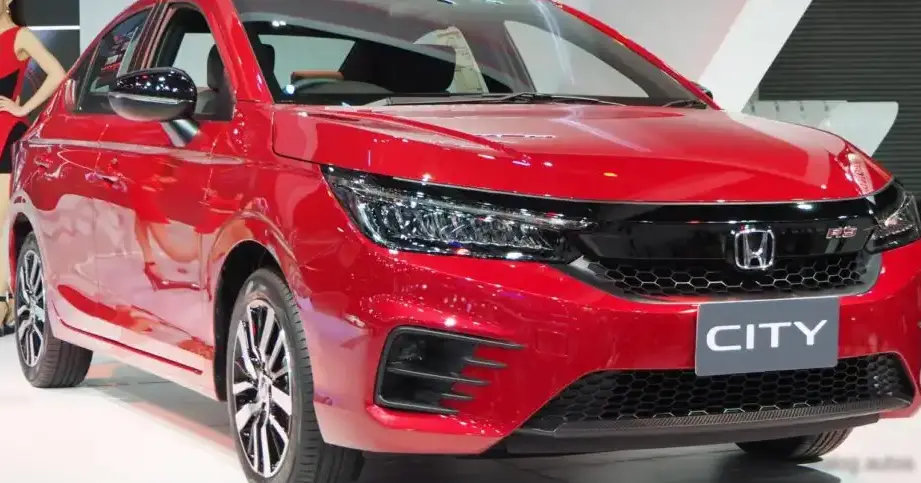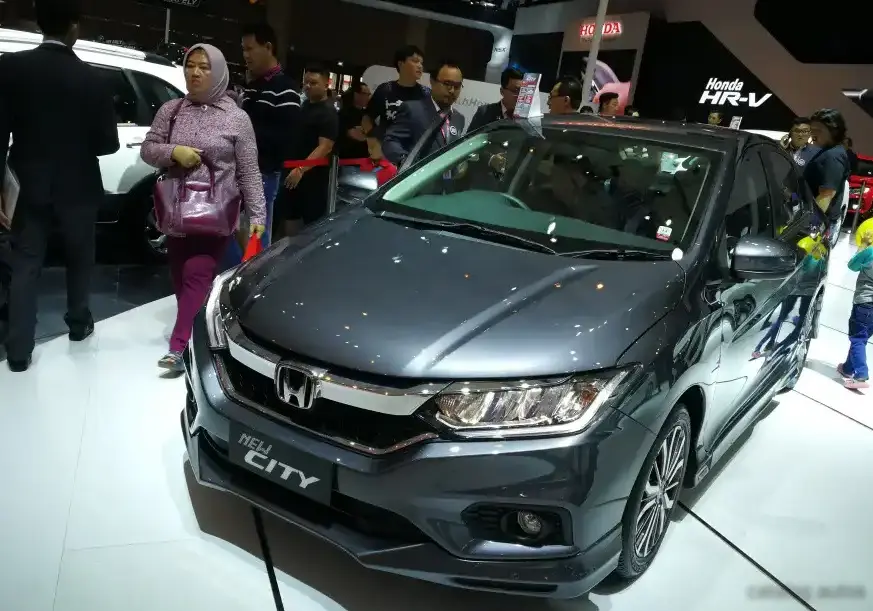
The Honda City VI (facelift, introduced in 2017) 1.5i Automatic represents a significant iteration of Honda’s globally successful compact sedan. Produced from 2017 to 2019, this variant was primarily aimed at markets in Asia, South America, and parts of Africa, where the City consistently ranked as a top-selling model. Positioned as a mid-range offering within the City VI lineup, the 1.5i Automatic provided a balance of fuel efficiency, comfort, and affordability, appealing to families and commuters. It built upon the foundation of the fifth-generation City (GM2/GM3 platform) with styling updates and refinements, continuing Honda’s reputation for reliability and practicality in the B-segment.
Technical Specifications
| Brand | Honda |
| Model | City |
| Generation | City VI (facelift 2017) |
| Type (Engine) | 1.5i (119 Hp) Automatic |
| Start of production | 2017 |
| End of production | 2019 |
| Powertrain Architecture | Internal Combustion engine |
| Body type | Sedan |
| Seats | 5 |
| Doors | 4 |
| Fuel consumption (combined) | 13.1 l/100 km (18 US mpg, 21.6 UK mpg, 7.6 km/l) |
| Fuel Type | Petrol (Gasoline) |
| Weight-to-power ratio | 9.1 kg/Hp, 110.2 Hp/tonne |
| Weight-to-torque ratio | 7.4 kg/Nm, 134.3 Nm/tonne |
| Power | 119 Hp @ 6600 rpm |
| Power per litre | 79.5 Hp/l |
| Torque | 145 Nm @ 4600 rpm (106.95 lb.-ft. @ 4600 rpm) |
| Engine layout | Front, Transverse |
| Engine displacement | 1497 cm3 (91.35 cu. in.) |
| Number of cylinders | 4 |
| Engine configuration | Inline |
| Number of valves per cylinder | 4 |
| Fuel injection system | Multi-port manifold injection |
| Engine aspiration | Naturally aspirated engine |
| Valvetrain | SOHC, i-VTEC |
| Engine oil capacity | 3.6 l (3.8 US qt | 3.17 UK qt) |
| Coolant capacity | 3.97 l (4.2 US qt | 3.49 UK qt) |
| Kerb Weight | 1080-1107 kg (2380.99 – 2440.52 lbs.) |
| Max. weight | 1455-1482 kg (3207.73 – 3267.25 lbs.) |
| Max load | 375 kg (826.73 lbs.) |
| Trunk (boot) space – minimum | 510 l (18.01 cu. ft.) |
| Fuel tank capacity | 40 l (10.57 US gal | 8.8 UK gal) |
| Length | 4440 mm (174.8 in.) |
| Width | 1695 mm (66.73 in.) |
| Height | 1495 mm (58.86 in.) |
| Wheelbase | 2600 mm (102.36 in.) |
| Front track | 1475-1490 mm (58.07 – 58.66 in.) |
| Rear (Back) track | 1465-1480 mm (57.68 – 58.27 in.) |
| Minimum turning circle | 10.6 m (34.78 ft.) |
| Drivetrain Architecture | Front wheel drive, Internal Combustion engine |
| Number of gears and type of gearbox | automatic transmission CVT |
| Front suspension | Independent type McPherson |
| Rear suspension | Torsion |
| Front brakes | Ventilated discs |
| Rear brakes | Drum |
| Assisting systems | ABS (Anti-lock braking system) |
| Steering type | Steering rack and pinion |
| Power steering | Electric Steering |
| Tires size | 175/65 R15; 185/55 R16 |
| Wheel rims size | 5.5J x 15; 6J x 16 |
Powertrain & Engine Architecture
The heart of the 2017-2019 Honda City 1.5i Automatic is the SOHC 1.5-liter inline-four cylinder engine, typically identified by engine code L15A. This engine utilizes Honda’s i-VTEC (intelligent Variable valve Timing and lift Electronic Control) system, which optimizes valve timing for improved fuel efficiency and power delivery across the rev range. The engine employs multi-point fuel injection, delivering fuel directly to the intake ports. The 119 horsepower output at 6600 rpm and 145 Nm (107 lb-ft) of torque at 4600 rpm are respectable figures for a naturally aspirated engine of this displacement. Crucially, this variant was paired exclusively with a Continuously Variable Transmission (CVT). Honda’s CVT design prioritizes smooth acceleration and fuel economy over the more direct feel of a traditional automatic transmission. The CVT simulates gear changes through varying pulley ratios, maintaining the engine within its optimal power band.
Driving Characteristics
The 1.5i Automatic City offers a comfortable and predictable driving experience. The CVT, while efficient, doesn’t provide the same level of responsiveness as a traditional automatic or manual transmission. Acceleration is linear, but can feel somewhat subdued, particularly when overtaking or climbing hills. The CVT’s programming is tuned for fuel economy, meaning the engine often operates at lower RPMs, which can sometimes result in a slight delay in response. Compared to the manual transmission versions of the City, the automatic sacrifices some performance for ease of use. The weight-to-power ratio of around 9.1 kg/hp means it isn’t a particularly quick car, but it’s adequate for everyday driving. The suspension is tuned for comfort, absorbing bumps and imperfections in the road reasonably well.
Equipment & Trim Levels
The 1.5i Automatic trim typically included standard features such as air conditioning, power windows, power door locks, and a basic audio system with USB connectivity. Safety features generally included dual front airbags, ABS (Anti-lock Braking System), and EBD (Electronic Brakeforce Distribution). Higher trim levels, available as optional upgrades, could add features like alloy wheels, a touchscreen infotainment system, a rearview camera, and keyless entry. Interior upholstery was typically cloth, with a straightforward dashboard layout focused on functionality. The overall interior design was practical and durable, reflecting the City’s target market.
Chassis & Braking
The City VI utilized a front-wheel-drive layout with an independent McPherson strut suspension in the front and a torsion beam suspension in the rear. This configuration provides a good balance of ride comfort and handling. The front brakes were ventilated discs, offering adequate stopping power, while the rear brakes were drums, a cost-saving measure common in this segment. Electric power steering provided light and easy steering feel, making it maneuverable in urban environments. Tire sizes varied depending on the trim level, with 175/65 R15 and 185/55 R16 being common options.
Market Reception & Comparison
The Honda City 1.5i Automatic was generally well-received by critics and consumers alike. It was praised for its fuel efficiency, reliability, and spacious interior. However, some reviewers noted the CVT’s lack of responsiveness and the engine’s modest power output. Compared to other trims in the City lineup, such as the 1.5-liter manual transmission version, the automatic offered greater convenience but slightly reduced performance. Against competitors like the Toyota Vios, Nissan Almera, and Hyundai Accent, the City 1.5i Automatic held its own, often being favored for its brand reputation and overall build quality. Fuel economy figures of around 18 US mpg in combined driving were typical, making it a relatively economical choice.
Legacy
The Honda City VI 1.5i Automatic has proven to be a reliable and durable vehicle. The L15A engine is known for its longevity, and the CVT, while sometimes criticized, has generally held up well over time with proper maintenance. In the used car market, these models remain popular due to their affordability and Honda’s reputation for dependability. Common maintenance issues include routine servicing of the CVT fluid and regular checks of the i-VTEC system. Overall, the 2017-2019 Honda City 1.5i Automatic represents a solid and practical choice for buyers seeking a fuel-efficient and reliable compact sedan.