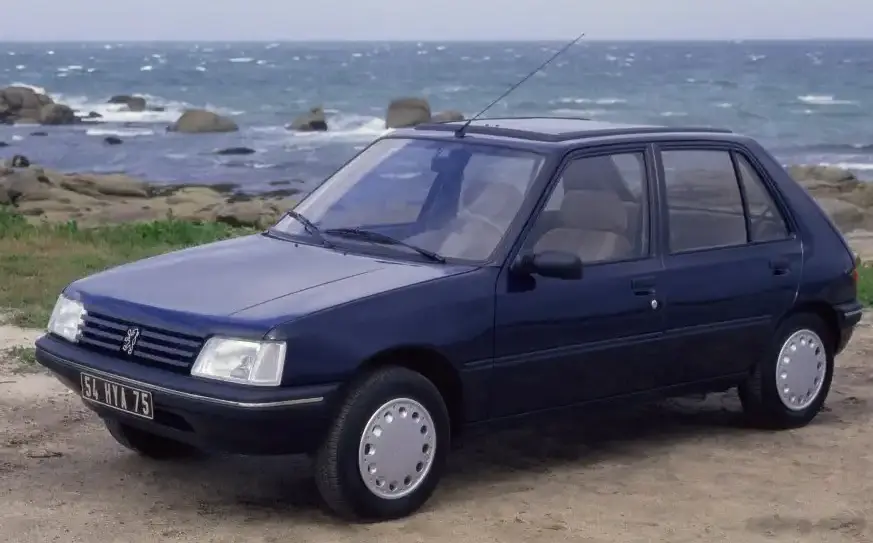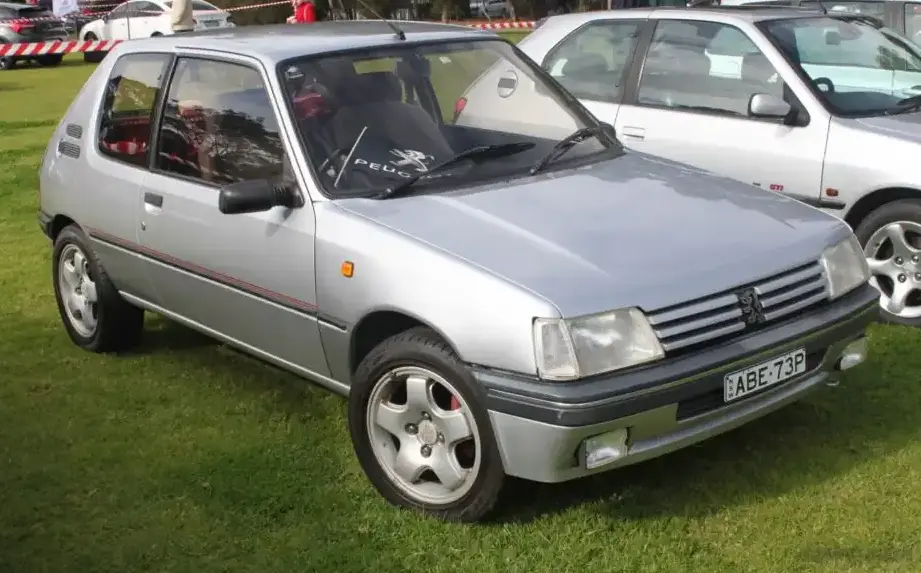
The Peugeot 205 1.6 GTI, produced from 1987 to 1989, represents a pivotal point in the iconic 205 series. This 3-door hatchback, part of the 20A/C facelift generation, was designed to deliver a more engaging driving experience than the standard 205 models. Positioned as the performance variant, it sat above the GL and XL trims, offering a significant power upgrade and sport-tuned suspension. The 1.6 GTI quickly gained a reputation as a benchmark for affordable hot hatches in Europe, celebrated for its nimble handling and responsive engine.
Technical Specifications
| Brand | Peugeot |
| Model | 205 |
| Generation | 205 I (20A/C, facelift 1987) 3-door |
| Type (Engine) | 1.6 GTI (113 Hp) |
| Start of production | 1987 |
| End of production | 1989 |
| Powertrain Architecture | Internal Combustion engine |
| Body type | Hatchback |
| Seats | 5 |
| Doors | 3 |
| Fuel consumption (urban) | 9.2 l/100 km (25.6 US mpg) |
| Fuel consumption (extra urban) | 5.9 l/100 km (39.9 US mpg) |
| Fuel consumption (combined) | 7.5 l/100 km (31.4 US mpg) |
| Fuel Type | Petrol (Gasoline) |
| Acceleration 0 – 100 km/h | 9.1 sec |
| Acceleration 0 – 62 mph | 9.1 sec |
| Acceleration 0 – 60 mph | 8.6 sec |
| Maximum speed | 196 km/h (121.79 mph) |
| Weight-to-power ratio | 7.5 kg/Hp |
| Weight-to-torque ratio | 6.5 kg/Nm |
| Power | 113 Hp @ 6250 rpm |
| Power per litre | 71.5 Hp/l |
| Torque | 131 Nm @ 4000 rpm (96.62 lb.-ft. @ 4000 rpm) |
| Engine layout | Front, Transverse |
| Engine Model/Code | XU5JA |
| Engine displacement | 1580 cm3 (96.42 cu. in.) |
| Number of cylinders | 4 |
| Engine configuration | Inline |
| Cylinder Bore | 83 mm (3.27 in.) |
| Piston Stroke | 73 mm (2.87 in.) |
| Compression ratio | 9.8:1 |
| Number of valves per cylinder | 2 |
| Fuel injection system | Multi-port manifold injection |
| Engine aspiration | Naturally aspirated engine |
| Valvetrain | OHC |
| Engine oil capacity | 4.6 l (4.86 US qt | 4.05 UK qt) |
| Coolant | 6.6 l (6.97 US qt | 5.81 UK qt) |
| Kerb Weight | 850 kg (1873.93 lbs.) |
| Max. weight | 1275 kg (2810.89 lbs.) |
| Max load | 425 kg (936.96 lbs.) |
| Trunk (boot) space – minimum | 216 l (7.63 cu. ft.) |
| Trunk (boot) space – maximum | 564 l (19.92 cu. ft.) |
| Fuel tank capacity | 50 l (13.21 US gal | 11 UK gal) |
| Length | 3705 mm (145.87 in.) |
| Width | 1570 mm (61.81 in.) |
| Height | 1355 mm (53.35 in.) |
| Wheelbase | 2420 mm (95.28 in.) |
| Front track | 1390 mm (54.72 in.) |
| Rear (Back) track | 1330 mm (52.36 in.) |
| Drivetrain Architecture | The Internal combustion engine (ICE) drives the front wheels of the vehicle. |
| Drive wheel | Front wheel drive |
| Number of gears and type of gearbox | 5 gears, manual transmission |
| Front suspension | Independent, type McPherson with coil spring and anti-roll bar |
| Rear suspension | Torsion |
| Front brakes | Disc |
| Rear brakes | Disc |
| Assisting systems | ABS (Anti-lock braking system) |
| Steering type | Steering rack and pinion |
| Tires size | 185/60 R14 |
| Wheel rims size | 14 |
Powertrain & Engine Architecture
The heart of the 205 1.6 GTI is the XU5JA engine, a 1.6-liter inline-four cylinder powerplant. This engine, part of Peugeot-Citroën’s XU series, featured a single overhead camshaft (OHC) design and multi-port fuel injection. The XU5JA was known for its robust construction and willingness to rev. The engine produced 113 horsepower at 6250 rpm and 131 Nm (96.62 lb-ft) of torque at 4000 rpm. The five-speed manual transmission, specifically designed for the GTI, featured relatively short gear ratios to maximize acceleration. This transmission was a key component in delivering the car’s sporty character. The engine’s design prioritized responsiveness over outright fuel economy, though combined fuel consumption was still a respectable 7.5 l/100 km (31.4 US mpg).
Driving Characteristics
The 205 1.6 GTI offered a distinctly engaging driving experience. Its relatively light weight (850 kg or 1873.93 lbs) combined with the 113 hp engine resulted in brisk acceleration – 0 to 60 mph in approximately 8.6 seconds and a top speed of 196 km/h (121.79 mph). The short-throw gearbox and precise steering provided excellent driver feedback. Compared to the lower-powered 1.1 and 1.4-liter versions, the GTI offered a significantly more dynamic experience. While the later 205 GTI 1.9 offered even more power, the 1.6 GTI struck a balance between performance and affordability. The torsion beam rear suspension, while simple, contributed to the car’s nimble handling, though it could become unsettled on very rough surfaces.
Equipment & Trim Levels
The 1.6 GTI came reasonably well-equipped for its time. Standard features included sports seats, a leather-wrapped steering wheel, and a more comprehensive instrument cluster than the base models. Interior trim was typically cloth upholstery, with options for upgraded materials. Optional extras included a sunroof, central locking, and upgraded audio systems. The dashboard layout was functional and driver-focused, with all essential controls within easy reach. The GTI also featured distinctive exterior styling cues, including a rear spoiler, wider wheel arches, and unique alloy wheels.
Chassis & Braking
The 205 1.6 GTI utilized an independent McPherson strut front suspension with a coil spring and anti-roll bar, providing responsive steering and good body control. The rear suspension employed a simple torsion beam setup, which was cost-effective and contributed to the car’s light weight. Braking was handled by disc brakes on all four wheels, a significant upgrade over the drum brakes found on lower-spec models. An Anti-lock Braking System (ABS) was available as an option, enhancing safety. The steering was a rack and pinion system, known for its precision and direct feel.
Market Reception & Comparison
The Peugeot 205 1.6 GTI was widely praised by automotive journalists for its handling, performance, and affordability. It was often compared favorably to rivals such as the Volkswagen Golf GTI and the Ford Escort XR3. Critics noted its nimble handling and responsive engine, but some found the interior somewhat basic. Fuel economy was considered acceptable for a performance car of its era. The 1.6 GTI offered a compelling alternative to the more expensive 1.9 GTI, appealing to buyers who wanted a sporty driving experience without the higher price tag. Reliability was generally good, although regular maintenance was essential to keep the engine running smoothly.
Legacy
The Peugeot 205 1.6 GTI remains a highly sought-after classic car today. Its combination of performance, handling, and affordability has cemented its place in automotive history. Well-maintained examples are increasingly valuable, attracting collectors and enthusiasts alike. The XU5JA engine, while now aging, is known for its durability when properly maintained. The 205 GTI, in all its forms, helped establish Peugeot as a manufacturer of engaging and fun-to-drive cars, and its influence can still be seen in Peugeot’s current lineup. The 1.6 GTI, in particular, represents a sweet spot in the 205 range, offering a rewarding driving experience without the premium price of the later 1.9 models.