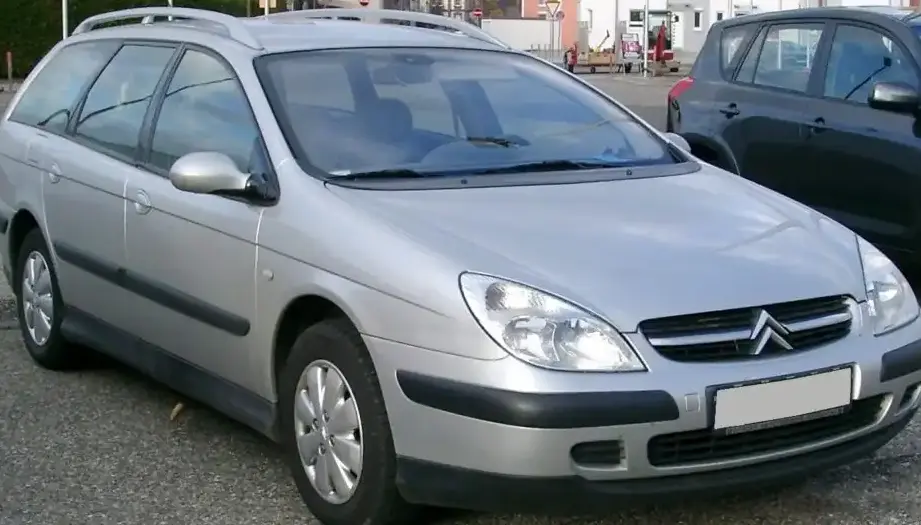
Technical Specifications
| Brand | Citroën |
| Model | C5 |
| Generation | C5 I Break (Phase I, 2000) |
| Type (Engine) | 2.0 HDi (109 Hp) FAP |
| Start of production | 2001 |
| End of production | 2004 |
| Powertrain Architecture | Internal Combustion engine |
| Body type | Station wagon (estate) |
| Seats | 5 |
| Doors | 5 |
| Fuel consumption (urban) | 8 l/100 km (29.4 US mpg, 35.3 UK mpg, 12.5 km/l) |
| Fuel consumption (extra urban) | 4.9 l/100 km (48 US mpg, 57.6 UK mpg, 20.4 km/l) |
| Fuel consumption (combined) | 6 l/100 km (39.2 US mpg, 47.1 UK mpg, 16.7 km/l) |
| CO2 emissions | 173 g/km |
| Fuel Type | Diesel |
| Acceleration 0 – 100 km/h | 13.3 sec |
| Acceleration 0 – 62 mph | 13.3 sec |
| Acceleration 0 – 60 mph | 12.6 sec |
| Maximum speed | 186 km/h (115.58 mph) |
| Emission standard | Euro 3 |
| Weight-to-power ratio | 13.3 kg/Hp, 75.1 Hp/tonne |
| Weight-to-torque ratio | 5.8 kg/Nm, 172.2 Nm/tonne |
| Power | 109 Hp @ 4000 rpm |
| Power per litre | 54.6 Hp/l |
| Torque | 250 Nm @ 1750 rpm (184.39 lb.-ft. @ 1750 rpm) |
| Engine layout | Front, Transverse |
| Engine Model/Code | RHS DW10ATED |
| Engine displacement | 1997 cm3 (121.86 cu. in.) |
| Number of cylinders | 4 |
| Engine configuration | Inline |
| Cylinder Bore | 85 mm (3.35 in.) |
| Piston Stroke | 88 mm (3.46 in.) |
| Compression ratio | 17.6:1 |
| Number of valves per cylinder | 2 |
| Fuel injection system | Diesel Commonrail |
| Engine aspiration | Turbocharger, Intercooler |
| Valvetrain | OHC |
| Engine oil capacity | 4.8 l (5.07 US qt | 4.22 UK qt) |
| Coolant | 10.7 l (11.31 US qt | 9.41 UK qt) |
| Kerb Weight | 1452 kg (3201.11 lbs.) |
| Max. weight | 2038 kg (4493.02 lbs.) |
| Max load | 586 kg (1291.91 lbs.) |
| Trunk (boot) space – minimum | 563 l (19.88 cu. ft.) |
| Trunk (boot) space – maximum | 1658 l (58.55 cu. ft.) |
| Fuel tank capacity | 68 l (17.96 US gal | 14.96 UK gal) |
| Max. roof load | 75 kg (165.35 lbs.) |
| Permitted trailer load with brakes (8%) | 1600 kg (3527.4 lbs.) |
| Permitted trailer load with brakes (12%) | 1500 kg (3306.93 lbs.) |
| Permitted trailer load without brakes | 750 kg (1653.47 lbs.) |
| Permitted towbar download | 75 kg (165.35 lbs.) |
| Length | 4760 mm (187.4 in.) |
| Width | 1770 mm (69.69 in.) |
| Width including mirrors | 2100 mm (82.68 in.) |
| Height | 1520-1560 mm (59.84 – 61.42 in.) |
| Wheelbase | 2750 mm (108.27 in.) |
| Front track | 1540 mm (60.63 in.) |
| Rear (Back) track | 1510 mm (59.45 in.) |
| Front overhang | 970 mm (38.19 in.) |
| Rear overhang | 1040 mm (40.94 in.) |
| Minimum turning circle | 12.46 m (40.88 ft.) |
| Drivetrain Architecture | Front wheel drive |
| Number of gears and type of gearbox | 5 gears, manual transmission |
| Front suspension | Independent type McPherson |
| Rear suspension | Semi-independent, coil spring |
| Front brakes | Ventilated discs |
| Rear brakes | Disc |
| Assisting systems | ABS (Anti-lock braking system) |
| Steering type | Steering rack and pinion |
| Power steering | Hydraulic Steering |
| Tires size | 195/65 R15 |
| Wheel rims size | 6.5J x 15 |
The Citroën C5 I Break, specifically the 2.0 HDi 109 hp variant produced between 2001 and 2004, was a popular choice in the mid-size station wagon segment, particularly in Europe. As part of the first generation (X3/X4) C5 range, this model aimed to deliver Citroën’s signature comfort alongside the practicality expected of a family vehicle. The “Break” designation denotes the estate (station wagon) body style, offering significantly increased cargo space compared to the sedan version. This particular engine and trim level occupied a middle ground within the C5 lineup, striking a balance between fuel efficiency, reasonable performance, and affordability. It sat below the more powerful HDi options and above the base-level petrol engines.
Powertrain & Engine Architecture
The engine powering this C5 variant is the RHS DW10ATED, a 2.0-liter inline-four cylinder diesel engine. Developed by PSA (Peugeot-Citroën), this engine was a mainstay in many of their vehicles. The ‘DW10’ signifies the engine family, while ‘ATED’ indicates the inclusion of a diesel particulate filter (DPF), or FAP as Citroën calls it. This engine utilizes a common rail direct injection system, injecting fuel at extremely high pressure for optimized combustion efficiency. A turbocharger and intercooler further enhance performance, resulting in 109 horsepower and 250 Nm (184 lb-ft) of torque. The engine features an overhead camshaft (OHC) valvetrain with two valves per cylinder. The FAP system was crucial for meeting the increasingly strict European emission regulations. The engine is mounted transversely, driving the front wheels.
Driving Characteristics
The 2.0 HDi 109 hp engine, coupled with a five-speed manual transmission, provided a comfortable and economical driving experience. Acceleration wasn’t a highlight, taking approximately 12.6 seconds to reach 60 mph. However, the engine’s torque, readily available from low RPMs (around 1750 rpm), made it well-suited for relaxed highway cruising and overtaking maneuvers. Compared to the more potent 2.2 HDi versions, this engine prioritized fuel economy over outright speed. The gear ratios were optimized for efficiency and smooth operation, minimizing engine noise. The C5’s renowned hydropneumatic suspension system contributed significantly to a comfortable ride, effectively absorbing road imperfections and providing a smooth, controlled feel.
Equipment & Trim Levels
The 2.0 HDi 109 hp model typically came with a respectable standard equipment list. This included power steering, central locking, electric front windows, and an RDS radio. Air conditioning was often offered as an optional extra. The interior featured cloth upholstery with a functional and durable design. Higher trim levels offered upgrades such as alloy wheels, rear electric windows, and a more advanced audio system. Safety features included ABS brakes and driver/passenger airbags. The dashboard layout was characteristic of Citroëns from that era, emphasizing ergonomics and ease of use.
Chassis & Braking
The C5 I Break utilized an independent McPherson strut front suspension and a semi-independent coil spring rear suspension. This configuration provided a good compromise between ride comfort and handling. The front brakes were ventilated discs, offering strong stopping power, while the rear brakes were solid discs. Hydraulic power steering provided light and precise steering feel. The C5’s hydropneumatic suspension, a signature Citroën feature, allowed for adjustable ride height and automatic self-leveling, further enhancing ride comfort and stability, particularly when the vehicle was loaded with passengers or cargo.
Market Reception & Comparison
The Citroën C5 I Break 2.0 HDi 109 hp was generally well-received by automotive critics as a practical and comfortable family car. It was praised for its fuel efficiency, spacious interior, and comfortable ride quality. Some reviewers did note its relatively modest performance compared to competitors. Compared to the more powerful HDi variants, this model offered a more affordable entry point into the C5 range, appealing to buyers who valued economy and comfort over outright performance. Its fuel economy was competitive with other diesel estate cars available at the time, and its reliability was generally considered to be good.
Legacy
The 2.0 HDi engine proved to be a durable and reliable powerplant, and many examples remain on the road today. While the FAP system may require maintenance or eventual replacement, the engine itself is generally robust. In the used car market, this variant of the C5 I Break represents a good value proposition, offering a comfortable and practical vehicle at an affordable price. Its reputation for comfort, fuel efficiency, and reliability continues to attract buyers seeking a dependable and economical estate car.