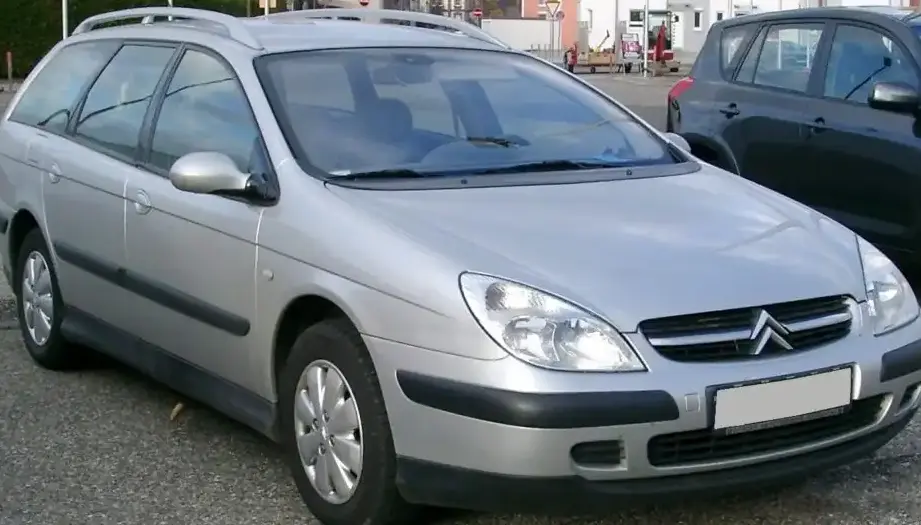
The Citroën C5 I Break 2.0 HDi Automatic, produced between 2001 and 2004, represents a significant offering within the first generation (X3/X4) of Citroën’s large family car. This variant, part of the Phase I facelift of the C5 Break (estate) model, aimed to provide a blend of comfort, practicality, and fuel efficiency for European buyers. Positioned as a mid-range option within the C5 Break lineup, it slotted between the lower-powered petrol engines and the more potent, higher-specification HDi diesels. The C5 I Break, in general, was Citroën’s attempt to recapture the spirit of the legendary Citroën estates, offering a spacious and comfortable alternative to more conventional rivals.
Technical Specifications
| Brand | Citroen |
| Model | C5 |
| Generation | C5 I Break (Phase I, 2000) |
| Type (Engine) | 2.0 HDi (110 Hp) Automatic |
| Start of production | 2001 year |
| End of production | 2004 year |
| Powertrain Architecture | Internal Combustion engine |
| Body type | Station wagon (estate) |
| Seats | 5 |
| Doors | 5 |
| Fuel consumption (economy) – urban | 9.3 l/100 km (25.3 US mpg, 30.4 UK mpg, 10.8 km/l) |
| Fuel consumption (economy) – extra urban | 5.2 l/100 km (45.2 US mpg, 54.3 UK mpg, 19.2 km/l) |
| Fuel consumption (economy) – combined | 6.7 l/100 km (35.1 US mpg, 42.2 UK mpg, 14.9 km/l) |
| CO2 emissions | 178 g/km |
| Fuel Type | Diesel |
| Acceleration 0 – 100 km/h | 15.3 sec |
| Acceleration 0 – 62 mph | 15.3 sec |
| Acceleration 0 – 60 mph | 14.5 sec |
| Maximum speed | 183 km/h (113.71 mph) |
| Emission standard | Euro 3 |
| Weight-to-power ratio | 13.3 kg/Hp, 75.1 Hp/tonne |
| Weight-to-torque ratio | 5.9 kg/Nm, 170.8 Nm/tonne |
| Power | 110 Hp @ 4000 rpm |
| Power per litre | 55.1 Hp/l |
| Torque | 250 Nm @ 1750 rpm (184.39 lb.-ft. @ 1750 rpm) |
| Engine layout | Front, Transverse |
| Engine Model/Code | RHZ DW10ATED |
| Engine displacement | 1997 cm3 (121.86 cu. in.) |
| Number of cylinders | 4 |
| Engine configuration | Inline |
| Cylinder Bore | 85 mm (3.35 in.) |
| Piston Stroke | 88 mm (3.46 in.) |
| Compression ratio | 17.6:1 |
| Number of valves per cylinder | 2 |
| Fuel injection system | Diesel Commonrail |
| Engine aspiration | Turbocharger, Intercooler |
| Valvetrain | OHC |
| Engine oil capacity | 4.5 l (4.76 US qt | 3.96 UK qt) |
| Coolant | 10.7 l (11.31 US qt | 9.41 UK qt) |
| Kerb Weight | 1464 kg (3227.57 lbs.) |
| Max. weight | 2064 kg (4550.34 lbs.) |
| Max load | 600 kg (1322.77 lbs.) |
| Trunk (boot) space – minimum | 563 l (19.88 cu. ft.) |
| Trunk (boot) space – maximum | 1658 l (58.55 cu. ft.) |
| Fuel tank capacity | 68 l (17.96 US gal | 14.96 UK gal) |
| Max. roof load | 75 kg (165.35 lbs.) |
| Permitted trailer load with brakes (8%) | 1600 kg (3527.4 lbs.) |
| Permitted trailer load with brakes (12%) | 1500 kg (3306.93 lbs.) |
| Permitted trailer load without brakes | 750 kg (1653.47 lbs.) |
| Permitted towbar download | 75 kg (165.35 lbs.) |
| Length | 4760 mm (187.4 in.) |
| Width | 1770 mm (69.69 in.) |
| Width including mirrors | 2100 mm (82.68 in.) |
| Height | 1520-1560 mm (59.84 – 61.42 in.) |
| Wheelbase | 2750 mm (108.27 in.) |
| Front track | 1540 mm (60.63 in.) |
| Rear (Back) track | 1510 mm (59.45 in.) |
| Front overhang | 970 mm (38.19 in.) |
| Rear overhang | 1040 mm (40.94 in.) |
| Minimum turning circle (turning diameter) | 12.46 m (40.88 ft.) |
| Drivetrain Architecture | The Internal combustion engine (ICE) drives the front wheels of the vehicle. |
| Drive wheel | Front wheel drive |
| Number of gears and type of gearbox | 4 gears, automatic transmission |
| Front suspension | Independent type McPherson |
| Rear suspension | Semi-independent, coil spring |
| Front brakes | Ventilated discs |
| Rear brakes | Disc |
| Assisting systems | ABS (Anti-lock braking system) |
| Steering type | Steering rack and pinion |
| Power steering | Hydraulic Steering |
| Tires size | 195/65 R15 |
| Wheel rims size | 6.5J x 15 |
INTRODUCTION
The Citroën C5 I Break 2.0 HDi Automatic, launched in 2001 as part of the Phase I refresh, was a key variant in Citroën’s strategy to offer a comfortable and practical estate car. Built on the PSA Group’s 1HX0/A3 platform, shared with the Peugeot 406 and later the Peugeot 407, the C5 aimed to blend traditional Citroën values of ride comfort with modern technology and safety features. The 2.0 HDi engine, coupled with a four-speed automatic transmission, was intended to appeal to buyers seeking a relaxed driving experience and good fuel economy for long journeys and family use. This particular configuration represented a middle ground in the C5 Break range, offering a step up in performance from the base petrol engines while remaining more affordable than the flagship 2.2 HDi models.
Powertrain & Engine Architecture
The heart of this C5 variant is the DW10ATED engine, commonly referred to as the 2.0 HDi. This engine, a four-cylinder inline diesel, utilizes a common rail direct injection system, delivering fuel at extremely high pressure for improved combustion efficiency and reduced emissions. The engine code RHZ signifies a specific calibration of the DW10ATED, optimized for the C5’s application. The engine produces 110 horsepower at 4000 rpm and 250 Nm (184 lb-ft) of torque at 1750 rpm. A turbocharger with an intercooler is employed to boost power and torque output. The valvetrain features a single overhead camshaft (OHC) design. The four-speed automatic transmission, while providing convenience, is a relatively conventional unit for its time. It lacks the sophistication of more modern automatic gearboxes, with noticeable shifts and a tendency to ‘hunt’ for gears under heavy load.
Driving Characteristics
The 2.0 HDi Automatic C5 Break delivers a comfortable, if not particularly sporty, driving experience. The engine’s torque peak at 1750 rpm provides adequate pulling power for everyday driving and overtaking maneuvers. However, the four-speed automatic transmission limits the engine’s ability to stay in its optimal power band, especially when accelerating quickly. Compared to the manual transmission versions of the 2.0 HDi, the automatic feels noticeably slower. The gear ratios are spaced to prioritize fuel economy and smooth cruising rather than outright performance. The C5’s renowned hydropneumatic suspension (depending on the specific trim level – some base models used conventional springs) contributes significantly to ride comfort, absorbing bumps and imperfections in the road surface with ease.
Equipment & Trim Levels
The C5 I Break 2.0 HDi Automatic typically came equipped with a reasonable level of standard features. These included central locking, electric front windows, power steering, and an RDS stereo. Higher trim levels, such as Exclusive, added features like automatic climate control, alloy wheels, rear parking sensors, and upgraded interior trim. Interior upholstery was typically cloth, with leather options available as an extra. The dashboard layout was functional and ergonomically designed, with a focus on ease of use. Optional extras included a sunroof, satellite navigation, and a premium sound system.
Chassis & Braking
The C5 I Break featured independent front suspension using a McPherson strut setup, providing good handling and stability. The rear suspension was typically a semi-independent torsion beam arrangement, which offered a good balance between comfort and handling. Braking duties were handled by ventilated discs on the front wheels and discs on the rear. Anti-lock Braking System (ABS) was standard, enhancing safety during emergency braking situations. The steering utilized a rack and pinion system with hydraulic power assistance, providing a light and responsive feel.
Market Reception & Comparison
The C5 I Break 2.0 HDi Automatic was generally well-received by automotive critics as a comfortable and practical family car. However, the automatic transmission was often criticized for its lack of responsiveness and tendency to detract from the engine’s performance. Compared to the 2.2 HDi models, the 2.0 HDi offered a more affordable entry point into the C5 Break range, but at the expense of outright performance. Fuel economy was a strong point, with the 2.0 HDi returning respectable figures for a car of its size and weight. Reliability was generally good, although some owners reported issues with the automatic transmission and the hydropneumatic suspension (if equipped).
Legacy
The Citroën C5 I Break 2.0 HDi Automatic has become a popular choice among used car buyers seeking a comfortable and affordable estate car. The DW10ATED engine is known for its durability and relatively low maintenance costs, although regular servicing is essential. The automatic transmission, while not the most refined, can provide years of reliable service if properly maintained. Today, these cars represent a good value proposition for those seeking a spacious and practical vehicle with a touch of French flair. The C5 Break, in general, helped to revive Citroën’s reputation for building comfortable and innovative estate cars, paving the way for future generations of the model.