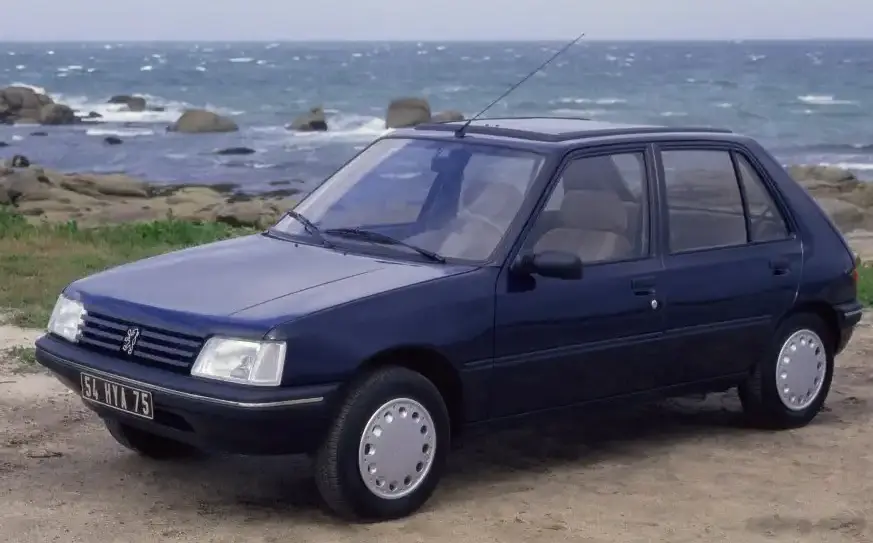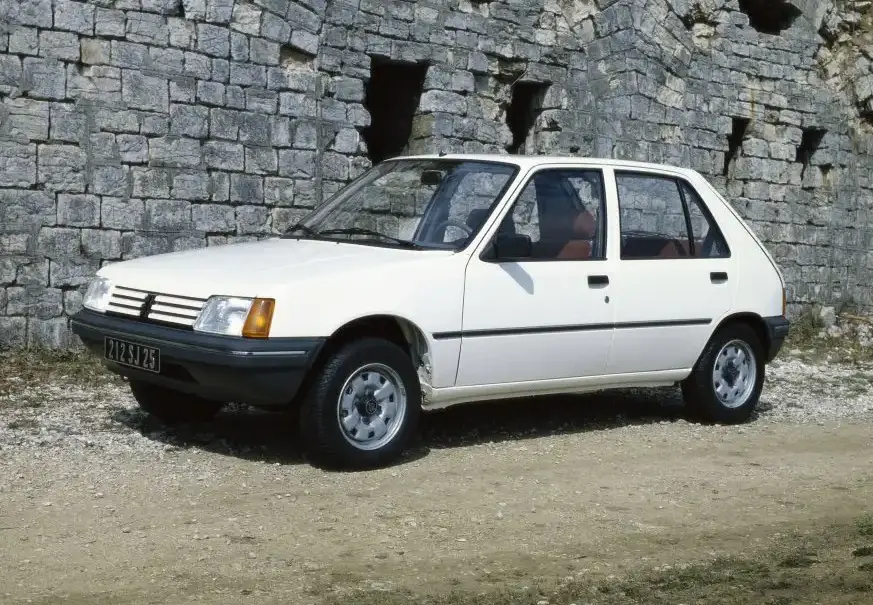
The Peugeot 205 1.0, produced between 1983 and 1987, represents the entry point into the hugely successful 205 series. Part of the 741A/C generation, this variant was designed to offer affordable and economical transportation within the European market. It served as the base model, providing a practical and reliable hatchback for budget-conscious buyers. While not known for its performance, the 1.0-liter engine and four-speed manual transmission combination offered a simple and durable package that proved popular, particularly with first-time car owners and those seeking a city runabout. This model played a crucial role in establishing the 205 as a dominant force in the supermini segment.
Technical Specifications
| Brand | Peugeot |
| Model | 205 |
| Generation | 205 I (741A/C) |
| Type (Engine) | 1.0 (45 Hp) |
| Start of production | 1983 |
| End of production | 1987 |
| Powertrain Architecture | Internal Combustion engine |
| Body type | Hatchback |
| Seats | 4 |
| Doors | 5 |
| Fuel consumption (urban) | 6.8 l/100 km (34.6 US mpg) |
| Fuel consumption (extra urban) | 5.1 l/100 km (46.1 US mpg) |
| Fuel Type | Petrol (Gasoline) |
| Acceleration 0 – 100 km/h | 18.8 sec |
| Acceleration 0 – 62 mph | 18.8 sec |
| Acceleration 0 – 60 mph | 17.9 sec |
| Maximum speed | 134 km/h (83.26 mph) |
| Weight-to-power ratio | 16.4 kg/Hp |
| Weight-to-torque ratio | 10.9 kg/Nm |
| Power | 45 Hp @ 6000 rpm |
| Power per litre | 47.2 Hp/l |
| Torque | 68 Nm @ 2750 rpm (50.15 lb.-ft. @ 2750 rpm) |
| Engine layout | Front, Transverse |
| Engine Model/Code | XV8 |
| Engine displacement | 954 cm3 (58.22 cu. in.) |
| Number of cylinders | 4 |
| Engine configuration | Inline |
| Cylinder Bore | 70 mm (2.76 in.) |
| Piston Stroke | 62 mm (2.44 in.) |
| Compression ratio | 9.3:1 |
| Number of valves per cylinder | 2 |
| Fuel injection system | Carburettor |
| Engine aspiration | Naturally aspirated engine |
| Valvetrain | OHV |
| Engine oil capacity | 5 l (5.28 US qt | 4.4 UK qt) |
| Coolant | 6 l (6.34 US qt | 5.28 UK qt) |
| Kerb Weight | 740 kg (1631.42 lbs.) |
| Max. weight | 1140 kg (2513.27 lbs.) |
| Max load | 400 kg (881.85 lbs.) |
| Trunk (boot) space – minimum | 216 l (7.63 cu. ft.) |
| Trunk (boot) space – maximum | 564 l (19.92 cu. ft.) |
| Fuel tank capacity | 40 l (10.57 US gal | 8.8 UK gal) |
| Permitted trailer load with brakes (12%) | 700 kg (1543.24 lbs.) |
| Length | 3705 mm (145.87 in.) |
| Width | 1572 mm (61.89 in.) |
| Height | 1373 mm (54.06 in.) |
| Wheelbase | 2420 mm (95.28 in.) |
| Front track | 1350 mm (53.15 in.) |
| Rear (Back) track | 1300 mm (51.18 in.) |
| Front overhang | 680 mm (26.77 in.) |
| Rear overhang | 605 mm (23.82 in.) |
| Drag coefficient (Cd) | 0.35 |
| Minimum turning circle (turning diameter) | 10.5 m (34.45 ft.) |
| Drivetrain Architecture | Front wheel drive |
| Number of gears and type of gearbox | 4 gears, manual transmission |
| Front suspension | Independent, type McPherson with coil spring and anti-roll bar |
| Rear suspension | Torsion |
| Front brakes | Disc |
| Rear brakes | Drum |
| Steering type | Steering rack and pinion |
| Tires size | 135/80 R13 |
| Wheel rims size | 13 |
Powertrain & Engine Architecture
The heart of the 205 1.0 is the XV8 engine, a 954cc inline-four cylinder unit. This engine utilized a relatively simple overhead valve (OHV) valvetrain and a single carburetor for fuel delivery. The XV8 was a robust and uncomplicated design, prioritizing reliability and fuel efficiency over outright performance. It produced 45 horsepower at 6000 rpm and 68 Nm (50.15 lb-ft) of torque at 2750 rpm. The engine’s transverse mounting and front-wheel drive configuration were typical for European small cars of the era. The four-speed manual transmission was a standard feature, chosen for its simplicity and cost-effectiveness. This transmission featured non-synchronized reverse, a common characteristic of the time.
Driving Characteristics
The 205 1.0’s driving experience was defined by its modest power output. Acceleration was slow, taking approximately 18.8 seconds to reach 62 mph (100 km/h). Top speed was around 83 mph (134 km/h). The four-speed gearbox, while durable, had relatively wide gear ratios, meaning the engine often felt strained during acceleration or when climbing hills. Compared to the more powerful 1.4 or 1.6-liter versions of the 205, or even the diesel variants, the 1.0 felt significantly underpowered. However, its light weight (around 740 kg or 1631 lbs) helped to mitigate some of the performance deficit. The steering was light and precise, making it easy to maneuver in urban environments. The suspension, while basic, provided a reasonably comfortable ride.
Equipment & Trim Levels
As the entry-level model, the 205 1.0 was sparsely equipped. Standard features typically included basic cloth upholstery, a simple dashboard layout, and manual windows and door locks. Options were limited, but could include a radio, upgraded interior trim, and occasionally, a sunroof. The interior was functional and utilitarian, prioritizing practicality over luxury. The exterior featured steel wheels, black plastic bumpers, and minimal chrome trim. The focus was on providing a basic, affordable, and reliable mode of transportation.
Chassis & Braking
The 205 1.0 utilized a McPherson strut front suspension with a coil spring and anti-roll bar, providing decent handling characteristics for a small car. The rear suspension employed a torsion beam setup, which was cost-effective and space-efficient. The braking system consisted of disc brakes on the front wheels and drum brakes on the rear. While adequate for the car’s performance, the braking system lacked the stopping power of the larger-engined models. The steering was a rack and pinion system, offering precise and responsive control.
Market Reception & Comparison
The Peugeot 205 1.0 was generally well-received as an affordable and economical city car. Critics acknowledged its practicality and reliability, but often noted its lack of performance. Compared to the 1.4 and 1.6-liter versions, the 1.0 offered significantly less power and refinement. However, it was more fuel-efficient and cheaper to purchase and insure. The 1.8 diesel offered better fuel economy and more torque, but at the cost of increased noise and vibration. The 1.0 appealed to a specific segment of the market – those prioritizing affordability and low running costs over driving excitement.
Legacy
The Peugeot 205 1.0, while not the most glamorous version of the 205, played a vital role in the model’s success. Its affordability and reliability made it a popular choice for first-time car buyers and those seeking a practical city car. The XV8 engine proved to be remarkably durable, and many examples are still on the road today. In the used car market, the 205 1.0 remains a relatively affordable classic, appealing to enthusiasts looking for a simple and charming piece of automotive history. While maintenance is generally straightforward, finding parts can sometimes be a challenge due to the car’s age. The 205 1.0 stands as a testament to Peugeot’s ability to create a well-rounded and enduring small car.