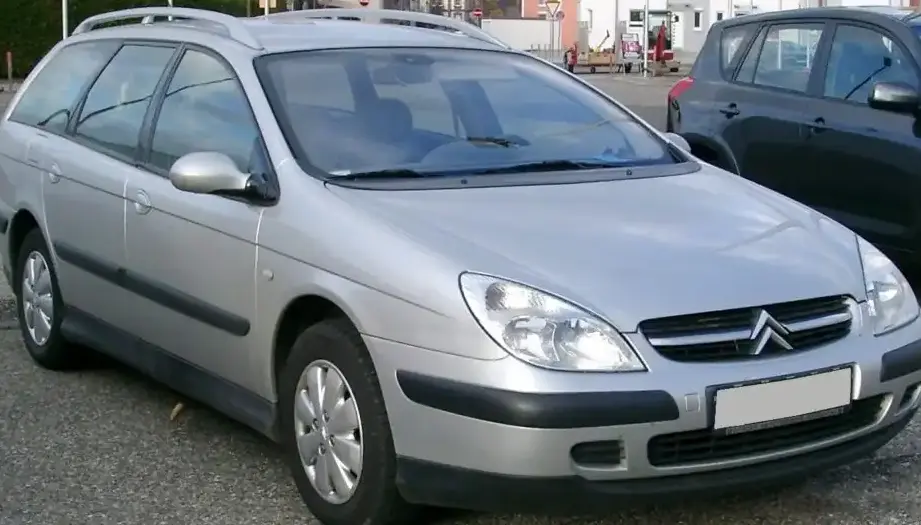
The Citroën C5 I Break 2.0 HDi 90 hp, produced between 2001 and 2004, represents a key variant within the first generation (X3/X4) of Citroën’s large family car. This model, part of the Phase I refresh of the C5 Break (estate) body style, was positioned as an economical and practical option within the range, appealing to buyers prioritizing fuel efficiency and load-carrying capacity over outright performance. It occupied the lower-mid range of the C5 lineup, slotting below the more powerful petrol and HDi diesel engines, and above the base-level trims. The C5 I Break aimed to combine Citroën’s renowned comfort with a modern, spacious interior and a focus on practicality for families.
Technical Specifications
| Brand | Citroen |
| Model | C5 |
| Generation | C5 I Break (Phase I, 2000) |
| Type (Engine) | 2.0 HDi (90 Hp) |
| Start of production | 2001 |
| End of production | 2004 |
| Powertrain Architecture | Internal Combustion engine |
| Body type | Station wagon (estate) |
| Seats | 5 |
| Doors | 5 |
| Fuel consumption (urban) | 7.7 l/100 km (30.5 US mpg, 36.7 UK mpg, 13 km/l) |
| Fuel consumption (extra urban) | 4.6 l/100 km (51.1 US mpg, 61.4 UK mpg, 21.7 km/l) |
| Fuel consumption (combined) | 5.7 l/100 km (41.3 US mpg, 49.6 UK mpg, 17.5 km/l) |
| CO2 emissions | 152 g/km |
| Fuel Type | Diesel |
| Acceleration 0 – 100 km/h | 15.8 sec |
| Acceleration 0 – 62 mph | 15.8 sec |
| Acceleration 0 – 60 mph | 15 sec |
| Maximum speed | 175 km/h (108.74 mph) |
| Emission standard | Euro 3 |
| Weight-to-power ratio | 15.8 kg/Hp, 63.2 Hp/tonne |
| Weight-to-torque ratio | 6.9 kg/Nm, 144.1 Nm/tonne |
| Power | 90 Hp @ 4000 rpm |
| Power per litre | 45.1 Hp/l |
| Torque | 205 Nm @ 1900 rpm (151.2 lb.-ft. @ 1900 rpm) |
| Engine layout | Front, Transverse |
| Engine Model/Code | RHY DW10TD |
| Engine displacement | 1997 cm3 (121.86 cu. in.) |
| Number of cylinders | 4 |
| Engine configuration | Inline |
| Cylinder Bore | 85 mm (3.35 in.) |
| Piston Stroke | 88 mm (3.46 in.) |
| Compression ratio | 17.6:1 |
| Number of valves per cylinder | 2 |
| Fuel injection system | Diesel Commonrail |
| Engine aspiration | Turbocharger, Intercooler |
| Valvetrain | OHC |
| Engine oil capacity | 4.5 l (4.76 US qt | 3.96 UK qt) |
| Coolant | 8.5 l (8.98 US qt | 7.48 UK qt) |
| Kerb Weight | 1423 kg (3137.18 lbs.) |
| Max. weight | 2023 kg (4459.95 lbs.) |
| Max load | 600 kg (1322.77 lbs.) |
| Trunk (boot) space – minimum | 563 l (19.88 cu. ft.) |
| Trunk (boot) space – maximum | 1658 l (58.55 cu. ft.) |
| Fuel tank capacity | 68 l (17.96 US gal | 14.96 UK gal) |
| Max. roof load | 75 kg (165.35 lbs.) |
| Permitted trailer load with brakes (8%) | 1500 kg (3306.93 lbs.) |
| Permitted trailer load with brakes (12%) | 1400 kg (3086.47 lbs.) |
| Permitted trailer load without brakes | 745 kg (1642.44 lbs.) |
| Permitted towbar download | 75 kg (165.35 lbs.) |
| Length | 4760 mm (187.4 in.) |
| Width | 1770 mm (69.69 in.) |
| Width including mirrors | 2100 mm (82.68 in.) |
| Height | 1520-1560 mm (59.84 – 61.42 in.) |
| Wheelbase | 2750 mm (108.27 in.) |
| Front track | 1540 mm (60.63 in.) |
| Rear (Back) track | 1510 mm (59.45 in.) |
| Front overhang | 970 mm (38.19 in.) |
| Rear overhang | 1040 mm (40.94 in.) |
| Minimum turning circle | 12.46 m (40.88 ft.) |
| Drivetrain Architecture | Front wheel drive |
| Number of gears and type of gearbox | 5 gears, manual transmission |
| Front suspension | Independent, type McPherson with coil spring and anti-roll bar |
| Rear suspension | Semi-independent, coil spring |
| Front brakes | Ventilated discs |
| Rear brakes | Disc |
| Assisting systems | ABS (Anti-lock braking system) |
| Steering type | Steering rack and pinion |
| Power steering | Hydraulic Steering |
| Tires size | 195/65 R15 |
| Wheel rims size | 6.5J x 15 |
Powertrain & Engine Architecture
The C5 I Break 2.0 HDi 90 hp utilized the DW10TD engine family, specifically the RHY variant. This 1997cc, four-cylinder diesel engine featured a cast iron block and aluminum cylinder head. It employed a turbocharger with an intercooler to boost power output, and benefited from direct injection technology via a Common Rail system. This system, a relatively new technology at the time, allowed for precise control of fuel delivery, improving efficiency and reducing emissions. The engine’s valvetrain consisted of a single overhead camshaft (OHC) operating two valves per cylinder. The RHY engine was known for its durability, but could be susceptible to turbocharger failure if not properly maintained. The five-speed manual transmission was the standard offering, chosen for its efficiency and cost-effectiveness.
Driving Characteristics
With 90 horsepower and 205 Nm (151 lb-ft) of torque, the 2.0 HDi 90 hp C5 Break wasn’t designed for spirited driving. Acceleration was modest, taking around 15.8 seconds to reach 62 mph. However, the engine’s torque delivery, peaking at 1900 rpm, provided adequate pulling power for everyday driving and comfortable cruising. The manual transmission’s gear ratios were geared towards economy, meaning the engine often needed to be worked harder on inclines or when overtaking. Compared to the more powerful HDi variants (like the 110 hp version), this model felt noticeably slower, but offered a significant fuel economy advantage. The focus was on relaxed, comfortable progress rather than outright performance.
Equipment & Trim Levels
The 2.0 HDi 90 hp C5 Break typically came equipped with a reasonable level of standard features. These included central locking, electric front windows, power steering, and an ABS anti-lock braking system. Interior upholstery was typically cloth, and the dashboard featured a functional, if somewhat understated, design. Optional extras included air conditioning, alloy wheels, a CD stereo, and rear electric windows. Higher trim levels added features like automatic headlights, rain-sensing wipers, and upgraded interior trim materials. The overall interior ambiance prioritized practicality and comfort over luxury.
Chassis & Braking
The C5 I Break featured a comfortable and compliant suspension setup. The front suspension utilized independent McPherson struts with a coil spring and anti-roll bar, while the rear employed a semi-independent torsion beam arrangement with coil springs. This setup prioritized ride quality, absorbing bumps and imperfections in the road effectively. Braking duties were handled by ventilated discs at the front and solid discs at the rear. The ABS system provided enhanced braking control, particularly in slippery conditions. The steering was hydraulic, offering a reasonable level of assistance without feeling overly light or disconnected.
Market Reception & Comparison
The Citroën C5 I Break 2.0 HDi 90 hp was generally well-received by critics as a practical and economical family car. It was praised for its comfortable ride, spacious interior, and fuel efficiency. However, its relatively modest performance was often noted. Compared to the more powerful HDi variants, it offered a lower purchase price and better fuel economy, but at the expense of acceleration and overall driving enjoyment. Against competitors like the Ford Mondeo and Volkswagen Passat, the C5 Break offered a unique blend of comfort and practicality, appealing to buyers who prioritized these qualities over sporty handling.
Legacy
The 2.0 HDi engine, in its various iterations, proved to be a durable and reliable powerplant. While the RHY variant isn’t known for any specific widespread issues, regular maintenance, particularly regarding the turbocharger and fuel system, is crucial for long-term reliability. Today, the C5 I Break 2.0 HDi 90 hp can be found as an affordable used car, offering a comfortable and practical option for those seeking a spacious estate car. Its fuel efficiency remains a strong selling point, and its relatively simple mechanicals make it a potentially appealing option for DIY mechanics. However, potential buyers should be aware of the car’s age and the potential for wear and tear on components like the suspension and braking system.