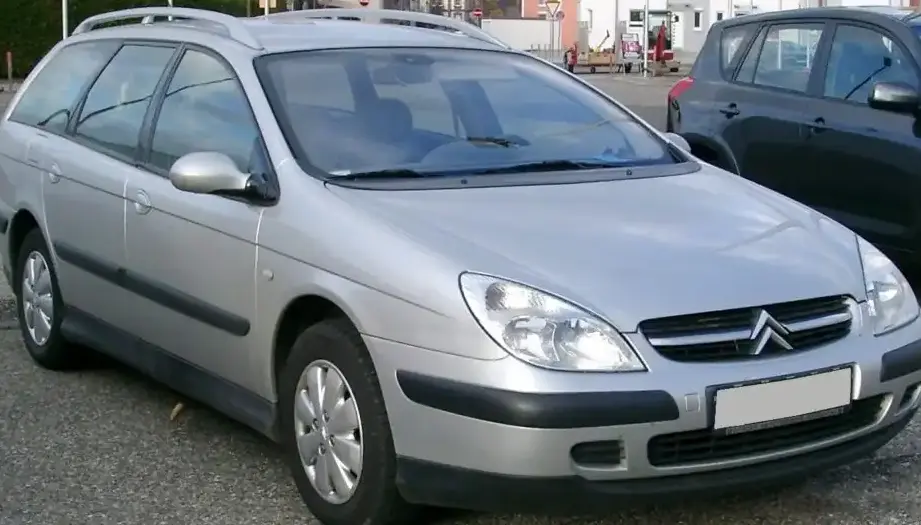
The Citroën C5 I Break 2.0i 16V, produced between 2001 and 2004, represents a significant offering within the first generation (X3/X4) of Citroën’s large family car. Positioned as a mid-range variant within the Break (estate/station wagon) body style, it aimed to provide a balance of practicality, comfort, and reasonable performance for families and those requiring substantial cargo space. This model was a key part of Citroën’s strategy to compete in the European D-segment, offering a distinctive alternative to more conventional rivals like the Ford Mondeo and Volkswagen Passat. The C5 I series, including the Break, was notable for its innovative hydropneumatic suspension system, a Citroën hallmark, although this feature varied depending on the specific trim level.
Technical Specifications
| Brand | Citroen |
| Model | C5 |
| Generation | C5 I Break (Phase I, 2000) |
| Type (Engine) | 2.0i 16V (136 Hp) |
| Start of production | 2001 |
| End of production | 2004 |
| Powertrain Architecture | Internal Combustion engine |
| Body type | Station wagon (estate) |
| Seats | 5 |
| Doors | 5 |
| Fuel consumption (urban) | 11.9 l/100 km (19.8 US mpg, 23.7 UK mpg, 8.4 km/l) |
| Fuel consumption (extra urban) | 6.4 l/100 km (36.8 US mpg, 44.1 UK mpg, 15.6 km/l) |
| Fuel consumption (combined) | 8.4 l/100 km (28 US mpg, 33.6 UK mpg, 11.9 km/l) |
| CO2 emissions | 200 g/km |
| Fuel Type | Petrol (Gasoline) |
| Acceleration 0 – 100 km/h | 11 sec |
| Acceleration 0 – 62 mph | 11 sec |
| Acceleration 0 – 60 mph | 10.5 sec |
| Maximum speed | 203 km/h (126.14 mph) |
| Weight-to-power ratio | 10.1 kg/Hp, 99.5 Hp/tonne |
| Weight-to-torque ratio | 7.2 kg/Nm, 139 Nm/tonne |
| Power | 136 Hp @ 6000 rpm |
| Power per litre | 68.1 Hp/l |
| Torque | 190 Nm @ 4100 rpm (140.14 lb.-ft. @ 4100 rpm) |
| Engine layout | Front, Transverse |
| Engine Model/Code | RFN EW10J4 |
| Engine displacement | 1997 cm3 (121.86 cu. in.) |
| Number of cylinders | 4 |
| Engine configuration | Inline |
| Cylinder Bore | 85 mm (3.35 in.) |
| Piston Stroke | 88 mm (3.46 in.) |
| Compression ratio | 10.8:1 |
| Number of valves per cylinder | 4 |
| Fuel injection system | Multi-port manifold injection |
| Engine aspiration | Naturally aspirated engine |
| Valvetrain | DOHC |
| Engine oil capacity | 4.3 l (4.54 US qt | 3.78 UK qt) |
| Coolant | 8.8 l (9.3 US qt | 7.74 UK qt) |
| Kerb Weight | 1367 kg (3013.72 lbs.) |
| Max. weight | 1967 kg (4336.49 lbs.) |
| Max load | 600 kg (1322.77 lbs.) |
| Trunk (boot) space – minimum | 563 l (19.88 cu. ft.) |
| Trunk (boot) space – maximum | 1658 l (58.55 cu. ft.) |
| Fuel tank capacity | 66 l (17.44 US gal | 14.52 UK gal) |
| Max. roof load | 75 kg (165.35 lbs.) |
| Permitted trailer load with brakes (8%) | 1600 kg (3527.4 lbs.) |
| Permitted trailer load with brakes (12%) | 1500 kg (3306.93 lbs.) |
| Permitted trailer load without brakes | 720 kg (1587.33 lbs.) |
| Permitted towbar download | 75 kg (165.35 lbs.) |
| Length | 4760 mm (187.4 in.) |
| Width | 1770 mm (69.69 in.) |
| Width including mirrors | 2100 mm (82.68 in.) |
| Height | 1520-1560 mm (59.84 – 61.42 in.) |
| Wheelbase | 2750 mm (108.27 in.) |
| Front track | 1540 mm (60.63 in.) |
| Rear (Back) track | 1510 mm (59.45 in.) |
| Front overhang | 970 mm (38.19 in.) |
| Rear overhang | 1040 mm (40.94 in.) |
| Minimum turning circle | 12.46 m (40.88 ft.) |
| Drivetrain Architecture | The Internal combustion engine (ICE) drives the front wheels of the vehicle. |
| Drive wheel | Front wheel drive |
| Number of gears and type of gearbox | 5 gears, manual transmission |
| Front suspension | Independent type McPherson |
| Rear suspension | Semi-independent, coil spring |
| Front brakes | Ventilated discs |
| Rear brakes | Disc |
| Assisting systems | ABS (Anti-lock braking system) |
| Steering type | Steering rack and pinion |
| Power steering | Hydraulic Steering |
| Tires size | 205/65 R15 |
| Wheel rims size | 6.5J x 15 |
Powertrain & Engine Architecture
The C5 I Break 2.0i 16V utilizes the RFN (or sometimes EW10J4) engine code, a 1.997-liter inline-four cylinder gasoline engine. This engine is part of the EW series developed by PSA Peugeot Citroën. It features a multi-point fuel injection system and a double overhead camshaft (DOHC) valvetrain with four valves per cylinder. This configuration allows for efficient cylinder filling and exhaust scavenging, contributing to the engine’s power output. The engine’s 136 horsepower at 6000 rpm and 190 Nm (140 lb-ft) of torque at 4100 rpm were considered adequate for comfortable cruising and everyday driving. The engine’s design prioritized refinement and fuel efficiency over outright performance. The transmission paired with this engine was typically a 5-speed manual gearbox, although a 4-speed automatic transmission was also available, impacting performance and fuel economy.
Driving Characteristics
The 2.0i 16V with the manual transmission offered a reasonably engaging driving experience. Acceleration to 60 mph took around 10.5 seconds, and top speed was approximately 126 mph. The engine provided sufficient power for overtaking maneuvers on highways, but it wasn’t particularly sporty. The automatic transmission version, while offering convenience, noticeably dulled performance, extending the 0-60 mph time to around 11 seconds. Gear ratios were tuned for fuel economy and smooth operation rather than aggressive acceleration. The C5’s suspension, even in non-hydropneumatic forms, provided a comfortable ride, absorbing bumps and imperfections in the road effectively. However, the car’s weight and relatively soft suspension setup meant it wasn’t particularly agile in corners.
Equipment & Trim Levels
The 2.0i 16V trim typically included features such as power windows, central locking, air conditioning, and an RDS radio. Higher trim levels added options like alloy wheels, a sunroof, leather upholstery, and upgraded audio systems. Safety features included ABS brakes and front airbags. The interior was generally well-appointed, with comfortable seats and a functional dashboard layout. The Break’s defining feature was its spacious interior and large cargo area, making it ideal for families and those needing to transport bulky items. The rear seats could be folded down to further increase cargo capacity.
Chassis & Braking
The C5 I Break featured an independent McPherson strut front suspension and a semi-independent coil spring rear suspension. This setup provided a good balance of ride comfort and handling. Brakes were typically ventilated discs at the front and solid discs at the rear. ABS (Anti-lock Braking System) was standard, enhancing braking performance and stability. The steering was a hydraulic power-assisted rack and pinion system, providing light and precise steering feel.
Market Reception & Comparison
The C5 I Break 2.0i 16V was generally well-received by automotive critics. It was praised for its comfortable ride, spacious interior, and practical estate car body style. However, some critics found the engine to be somewhat underpowered, particularly when paired with the automatic transmission. Compared to the more powerful 2.2i 16V or the diesel variants, the 2.0i 16V offered a more affordable entry point into the C5 range. Fuel economy was respectable, but not class-leading. Reliability was generally good, although some owners reported minor electrical issues.
Legacy
The Citroën C5 I Break 2.0i 16V remains a popular choice in the used car market, particularly for those seeking a comfortable and practical family car. The RFN engine is generally considered reliable, although regular maintenance is essential. Parts availability is good, and repair costs are relatively reasonable. While it may not offer the performance of some of its rivals, the C5 I Break 2.0i 16V provides a unique blend of comfort, practicality, and French flair that continues to appeal to many drivers today. Its enduring appeal lies in its ability to provide a relaxed and comfortable driving experience, making it a suitable choice for long journeys and everyday use.