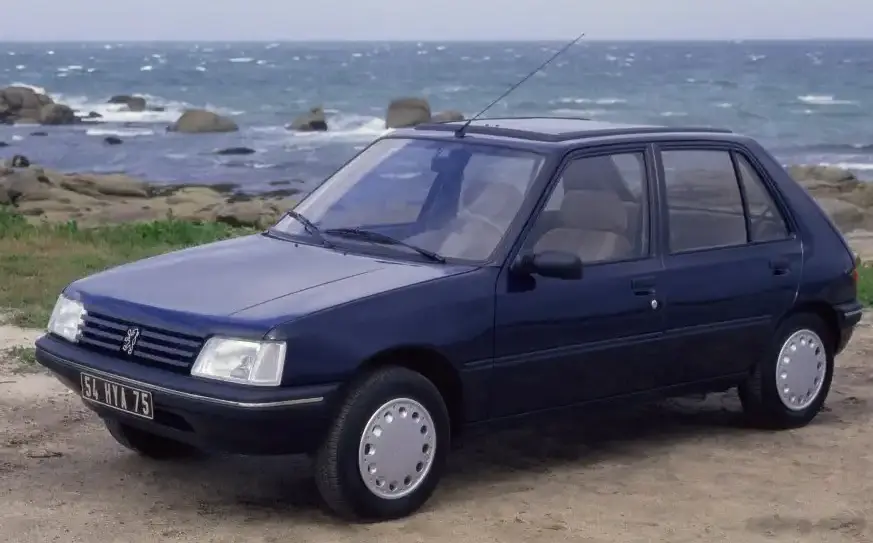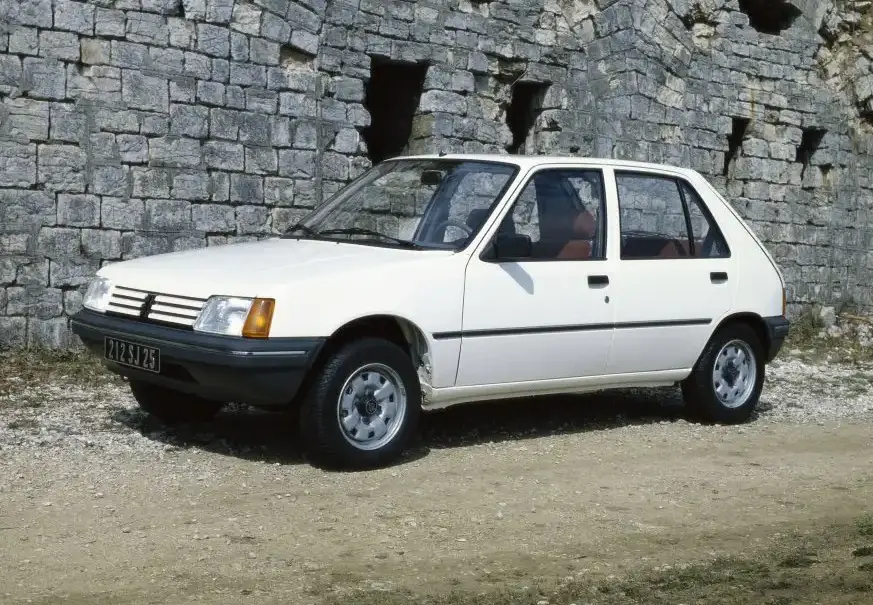
The Peugeot 205 I 1.4, produced between 1983 and 1987, represents the entry point into the hugely successful 205 series. Falling under the 741A/C chassis code designation, this variant was a cornerstone of Peugeot’s strategy to offer an affordable, practical, and stylish hatchback to the European market. It served as the base model, providing essential transportation for a broad customer base, and was positioned below the more powerful 1.6 and diesel variants. The 1.4-liter engine and manual transmission combination prioritized fuel economy and ease of driving over outright performance, making it a popular choice for first-time car buyers and urban commuters.
Technical Specifications
| Brand | Peugeot |
| Model | 205 |
| Generation | 205 I (741A/C) |
| Type (Engine) | 1.4 (60 Hp) |
| Start of production | 1983 |
| End of production | 1987 |
| Powertrain Architecture | Internal Combustion engine |
| Body type | Hatchback |
| Seats | 4 |
| Doors | 5 |
| Fuel consumption (urban) | 6.9 l/100 km (34.1 US mpg) |
| Fuel consumption (extra urban) | 4.6 l/100 km (51.1 US mpg) |
| Fuel Type | Petrol (Gasoline) |
| Acceleration 0 – 100 km/h | 14.8 sec |
| Acceleration 0 – 62 mph | 14.8 sec |
| Acceleration 0 – 60 mph | 14.1 sec |
| Maximum speed | 155 km/h (96.31 mph) |
| Weight-to-power ratio | 13.1 kg/Hp |
| Weight-to-torque ratio | 7.3 kg/Nm |
| Power | 60 Hp @ 5000 rpm |
| Power per litre | 44.1 Hp/l |
| Torque | 107 Nm @ 2500 rpm (78.92 lb.-ft. @ 2500 rpm) |
| Engine layout | Front, Transverse |
| Engine Model/Code | XY7 |
| Engine displacement | 1360 cm3 (82.99 cu. in.) |
| Number of cylinders | 4 |
| Engine configuration | Inline |
| Cylinder Bore | 75 mm (2.95 in.) |
| Piston Stroke | 77 mm (3.03 in.) |
| Compression ratio | 9.3:1 |
| Number of valves per cylinder | 2 |
| Fuel injection system | Carburettor |
| Engine aspiration | Naturally aspirated engine |
| Valvetrain | OHV |
| Engine oil capacity | 5 l (5.28 US qt | 4.4 UK qt) |
| Coolant | 5.8 l (6.13 US qt | 5.1 UK qt) |
| Kerb Weight | 785 kg (1730.63 lbs.) |
| Max. weight | 1240 kg (2733.73 lbs.) |
| Max load | 455 kg (1003.1 lbs.) |
| Trunk (boot) space – minimum | 216 l (7.63 cu. ft.) |
| Trunk (boot) space – maximum | 564 l (19.92 cu. ft.) |
| Fuel tank capacity | 50 l (13.21 US gal | 11 UK gal) |
| Permitted trailer load with brakes (12%) | 800 kg (1763.7 lbs.) |
| Length | 3705 mm (145.87 in.) |
| Width | 1572 mm (61.89 in.) |
| Height | 1373 mm (54.06 in.) |
| Wheelbase | 2420 mm (95.28 in.) |
| Front track | 1350 mm (53.15 in.) |
| Rear (Back) track | 1300 mm (51.18 in.) |
| Front overhang | 680 mm (26.77 in.) |
| Rear overhang | 605 mm (23.82 in.) |
| Drag coefficient (Cd) | 0.35 |
| Minimum turning circle (turning diameter) | 10.5 m (34.45 ft.) |
| Drivetrain Architecture | The Internal combustion engine (ICE) drives the front wheels of the vehicle. |
| Drive wheel | Front wheel drive |
| Number of gears and type of gearbox | 5 gears, manual transmission |
| Front suspension | Independent, type McPherson with coil spring and anti-roll bar |
| Rear suspension | Torsion |
| Front brakes | Disc |
| Rear brakes | Drum |
| Tires size | 165/70 R14 |
| Wheel rims size | 14 |
Powertrain & Engine Architecture
The heart of the 205 I 1.4 was the XY7 engine, a 1360cc inline-four cylinder unit. This engine utilized a relatively simple overhead valve (OHV) valvetrain and a single carburetor for fuel delivery. The carburetor system, while common for the era, was less efficient and precise than fuel injection, contributing to the engine’s modest power output. The engine’s 9.3:1 compression ratio was a compromise between performance and the fuel quality available in European markets. The engine was transversely mounted, a space-saving configuration common in front-wheel-drive vehicles. The 205 1.4 was exclusively offered with a five-speed manual transmission, providing a reasonable spread of gears for both urban driving and highway cruising. The transmission was known for its light and precise shift action, enhancing the driving experience.
Driving Characteristics
The 1.4-liter engine, producing 60 horsepower, delivered modest performance. Acceleration from 0 to 60 mph took approximately 14.1 seconds, and the top speed was around 96 mph. While not particularly quick, the 205 1.4 offered adequate power for everyday driving. The five-speed manual transmission allowed drivers to keep the engine in its optimal power band, but the lack of torque meant frequent downshifts were necessary, especially when overtaking. Compared to the more powerful 1.6-liter versions, the 1.4 felt noticeably slower, but it offered a more forgiving and economical driving experience. The gearing was optimized for fuel efficiency, resulting in a relatively relaxed cruising speed.
Equipment & Trim Levels
The 205 I 1.4 was typically equipped with basic but functional features. Standard equipment included cloth upholstery, a simple dashboard layout, and manual windows and door locks. The interior was designed with practicality in mind, offering sufficient space for four passengers and a usable trunk. Optional extras included a sunroof, upgraded upholstery, and a basic radio. The trim level was generally quite spartan, reflecting its position as the entry-level model. The focus was on providing affordable transportation rather than luxury or advanced features.
Chassis & Braking
The 205 I featured an independent McPherson strut front suspension and a torsion beam rear suspension. This setup provided a good balance between ride comfort and handling. The front brakes were disc brakes, while the rear brakes were drums. This configuration was typical for cars in this price range during the 1980s. The steering was unassisted, providing a direct and communicative feel. The relatively light weight of the 205 (approximately 785 kg or 1731 lbs) contributed to its nimble handling characteristics. Stabilizer bars were typically absent on the base 1.4 model, further emphasizing its focus on affordability.
Market Reception & Comparison
The Peugeot 205 I 1.4 was well-received in the European market as an affordable and reliable hatchback. Critics praised its fuel economy, handling, and practicality. However, the engine’s lack of power was often noted. Compared to the 1.6-liter versions, the 1.4 offered significantly lower running costs but at the expense of performance. The 1.4 was also more economical to insure, making it an attractive option for young drivers. The diesel variants offered even better fuel economy but were considerably slower. The 1.4 struck a balance between affordability and usability, making it a popular choice for a wide range of buyers.
Legacy
The Peugeot 205 I 1.4, while not the most powerful or technologically advanced version of the 205, remains a fondly remembered classic. The XY7 engine, while simple, proved to be relatively durable and reliable. Today, well-maintained examples are sought after by classic car enthusiasts. Parts availability can be a challenge, but the 205’s widespread popularity means that many components are still available. The 1.4’s simplicity makes it a relatively easy car to maintain and repair, appealing to DIY mechanics. The 205 I 1.4 represents a significant chapter in Peugeot’s history, embodying the brand’s commitment to producing affordable, practical, and stylish cars.