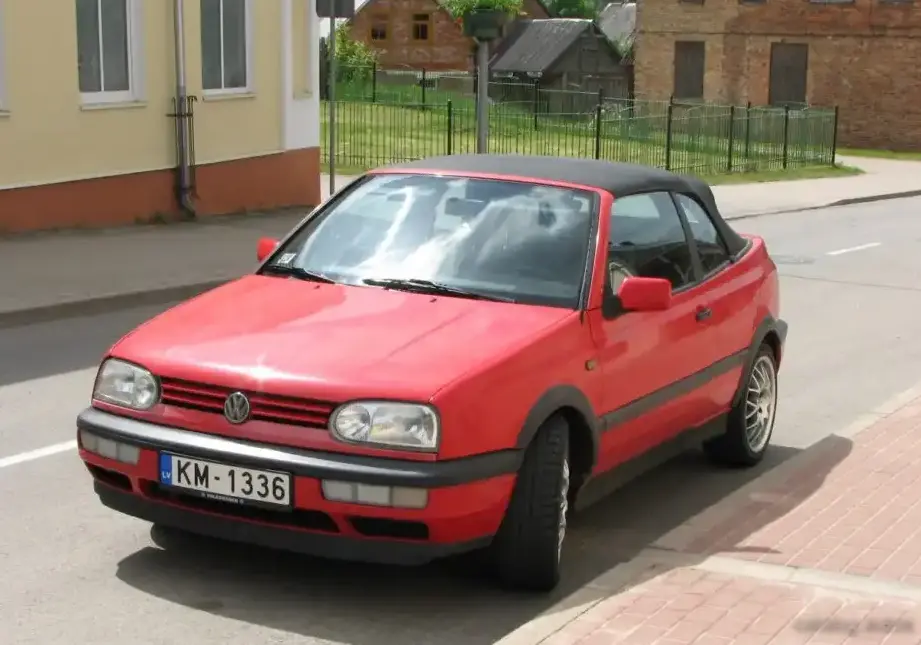
The Volkswagen Golf III Cabrio 2.0i (115 hp) was a variant of the third-generation Golf Cabriolet, produced between 1993 and 1998. Positioned as a mid-range offering within the Golf III Cabrio lineup, it provided a balance between performance and affordability. This model was primarily sold in Europe and other international markets, offering an open-air driving experience based on the popular Golf platform (1HX0/A3). It represented a continuation of the Golf Cabriolet’s success, building upon the foundation laid by its predecessors while incorporating updated styling and mechanical improvements.
Technical Specifications
| Brand | Volkswagen |
| Model | Golf |
| Generation | Golf III Cabrio |
| Type (Engine) | 2.0i (115 Hp) |
| Start of production | 1993 |
| End of production | 1998 |
| Powertrain Architecture | Internal Combustion engine |
| Body type | Cabriolet |
| Seats | 4 |
| Doors | 2 |
| Fuel consumption (combined) | 8.2 l/100 km |
| Fuel consumption (US mpg) | 28.7 US mpg |
| Fuel consumption (UK mpg) | 34.4 UK mpg |
| Fuel consumption (km/l) | 12.2 km/l |
| Fuel Type | Petrol (Gasoline) |
| Acceleration 0 – 100 km/h | 11.2 sec |
| Acceleration 0 – 62 mph | 11.2 sec |
| Acceleration 0 – 60 mph | 10.6 sec |
| Maximum speed | 190 km/h (118.06 mph) |
| Weight-to-power ratio | 11.1 kg/Hp |
| Weight-to-torque ratio | 7.4 kg/Nm |
| Power | 115 Hp @ 5400 rpm |
| Power per litre | 58 Hp/l |
| Torque | 172 Nm @ 3200 rpm (126.86 lb.-ft. @ 3200 rpm) |
| Engine layout | Front, Longitudinal |
| Engine Model/Code | 2E, ADY, AGG, AKR |
| Engine displacement | 1984 cm3 (121.07 cu. in.) |
| Number of cylinders | 4 |
| Engine configuration | Inline |
| Cylinder Bore | 82.5 mm (3.25 in.) |
| Piston Stroke | 92.8 mm (3.65 in.) |
| Compression ratio | 10.3:1 |
| Number of valves per cylinder | 2 |
| Fuel injection system | Multi-port manifold injection |
| Engine aspiration | Naturally aspirated |
| Engine oil capacity | 3.8 l (4.02 US qt | 3.34 UK qt) |
| Coolant capacity | 5.5 l (5.81 US qt | 4.84 UK qt) |
| Kerb Weight | 1280 kg (2821.92 lbs.) |
| Max. weight | 1620 kg (3571.49 lbs.) |
| Max load | 340 kg (749.57 lbs.) |
| Trunk (boot) space – minimum | 270 l (9.53 cu. ft.) |
| Trunk (boot) space – maximum | 448 l (15.82 cu. ft.) |
| Fuel tank capacity | 55 l (14.53 US gal | 12.1 UK gal) |
| Length | 4020 mm (158.27 in.) |
| Width | 1695 mm (66.73 in.) |
| Height | 1400 mm (55.12 in.) |
| Wheelbase | 2475 mm (97.44 in.) |
| Front track | 1464 mm (57.64 in.) |
| Rear track | 1428 mm (56.22 in.) |
| Drivetrain Architecture | Front wheel drive |
| Number of gears | 5 gears, manual transmission |
| Front suspension | Spring Strut |
| Rear suspension | Spring Strut |
| Front brakes | Ventilated discs |
| Rear brakes | Drum |
| Assisting systems | ABS (Anti-lock braking system) |
| Steering type | Steering rack and pinion |
| Power steering | Hydraulic Steering |
| Tires size | 185/60 R14 H |
| Wheel rims size | 14 |
INTRODUCTION
The Volkswagen Golf III Cabrio 2.0i (115 hp) represented a significant update to the Golf Cabriolet range. Introduced in 1993, it was based on the Golf Mk3 platform, sharing its mechanical components and styling cues with the hatchback and estate versions. However, the Cabriolet retained its unique identity with a manually operated soft top. This 2.0-liter variant aimed to provide a more spirited driving experience than the base 1.8-liter models, appealing to drivers who desired a blend of open-top fun and reasonable performance. Production continued until 1998, with minor revisions throughout its lifespan.
Powertrain & Engine Architecture
The heart of the Golf III Cabrio 2.0i was the 1984cc inline-four cylinder engine, available with several engine codes including 2E, ADY, AGG, and AKR depending on the year and market. This engine featured a cast iron block and an aluminum cylinder head, employing a multi-port fuel injection system for precise fuel delivery. The engine utilized a two-valve per cylinder configuration, operated by a single overhead camshaft. The 2.0-liter engine produced 115 horsepower at 5400 rpm and 172 Nm (126.86 lb-ft) of torque at 3200 rpm. The engine was typically paired with a five-speed manual transmission, although a four-speed automatic transmission was also offered, albeit less common. The automatic transmission, while offering convenience, did impact acceleration and fuel economy compared to the manual version.
Driving Characteristics
The 2.0i variant offered a noticeable improvement in performance over the base 1.8-liter Golf III Cabrio. While not a sports car, the 115 hp engine provided adequate power for comfortable cruising and overtaking maneuvers. Acceleration from 0 to 60 mph took around 10.6 seconds, and the car had a top speed of approximately 118 mph. The five-speed manual transmission allowed drivers to make the most of the engine’s powerband, while the optional automatic transmission provided a smoother, more relaxed driving experience. However, the automatic reduced responsiveness and increased fuel consumption. The Cabriolet’s handling was typical of front-wheel-drive cars of the era – safe and predictable, but not particularly engaging. The soft top did introduce some body flex, particularly on uneven surfaces.
Equipment & Trim Levels
The Golf III Cabrio 2.0i typically came equipped with features such as power steering, central locking, and electric front windows. Interior upholstery was usually cloth, with options for upgraded materials like leatherette. Trim levels varied depending on the market, but generally included features like alloy wheels, a sunroof (in addition to the soft top), and a more sophisticated audio system. Optional extras included air conditioning, heated front seats, and upgraded interior trim. The dashboard layout was similar to that of the Golf Mk3 hatchback, with a clear and functional design. Safety features included ABS brakes as standard equipment.
Chassis & Braking
The Golf III Cabrio 2.0i utilized a MacPherson strut front suspension and a twist-beam rear suspension. The front brakes were ventilated discs, providing good stopping power, while the rear brakes were typically drum brakes, a cost-saving measure for this weight class. The suspension was tuned for comfort, providing a relatively smooth ride, although it could feel somewhat soft in corners. Stabilizer bars were fitted to both the front and rear axles to reduce body roll. The steering was a rack-and-pinion system with hydraulic power assistance, offering light and precise steering feel.
Market Reception & Comparison
The Golf III Cabrio 2.0i was generally well-received by automotive critics. It was praised for its comfortable ride, practical interior, and relatively affordable price. Compared to the base 1.8-liter models, the 2.0i offered a noticeable performance boost, making it a more enjoyable car to drive. However, it was often criticized for its somewhat bland styling and lack of sporting pretensions. Compared to the more powerful VR6 Cabriolet, the 2.0i offered better fuel economy and lower maintenance costs, making it a more sensible choice for many buyers. The 1.9 TDI diesel Cabriolet provided even better fuel economy, but at the expense of performance.
Legacy
The Golf III Cabrio 2.0i remains a popular choice among classic car enthusiasts and used car buyers. The 2.0-liter engine is known for its reliability and relatively simple maintenance requirements. Parts availability is generally good, thanks to the Golf’s widespread popularity. However, like all older cars, the Golf III Cabrio is susceptible to rust, particularly in areas exposed to harsh weather conditions. The soft top can also require periodic replacement. Today, well-maintained examples of the 2.0i Cabriolet are sought after by collectors and drivers who appreciate its classic styling and open-air driving experience. The combination of a reliable engine, practical design, and affordable price has ensured its enduring appeal.