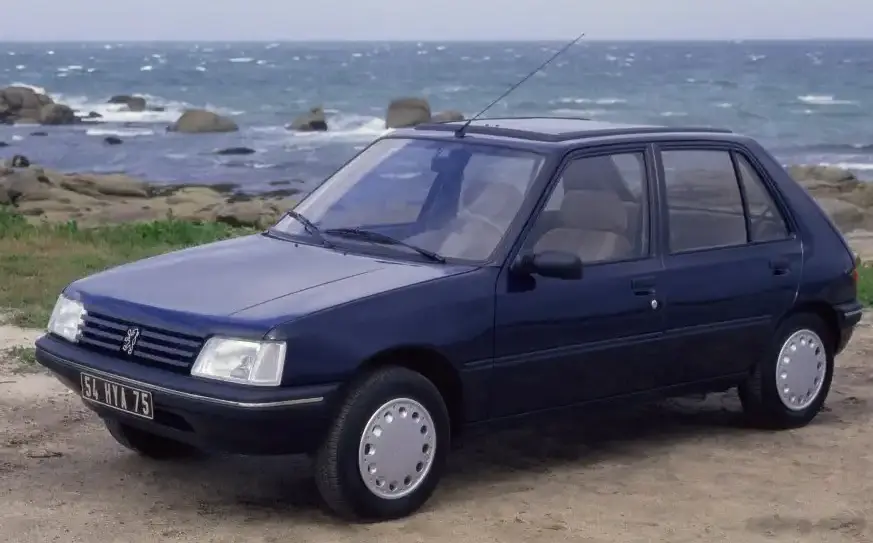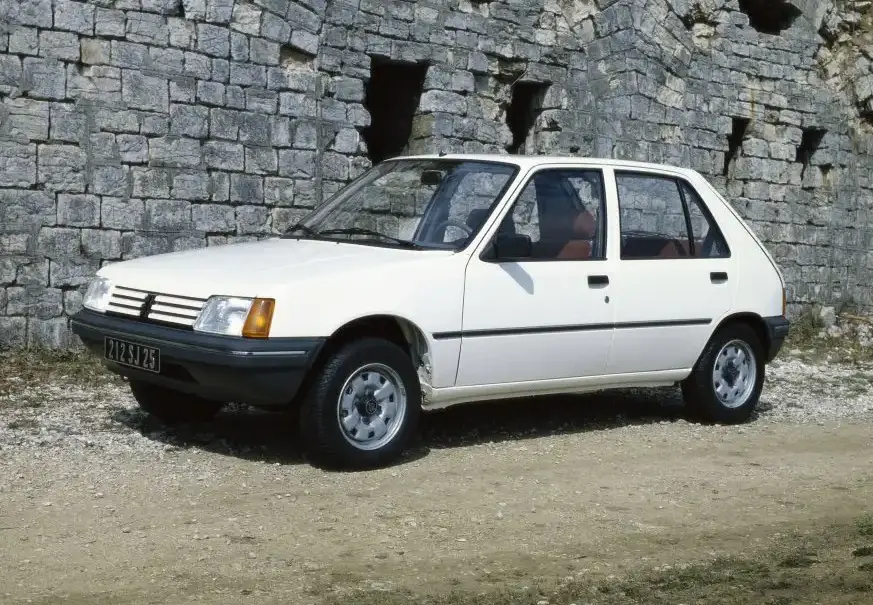
The Peugeot 205 1.6 Automatic, produced between 1983 and 1987, represents a significant entry point into the highly successful 205 series. Part of the 741A/C generation, this variant offered a blend of practicality and affordability, aimed at buyers seeking a comfortable and easy-to-drive hatchback. While not the sportiest iteration of the 205, the 1.6 Automatic carved out a niche for itself as a reliable and accessible family car within the European market. It sat below the more powerful 1.9 GTI and diesel variants in the Peugeot lineup, targeting a broader audience prioritizing convenience over outright performance.
Technical Specifications
| Brand | Peugeot |
| Model | 205 |
| Generation | 205 I (741A/C) |
| Type (Engine) | 1.6 (80 Hp) Automatic |
| Start of production | 1983 |
| End of production | 1987 |
| Powertrain Architecture | Internal Combustion engine |
| Body type | Hatchback |
| Seats | 4 |
| Doors | 5 |
| Fuel consumption (urban) | 8.5 l/100 km (27.7 US mpg) |
| Fuel consumption (extra urban) | 5.6 l/100 km (42 US mpg) |
| Fuel Type | Petrol (Gasoline) |
| Acceleration 0 – 100 km/h | 13.6 sec |
| Acceleration 0 – 62 mph | 13.6 sec |
| Acceleration 0 – 60 mph | 12.9 sec |
| Maximum speed | 166 km/h (103.15 mph) |
| Weight-to-power ratio | 10.4 kg/Hp |
| Weight-to-torque ratio | 6.4 kg/Nm |
| Power | 80 Hp @ 5600 rpm |
| Torque | 130 Nm @ 2800 rpm (95.88 lb.-ft. @ 2800 rpm) |
| Engine layout | Front, Transverse |
| Engine Model/Code | XU51C |
| Engine displacement | 1580 cm3 (96.42 cu. in.) |
| Number of cylinders | 4 |
| Engine configuration | Inline |
| Cylinder Bore | 83 mm (3.27 in.) |
| Piston Stroke | 73 mm (2.87 in.) |
| Compression ratio | 9.4:1 |
| Number of valves per cylinder | 2 |
| Fuel injection system | Carburettor |
| Engine aspiration | Naturally aspirated |
| Valvetrain | OHC |
| Engine oil capacity | 5 l (5.28 US qt | 4.4 UK qt) |
| Coolant capacity | 6.7 l (7.08 US qt | 5.9 UK qt) |
| Kerb Weight | 832 kg (1834.25 lbs.) |
| Max. weight | 1300 kg (2866.01 lbs.) |
| Max load | 468 kg (1031.76 lbs.) |
| Trunk (boot) space – minimum | 216 l (7.63 cu. ft.) |
| Trunk (boot) space – maximum | 564 l (19.92 cu. ft.) |
| Fuel tank capacity | 50 l (13.21 US gal | 11 UK gal) |
| Permitted trailer load with brakes (12%) | 800 kg (1763.7 lbs.) |
| Length | 3705 mm (145.87 in.) |
| Width | 1572 mm (61.89 in.) |
| Height | 1373 mm (54.06 in.) |
| Wheelbase | 2420 mm (95.28 in.) |
| Front track | 1350 mm (53.15 in.) |
| Rear track | 1300 mm (51.18 in.) |
| Front overhang | 680 mm (26.77 in.) |
| Rear overhang | 605 mm (23.82 in.) |
| Drag coefficient (Cd) | 0.35 |
| Minimum turning circle | 10.5 m (34.45 ft.) |
| Drivetrain | Front wheel drive |
| Number of gears | 4 |
| Gearbox type | Automatic transmission |
| Front suspension | Independent, McPherson with coil spring and anti-roll bar |
| Rear suspension | Torsion |
| Front brakes | Disc |
| Rear brakes | Drum |
| Tires size | 165/70 R13 |
| Wheel rims size | 13 |
Powertrain & Engine Architecture
The heart of the 205 1.6 Automatic is the XU51C engine, a 1.6-liter inline-four cylinder petrol engine. This engine, a mainstay in many Peugeot and Citroën vehicles of the era, is characterized by its relatively simple design and robust construction. The XU51C utilizes a single overhead camshaft (OHC) valvetrain with two valves per cylinder. Fuel delivery is managed by a carburetor, a common feature for vehicles of this period, rather than fuel injection. This carburetor setup, while less precise than modern fuel injection systems, contributed to the engine’s simplicity and ease of maintenance. The engine produces 80 horsepower at 5600 rpm and 130 Nm (95.88 lb-ft) of torque at 2800 rpm. The automatic transmission is a three-speed unit, designed to provide smooth and convenient gear changes. It’s a hydraulic automatic, lacking the electronic controls found in later transmissions.
Driving Characteristics
The 1.6 Automatic offers a distinctly different driving experience compared to the manual transmission or higher-powered 205 variants. Acceleration is modest, taking approximately 13.6 seconds to reach 62 mph (100 km/h). The automatic transmission, while providing ease of use, does sap some of the engine’s power, resulting in a less responsive feel. Gear ratios are optimized for fuel efficiency and comfortable cruising rather than spirited driving. The automatic transmission’s shift points are relatively conservative, prioritizing smoothness over maximizing performance. Compared to the five-speed manual, the automatic feels noticeably slower, particularly during overtaking maneuvers. However, for everyday commuting and urban driving, the convenience of the automatic outweighs the performance deficit for many drivers.
Equipment & Trim Levels
The 1.6 Automatic trim level typically included features such as cloth upholstery, a basic instrument cluster, and manual windows. Power steering was often an optional extra, as was a sunroof. Interior plastics were durable but utilitarian, reflecting the car’s affordable positioning. The dashboard layout is straightforward and functional, with clearly labeled controls. Higher-spec versions might have included upgraded seat fabrics, a more comprehensive instrument panel, and additional convenience features like a rear wiper. The focus was on providing a comfortable and practical interior rather than luxury.
Chassis & Braking
The 205 1.6 Automatic utilizes a McPherson strut front suspension with a coil spring and anti-roll bar, providing a reasonable balance of ride comfort and handling. The rear suspension employs a torsion beam setup, which is simple and effective for everyday driving. Braking is handled by disc brakes at the front and drum brakes at the rear. While adequate for the car’s performance, the drum brakes on the rear wheels are less effective than disc brakes, particularly under heavy braking. The 165/70 R13 tires provide reasonable grip, but are not designed for high-performance driving.
Market Reception & Comparison
The Peugeot 205 1.6 Automatic was generally well-received as a practical and affordable family car. Critics praised its comfortable ride, ease of driving, and fuel efficiency. However, the automatic transmission was often criticized for its sluggish performance compared to the manual gearbox. Compared to the 1.9 GTI, the 1.6 Automatic offered significantly less performance but at a lower price point. The 1.9 diesel variant provided better fuel economy but lacked the refinement of the petrol engine. The 1.6 Automatic appealed to buyers who prioritized convenience and affordability over sporty handling and outright speed.
Legacy
The Peugeot 205 1.6 Automatic, while not the most iconic version of the 205, remains a popular choice among classic car enthusiasts and collectors. The XU51C engine is known for its reliability and durability, and parts availability is generally good. The automatic transmission, while not as sought after as the manual, is relatively straightforward to maintain. Today, well-maintained examples of the 205 1.6 Automatic can be found in the used car market, offering a nostalgic and affordable driving experience. Its simplicity and robust construction contribute to its enduring appeal, making it a charming and practical classic for those seeking a taste of 1980s French motoring.