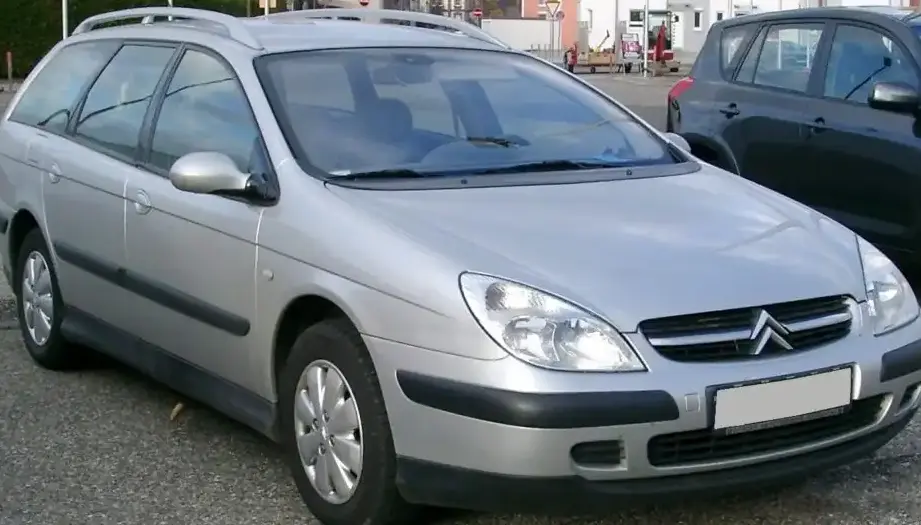
The Citroën C5 I Break, specifically the 3.0i V6 variant produced between 2001 and 2004, represents a compelling blend of comfort, performance, and practicality within the large family car segment. Part of the first generation (X4/X5) C5 range, the Break – Citroën’s designation for a station wagon – offered increased cargo capacity compared to the sedan, making it a popular choice for families and those requiring substantial load-lugging ability. This particular version, equipped with the naturally aspirated 3.0-liter V6 engine and a four-speed automatic transmission, occupied a premium position in the C5 lineup, offering a significant step up in performance from the four-cylinder options.
Technical Specifications
| Brand | Citroën |
| Model | C5 |
| Generation | C5 I Break (Phase I, 2000) |
| Type (Engine) | 3.0i V6 (207 Hp) Automatic |
| Start of production | 2001 |
| End of production | 2004 |
| Powertrain Architecture | Internal Combustion engine |
| Body type | Station wagon (estate) |
| Seats | 5 |
| Doors | 5 |
| Fuel consumption (urban) | 14.8 l/100 km (15.9 US mpg, 19.1 UK mpg, 6.8 km/l) |
| Fuel consumption (extra urban) | 7.7 l/100 km (30.5 US mpg, 36.7 UK mpg, 13 km/l) |
| Fuel consumption (combined) | 10.4 l/100 km (22.6 US mpg, 27.2 UK mpg, 9.6 km/l) |
| CO2 emissions | 245 g/km |
| Fuel Type | Petrol (Gasoline) |
| Acceleration 0 – 100 km/h | 10.6 sec |
| Acceleration 0 – 62 mph | 10.6 sec |
| Acceleration 0 – 60 mph | 10.1 sec |
| Maximum speed | 226 km/h (140.43 mph) |
| Emission standard | Euro 3 |
| Weight-to-power ratio | 7.5 kg/Hp, 133.8 Hp/tonne |
| Weight-to-torque ratio | 5.4 kg/Nm, 184.2 Nm/tonne |
| Power | 207 Hp @ 6000 rpm |
| Power per litre | 70.3 Hp/l |
| Torque | 285 Nm @ 3750 rpm (210.21 lb.-ft. @ 3750 rpm) |
| Engine layout | Front, Transverse |
| Engine Model/Code | XFX ES9J4S |
| Engine displacement | 2946 cm3 (179.78 cu. in.) |
| Number of cylinders | 6 |
| Engine configuration | V-engine |
| Cylinder Bore | 87 mm (3.43 in.) |
| Piston Stroke | 82.6 mm (3.25 in.) |
| Compression ratio | 10.9:1 |
| Number of valves per cylinder | 4 |
| Fuel injection system | Multi-port manifold injection |
| Engine aspiration | Naturally aspirated engine |
| Valvetrain | DOHC |
| Engine oil capacity | 5.3 l (5.6 US qt | 4.66 UK qt) |
| Coolant | 14 l (14.79 US qt | 12.32 UK qt) |
| Kerb Weight | 1547 kg (3410.55 lbs.) |
| Max. weight | 2160 kg (4761.98 lbs.) |
| Max load | 613 kg (1351.43 lbs.) |
| Trunk (boot) space – minimum | 563 l (19.88 cu. ft.) |
| Trunk (boot) space – maximum | 1658 l (58.55 cu. ft.) |
| Fuel tank capacity | 66 l (17.44 US gal | 14.52 UK gal) |
| Max. roof load | 75 kg (165.35 lbs.) |
| Permitted trailer load with brakes (8%) | 1600 kg (3527.4 lbs.) |
| Permitted trailer load with brakes (12%) | 1300 kg (2866.01 lbs.) |
| Permitted trailer load without brakes | 750 kg (1653.47 lbs.) |
| Permitted towbar download | 75 kg (165.35 lbs.) |
| Length | 4760 mm (187.4 in.) |
| Width | 1770 mm (69.69 in.) |
| Width including mirrors | 2100 mm (82.68 in.) |
| Height | 1520-1560 mm (59.84 – 61.42 in.) |
| Wheelbase | 2750 mm (108.27 in.) |
| Front track | 1540 mm (60.63 in.) |
| Rear (Back) track | 1510 mm (59.45 in.) |
| Front overhang | 970 mm (38.19 in.) |
| Rear overhang | 1040 mm (40.94 in.) |
| Minimum turning circle | 12.46 m (40.88 ft.) |
| Drivetrain Architecture | The Internal combustion engine (ICE) drives the front wheels. |
| Drive wheel | Front wheel drive |
| Number of gears and type of gearbox | 4 gears, automatic transmission |
| Front suspension | Independent type McPherson |
| Rear suspension | Semi-independent, coil spring |
| Front brakes | Ventilated discs |
| Rear brakes | Disc |
| Assisting systems | ABS (Anti-lock braking system) |
| Steering type | Steering rack and pinion |
| Power steering | Hydraulic Steering |
| Tires size | 215/55 R16 |
| Wheel rims size | 6.5J x 16 |
Powertrain & Engine Architecture
The heart of this C5 Break is the XFX ES9J4S 3.0-liter V6 engine. This engine, a naturally aspirated 60-degree V6, utilizes a multi-port fuel injection system and a double overhead camshaft (DOHC) valvetrain. The engine’s design prioritized smooth power delivery and refinement over outright performance. The 10.9:1 compression ratio contributed to its respectable power output. Paired with this engine is a four-speed automatic transmission. While not as sophisticated as modern automatic gearboxes, it was designed to provide comfortable and relatively smooth shifts, complementing the engine’s character. The transmission’s gear ratios were tuned for relaxed cruising and adequate acceleration, rather than sporty responsiveness.
Driving Characteristics
The 3.0i V6 automatic C5 Break offered a distinctly different driving experience compared to the lower-powered, typically manual transmission, versions. The V6 provided ample torque, making overtaking and highway cruising effortless. The automatic transmission, while lacking the engagement of a manual, contributed to a relaxed driving style. Acceleration to 60 mph took around 10.1 seconds, which was competitive for the time but not particularly brisk by modern standards. The C5’s renowned hydropneumatic suspension, even in its base form, provided a remarkably comfortable ride, absorbing bumps and imperfections in the road with ease. However, the added weight of the V6 engine and automatic transmission did slightly impact handling agility compared to lighter C5 models.
Equipment & Trim Levels
The 3.0i V6 automatic typically came with a generous level of standard equipment. This included air conditioning, power windows and mirrors, central locking, and an RDS stereo system. Higher trim levels, often denoted by options packages, added features such as leather upholstery, automatic headlights and wipers, and a sunroof. Interior appointments were generally comfortable and well-built, reflecting Citroën’s focus on passenger well-being. The dashboard layout was functional and ergonomically designed, although the abundance of controls could initially appear daunting.
Chassis & Braking
The C5 Break’s chassis featured independent front suspension using McPherson struts, and a semi-independent rear suspension with coil springs. This setup prioritized ride comfort and stability. Braking duties were handled by ventilated discs at the front and solid discs at the rear. Anti-lock Braking System (ABS) was standard, enhancing safety during emergency braking situations. The steering utilized a hydraulic power steering system, providing light and easy steering feel.
Market Reception & Comparison
The 3.0i V6 automatic C5 Break was generally well-received by automotive critics. It was praised for its comfortable ride, refined engine, and spacious interior. However, fuel economy was often cited as a drawback, with the V6 engine consuming significantly more fuel than the four-cylinder alternatives. Compared to the 2.0L or 1.8L models, the V6 offered a substantial performance upgrade but came at a higher price point and with increased running costs. The V6 was also positioned as a more luxurious alternative to the diesel-powered C5s, appealing to buyers who prioritized refinement over fuel efficiency.
Legacy
The XFX ES9J4S V6 engine, while not without its quirks, proved to be a relatively reliable unit when properly maintained. Common issues included occasional oil leaks and sensor failures, but these were generally not catastrophic. Today, the 3.0i V6 C5 Break represents a comfortable and distinctive classic car. Parts availability can be a challenge, but a dedicated community of Citroën enthusiasts exists to provide support and assistance. The car’s unique blend of French engineering, comfort, and performance continues to appeal to those seeking an alternative to more mainstream large family cars.