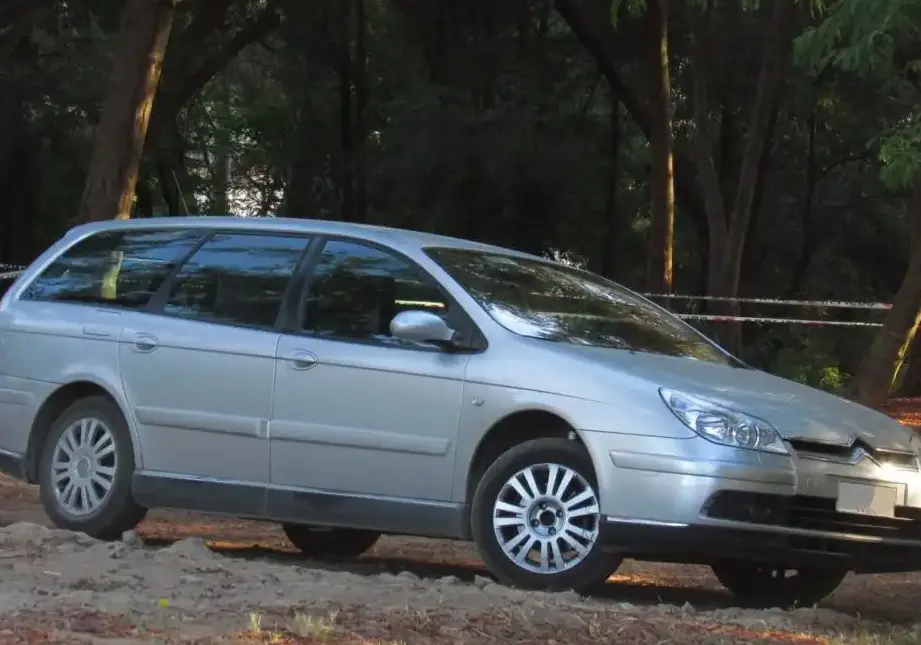
The Citroën C5 I Break (Phase II), specifically the 1.6 HDI 109 horsepower variant produced between 2004 and 2005, represents a compelling blend of practicality, fuel efficiency, and comfort within the mid-size station wagon segment. This version of the C5, part of the X3 platform generation, was positioned as an entry-level to mid-range offering, appealing to buyers prioritizing economy and space over outright performance. The Phase II facelift brought subtle styling revisions and refinements to the original C5 Break, solidifying its position as a popular choice in the European market.
Technical Specifications
| Brand | Citroën |
| Model | C5 |
| Generation | C5 I Break (Phase II, 2004) |
| Type (Engine) | 1.6 HDI (109 Hp) FAP |
| Start of production | 2004 |
| End of production | 2005 |
| Powertrain Architecture | Internal Combustion engine |
| Body type | Station wagon (estate) |
| Seats | 5 |
| Doors | 5 |
| Fuel consumption (urban) | 6.9 l/100 km (34.1 US mpg, 40.9 UK mpg, 14.5 km/l) |
| Fuel consumption (extra urban) | 4.6 l/100 km (51.1 US mpg, 61.4 UK mpg, 21.7 km/l) |
| Fuel consumption (combined) | 5.5 l/100 km (42.8 US mpg, 51.4 UK mpg, 18.2 km/l) |
| CO2 emissions | 145 g/km |
| Fuel Type | Diesel |
| Acceleration 0 – 100 km/h | 11.5 sec |
| Acceleration 0 – 62 mph | 11.5 sec |
| Acceleration 0 – 60 mph | 10.9 sec |
| Maximum speed | 186 km/h (115.58 mph) |
| Emission standard | Euro 3 |
| Weight-to-power ratio | 13.2 kg/Hp, 75.6 Hp/tonne |
| Weight-to-torque ratio | 6 kg/Nm, 166.4 Nm/tonne |
| Power | 109 Hp @ 4000 rpm |
| Power per litre | 69.9 Hp/l |
| Torque | 240 Nm @ 1750 rpm (177.01 lb.-ft. @ 1750 rpm) |
| Engine layout | Front, Transverse |
| Engine Model/Code | 9HZ DV6TED4 |
| Engine displacement | 1560 cm3 (95.2 cu. in.) |
| Number of cylinders | 4 |
| Engine configuration | Inline |
| Cylinder Bore | 75 mm (2.95 in.) |
| Piston Stroke | 88.3 mm (3.48 in.) |
| Compression ratio | 17.6:1 |
| Number of valves per cylinder | 4 |
| Fuel injection system | Diesel Commonrail |
| Engine aspiration | Turbocharger, Intercooler |
| Valvetrain | DOHC |
| Engine oil capacity | 3.8 l (4.02 US qt | 3.34 UK qt) |
| Coolant | 6.5 l (6.87 US qt | 5.72 UK qt) |
| Kerb Weight | 1442 kg (3179.07 lbs.) |
| Max. weight | 2056 kg (4532.7 lbs.) |
| Max load | 614 kg (1353.64 lbs.) |
| Trunk (boot) space – minimum | 563 l (19.88 cu. ft.) |
| Trunk (boot) space – maximum | 1658 l (58.55 cu. ft.) |
| Fuel tank capacity | 67 l (17.7 US gal | 14.74 UK gal) |
| Max. roof load | 75 kg (165.35 lbs.) |
| Permitted trailer load with brakes (12%) | 1300 kg (2866.01 lbs.) |
| Permitted trailer load without brakes | 745 kg (1642.44 lbs.) |
| Permitted towbar download | 75 kg (165.35 lbs.) |
| Length | 4839 mm (190.51 in.) |
| Width | 1780 mm (70.08 in.) |
| Height | 1511 mm (59.49 in.) |
| Wheelbase | 2750 mm (108.27 in.) |
| Front track | 1528 mm (60.16 in.) |
| Rear track | 1495 mm (58.86 in.) |
| Front overhang | 1033 mm (40.67 in.) |
| Rear overhang | 1056 mm (41.57 in.) |
| Minimum turning circle | 12.43 m (40.78 ft.) |
| Drivetrain Architecture | Front wheel drive |
| Drive wheel | Front wheel drive |
| Number of gears and type of gearbox | 5 gears, manual transmission |
| Front suspension | Independent, type McPherson with coil spring and anti-roll bar |
| Rear suspension | Semi-independent, coil spring |
| Front brakes | Ventilated discs |
| Rear brakes | Disc |
| Assisting systems | ABS (Anti-lock braking system) |
| Tires size | 215/55 R16 |
| Wheel rims size | 16 |
Powertrain & Engine Architecture
The heart of this C5 variant is the 9HZ DV6TED4 engine, a 1.6-liter inline-four cylinder diesel. This engine is a member of the DV6 family, developed jointly by PSA Peugeot Citroën and Ford. It features a common rail direct injection system, delivering fuel at extremely high pressure for optimized combustion. The turbocharger, coupled with an intercooler, enhances power output and efficiency. The engine utilizes a double overhead camshaft (DOHC) valvetrain with four valves per cylinder, contributing to its relatively high specific output. A Diesel Particulate Filter (DPF), denoted by the “FAP” in the model name, was standard equipment to meet increasingly stringent emissions regulations. The engine is transversely mounted at the front of the vehicle. The 5-speed manual transmission was the standard offering, providing a balance between fuel economy and drivability.
Driving Characteristics
The 109 horsepower output and 240 Nm (177 lb-ft) of torque provide adequate, though not exhilarating, performance. Acceleration from 0-100 km/h (0-62 mph) takes around 11.5 seconds. The engine’s torque peak, available from 1750 rpm, provides reasonable responsiveness for everyday driving situations. Compared to the more powerful 2.0 HDI variants, this 1.6L engine feels less strained during highway cruising and overtaking maneuvers. The 5-speed manual transmission is well-matched to the engine’s characteristics, offering a usable spread of gears. However, it lacks the refinement and quicker shifts of more modern automatic transmissions. The focus is clearly on fuel efficiency rather than sporty driving dynamics.
Equipment & Trim Levels
The 1.6 HDI 109 FAP typically came with a reasonable level of standard equipment. This included power steering, central locking, electric front windows, and an RDS radio. Air conditioning was often an optional extra. Interior upholstery was typically cloth, with a functional, if not luxurious, dashboard layout. Higher trim levels, available at extra cost, could add features like alloy wheels, rear parking sensors, and upgraded audio systems. Safety features included ABS brakes and driver/passenger airbags.
Chassis & Braking
The C5 I Break utilizes an independent McPherson strut suspension setup at the front, providing a comfortable ride. The rear suspension is a semi-independent coil spring arrangement. This configuration prioritizes ride comfort over sharp handling. The braking system consists of ventilated discs at the front and solid discs at the rear. ABS (Anti-lock Braking System) is standard, enhancing braking performance and stability. The suspension tuning is geared towards absorbing bumps and providing a smooth ride, making it well-suited for long journeys.
Market Reception & Comparison
The 1.6 HDI 109 FAP variant of the C5 I Break was generally well-received for its fuel economy and practicality. Critics praised its spacious interior and comfortable ride. However, some noted that the engine lacked the punch of the larger 2.0 HDI units. Compared to the 2.0 HDI, the 1.6 offered lower running costs but at the expense of performance. The 1.6 HDI was a popular choice for fleet buyers and private individuals seeking an economical and reliable family car.
Legacy
The DV6 engine family, including the 9HZ variant, has proven to be relatively durable, although the Diesel Particulate Filter (DPF) can be a potential source of issues if not properly maintained. Regular oil changes and the use of quality diesel fuel are crucial for long-term reliability. In the used car market, these C5s represent a good value proposition for buyers seeking an affordable and practical station wagon. While not the most exciting car to drive, the 1.6 HDI 109 FAP offers a compelling combination of fuel efficiency, space, and comfort.