
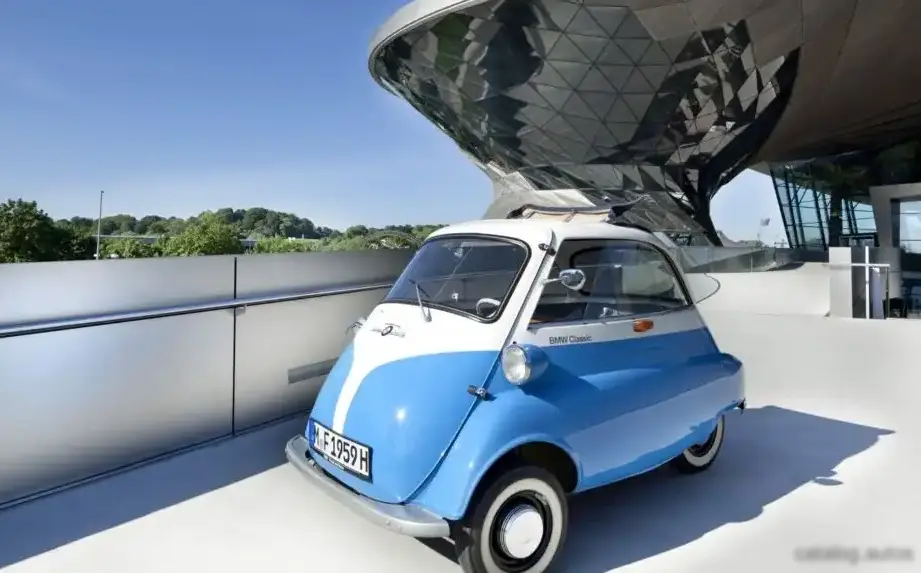
The BMW Isetta 250, produced between April 1955 and May 1962, represents a pivotal moment in post-war automotive history. Licensed from the Italian firm Iso SpA, the Isetta was initially conceived as a solution to Italy’s need for affordable transportation. BMW, facing its own financial difficulties in the mid-1950s, acquired the license and adapted the design for the German market. The Isetta 250, with its distinctive bubble-like shape and single front door, became a symbol of the “Wirtschaftswunder” – the economic miracle of West Germany. It was a quadricycle, falling into a legal grey area that allowed for simpler construction and lower taxes, making it accessible to a wider range of buyers. The 250 designation refers to the engine displacement, and this variant was the most popular of the Isetta models produced by BMW.
Technical Specifications
| Brand | BMW |
| Model | Isetta |
| Generation | Isetta |
| Type (Engine) | 250 (12 Hp) |
| Start of production | April, 1955 |
| End of production | May, 1962 |
| Powertrain Architecture | Internal Combustion engine |
| Body type | Quadricycle |
| Seats | 2 |
| Doors | 1 |
| Fuel consumption (combined) | 3.7 l/100 km (63.6 US mpg, 76.3 UK mpg, 27 km/l) |
| Fuel Type | Petrol (Gasoline) |
| Maximum speed | 85 km/h (52.82 mph) |
| Weight-to-power ratio | 30.8 kg/Hp, 32.4 Hp/tonne |
| Weight-to-torque ratio | 26.4 kg/Nm, 37.8 Nm/tonne |
| Power | 12 Hp @ 5800 rpm |
| Power per litre | 49 Hp/l |
| Torque | 14 Nm @ 4500 rpm (10.33 lb.-ft. @ 4500 rpm) |
| Engine layout | Middle, Longitudinal |
| Engine displacement | 245 cm3 (14.95 cu. in.) |
| Number of cylinders | 1 |
| Cylinder Bore | 68 mm (2.68 in.) |
| Piston Stroke | 68 mm (2.68 in.) |
| Compression ratio | 6.8:1 |
| Number of valves per cylinder | 2 |
| Fuel injection system | Carburettor |
| Engine aspiration | Naturally aspirated engine |
| Valvetrain | OHV |
| Engine oil capacity | 1.8 l (1.9 US qt | 1.58 UK qt) |
| Kerb Weight | 370 kg (815.71 lbs.) |
| Max. weight | 600 kg (1322.77 lbs.) |
| Max load | 230 kg (507.06 lbs.) |
| Fuel tank capacity | 13 l (3.43 US gal | 2.86 UK gal) |
| Length | 2355 mm (92.72 in.) |
| Width | 1380 mm (54.33 in.) |
| Height | 1340 mm (52.76 in.) |
| Wheelbase | 1500 mm (59.06 in.) |
| Front track | 520 mm (20.47 in.) |
| Rear track | 1200 mm (47.24 in.) |
| Minimum turning circle | 8.3 m (27.23 ft.) |
| Drivetrain Architecture | Rear wheel drive |
| Drive wheel | Rear wheel drive |
| Number of gears and type of gearbox | 4 gears, manual transmission |
| Front suspension | Independent coil spring |
| Rear suspension | Leaf spring |
| Front brakes | Drum, 180 mm |
| Rear brakes | Drum, 180 mm |
| Steering type | Worm-reduction unit |
Powertrain & Engine Architecture
The heart of the Isetta 250 was a single-cylinder, 245cc, two-stroke engine. While BMW initially experimented with a two-stroke design, the production version utilized a four-stroke engine, a significant improvement in refinement and longevity. This engine, designated as the BMW 250, produced a modest 12 horsepower at 5800 rpm and 14 Nm (10.33 lb-ft) of torque at 4500 rpm. The engine was mounted longitudinally in the rear of the vehicle, driving the rear wheels. It featured an overhead valve (OHV) configuration and was fed by a carburetor. The four-speed manual transmission, while simple, was robust and well-suited to the engine’s power characteristics. The engine’s small displacement and relatively high compression ratio (6.8:1) contributed to its fuel efficiency, a key selling point for the Isetta.
Driving Characteristics
The driving experience in an Isetta 250 was unique, to say the least. Acceleration was leisurely, with a top speed of around 53 mph. The small engine and lightweight construction (370 kg / 816 lbs) meant that the Isetta could reach its top speed relatively quickly, but overtaking required careful planning. The four-speed manual transmission allowed drivers to keep the engine in its optimal power band. The Isetta’s narrow track and simple suspension provided a somewhat bumpy ride, but the car was surprisingly nimble in city traffic. The rear-wheel drive layout and limited tire size meant that traction could be a concern in wet conditions.
Equipment & Trim Levels
The Isetta 250 was not a luxury vehicle. It was designed for basic transportation, and its equipment reflected that. Standard features included a basic instrument panel with speedometer and fuel gauge, a small bench seat for two occupants, and a single windshield wiper. The interior was spartan but functional. Optional extras included a sunroof, a heater, and upgraded upholstery. Later models offered more refined interior trim options. The single front door, hinged on the right side, was a defining feature of the Isetta and required a degree of agility to enter and exit.
Chassis & Braking
The Isetta 250 utilized a simple ladder frame chassis. Front suspension was independent, employing coil springs, while the rear suspension relied on a leaf spring setup. This combination provided a reasonable level of comfort for the time, considering the vehicle’s price point. Braking was accomplished via drum brakes on all four wheels, measuring 180mm in diameter. While adequate for the Isetta’s weight and speed, the braking system was not particularly powerful. The steering system was a worm-reduction unit, providing relatively direct steering feel.
Market Reception & Comparison
The BMW Isetta 250 was a commercial success, particularly in Germany. It provided affordable transportation to a population recovering from the war. Critics praised its fuel efficiency and maneuverability, but also noted its limited performance and cramped interior. Compared to other microcars of the era, such as the Messerschmitt KR200, the Isetta offered a slightly more spacious interior and a more conventional driving experience. It was significantly cheaper than larger, more conventional cars like the Volkswagen Beetle, making it an attractive option for budget-conscious buyers. The Isetta’s fuel economy of around 64 mpg was exceptional for the time.
Legacy
The BMW Isetta 250 played a crucial role in revitalizing BMW after World War II. It demonstrated the company’s ability to adapt and innovate, and it laid the foundation for its future success. Today, the Isetta 250 is a highly sought-after classic car, prized for its quirky design and historical significance. While the powertrain is relatively simple, maintenance can be challenging due to the age of the vehicle and the limited availability of parts. However, a thriving community of Isetta enthusiasts ensures that these little cars continue to be enjoyed and preserved for generations to come. The Isetta remains a beloved icon of post-war ingenuity and a testament to the power of affordable, accessible transportation.
