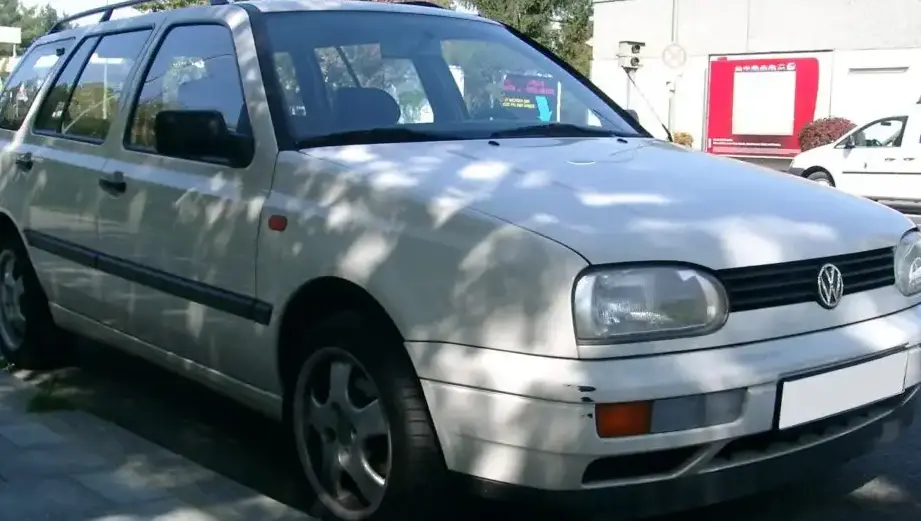
The Volkswagen Golf III Variant 1.8, producing 75 horsepower, was a popular iteration of the third-generation Golf family, specifically the station wagon (estate) body style. Produced from 1993 to 1999, this model occupied an important position in the European market as an affordable and practical family vehicle. It was built on the Volkswagen Group’s A3 platform (internally designated 1HX0 for the Variant), sharing its underpinnings with models like the SEAT Ibiza, Córdoba, and Škoda Octavia. This particular 1.8-liter variant, often equipped with an automatic transmission, represented an entry-level option within the Golf III Variant range, prioritizing fuel efficiency and ease of use over outright performance.
Technical Specifications
| Brand | Volkswagen |
| Model | Golf |
| Generation | Golf III Variant |
| Type (Engine) | 1.8 (75 Hp) |
| Start of production | 1993 |
| End of production | 1999 |
| Powertrain Architecture | Internal Combustion engine |
| Body type | Station wagon (estate) |
| Seats | 5 |
| Doors | 5 |
| Fuel consumption (urban) | 11 l/100 km (21.4 US mpg, 25.7 UK mpg, 9.1 km/l) |
| Fuel consumption (extra urban) | 6.3 l/100 km (37.3 US mpg, 44.8 UK mpg, 15.9 km/l) |
| Fuel consumption (combined) | 7.5 l/100 km (31.4 US mpg, 37.7 UK mpg, 13.3 km/l) |
| Fuel Type | Petrol (Gasoline) |
| Acceleration 0 – 100 km/h | 14.8 sec |
| Acceleration 0 – 62 mph | 14.8 sec |
| Acceleration 0 – 60 mph | 14.1 sec |
| Maximum speed | 165 km/h (102.53 mph) |
| Weight-to-power ratio | 15.9 kg/Hp, 63 Hp/tonne |
| Weight-to-torque ratio | 8.5 kg/Nm, 117.6 Nm/tonne |
| Power | 75 Hp @ 5000 rpm |
| Power per litre | 42.1 Hp/l |
| Torque | 140 Nm @ 2500 rpm (103.26 lb.-ft. @ 2500 rpm) |
| Engine layout | Front, Transverse |
| Engine Model/Code | AAM |
| Engine displacement | 1781 cm3 (108.68 cu. in.) |
| Number of cylinders | 4 |
| Engine configuration | Inline |
| Cylinder Bore | 81 mm (3.19 in.) |
| Piston Stroke | 86.4 mm (3.4 in.) |
| Compression ratio | 9:1 |
| Number of valves per cylinder | 2 |
| Fuel injection system | Single-point injection |
| Engine aspiration | Naturally aspirated engine |
| Valvetrain | OHC |
| Engine oil capacity | 3.8 l (4.02 US qt | 3.34 UK qt) |
| Coolant | 5.5 l (5.81 US qt | 4.84 UK qt) |
| Kerb Weight | 1190 kg (2623.5 lbs.) |
| Max. weight | 1650 kg (3637.63 lbs.) |
| Max load | 460 kg (1014.13 lbs.) |
| Trunk (boot) space – minimum | 466 l (16.46 cu. ft.) |
| Trunk (boot) space – maximum | 1425 l (50.32 cu. ft.) |
| Fuel tank capacity | 60 l (15.85 US gal | 13.2 UK gal) |
| Length | 4340 mm (170.87 in.) |
| Width | 1695 mm (66.73 in.) |
| Height | 1430 mm (56.3 in.) |
| Wheelbase | 2475 mm (97.44 in.) |
| Front track | 1478 mm (58.19 in.) |
| Rear (Back) track | 1465 mm (57.68 in.) |
| Drivetrain Architecture | The Internal combustion engine (ICE) drives the front wheels of the vehicle. |
| Drive wheel | Front wheel drive |
| Number of gears and type of gearbox | 5 gears, manual transmission |
| Front suspension | Wishbone |
| Rear suspension | Suspension with traction connecting levers |
| Front brakes | Disc |
| Rear brakes | Drum |
| Steering type | Steering rack and pinion |
| Power steering | Hydraulic Steering |
| Tires size | 195/60 R14 |
| Wheel rims size | 14 |
Powertrain & Engine Architecture
The Golf III Variant 1.8 (75 hp) was powered by the Volkswagen AAM engine, a 1.8-liter inline-four cylinder gasoline engine. This engine belonged to the EA827 series and featured a single-point fuel injection system (also known as mono-point injection). This system, while simpler and less expensive than multi-point injection, delivered fuel into a single point in the intake manifold. The engine utilized an overhead camshaft (OHC) valvetrain with two valves per cylinder. The AAM engine produced 75 horsepower at 5000 rpm and 140 Nm (103 lb-ft) of torque at 2500 rpm. The automatic transmission option, typically a four-speed unit, was designed to provide smooth and convenient shifting, prioritizing comfort over performance. This transmission was a common choice for drivers seeking a relaxed driving experience.
Driving Characteristics
The 1.8-liter, 75 hp engine paired with an automatic transmission resulted in a driving experience focused on practicality rather than spirited performance. Acceleration was modest, with a 0-60 mph time around 14.1 seconds. The automatic transmission, while offering convenience, did impact responsiveness. Gear ratios were optimized for fuel economy, meaning the engine often operated at lower RPMs during cruising. Compared to the manual transmission version or higher-output Golf III variants like the 1.9 TDI or the VR6, this setup felt noticeably slower. However, it provided a comfortable and predictable driving experience, well-suited for city driving and everyday commuting.
Equipment & Trim Levels
The Golf III Variant 1.8 (75 hp) typically came with a fairly basic level of equipment, reflecting its position as an entry-level model. Standard features generally included power steering, central locking, and a basic stereo system. Interior upholstery was typically cloth, and the dashboard featured a functional, if somewhat spartan, design. Optional extras included power windows, air conditioning, alloy wheels, and upgraded audio systems. Higher trim levels, such as the GL, offered more luxurious appointments and additional features.
Chassis & Braking
The Golf III Variant’s chassis featured a front independent suspension with wishbones and a rear suspension utilizing traction connecting levers. This setup provided a reasonable balance between ride comfort and handling. Braking was typically accomplished with front disc brakes and rear drum brakes. The drum brakes on the rear were a cost-saving measure common on lower-spec models. Stabilizer bars were often included, contributing to reduced body roll during cornering. The suspension was tuned for comfort, prioritizing a smooth ride over sporty handling.
Market Reception & Comparison
The Golf III Variant 1.8 (75 hp) was generally well-received as an affordable and practical family car. Critics acknowledged its fuel efficiency and ease of use, particularly with the automatic transmission. However, its performance was often criticized as being underwhelming, especially when compared to more powerful Golf variants. The 1.9 TDI diesel offered significantly better fuel economy and more torque, while the VR6 provided a substantial performance boost. In terms of reliability, the AAM engine was generally considered to be robust, but the automatic transmission could be prone to issues if not properly maintained.
Legacy
The Golf III Variant 1.8 (75 hp) remains a relatively common sight on European roads today, testament to the Golf’s enduring popularity and build quality. The AAM engine, while not known for its high performance, is generally regarded as a reliable unit. Parts availability is good, making maintenance relatively straightforward. In the used car market, these models are typically affordable and represent a practical choice for those seeking a classic Volkswagen estate car. While not a collector’s item, the Golf III Variant 1.8 (75 hp) holds a nostalgic appeal for many and continues to provide reliable transportation for its owners.