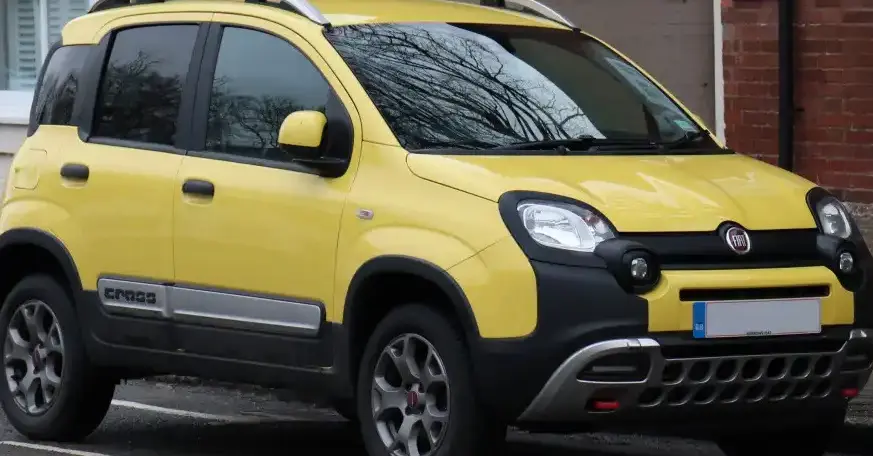
The Fiat Panda III Cross 1.3 Multijet II 4×4, produced from 2014 to 2015, represents a niche offering within the broader Panda III (2003-2012) generation. This variant aimed to combine the practicality and affordability of the Panda with enhanced off-road capability and a fuel-efficient diesel engine. Positioned as a more adventurous and rugged version of the standard Panda, the Cross 4×4 targeted buyers seeking a small, economical vehicle capable of handling mild off-road conditions and inclement weather. It was a key model in expanding the Panda’s appeal beyond purely urban environments, particularly in markets with varied terrain like Italy and other parts of Europe.
Technical Specifications
| Brand | Fiat |
| Model | Panda |
| Generation | Panda III Cross |
| Type (Engine) | 1.3 Multijet II (80 Hp) 4×4 |
| Start of production | 2014 |
| End of production | 2015 |
| Powertrain Architecture | Internal Combustion engine |
| Body type | Hatchback |
| Seats | 5 |
| Doors | 5 |
| Fuel consumption (urban) | 5 l/100 km (47 US mpg, 56.5 UK mpg, 20 km/l) |
| Fuel consumption (extra urban) | 4.6 l/100 km (51.1 US mpg, 61.4 UK mpg, 21.7 km/l) |
| Fuel consumption (combined) | 4.7 l/100 km (50 US mpg, 60.1 UK mpg, 21.3 km/l) |
| CO2 emissions | 125 g/km |
| Fuel Type | Diesel |
| Acceleration 0 – 100 km/h | 14.3 sec |
| Acceleration 0 – 62 mph | 14.3 sec |
| Acceleration 0 – 60 mph | 13.6 sec |
| Maximum speed | 160 km/h (99.42 mph) |
| Emission standard | Euro 5/Euro 6 |
| Weight-to-power ratio | 14.4 kg/Hp, 69.3 Hp/tonne |
| Weight-to-torque ratio | 6.1 kg/Nm, 164.5 Nm/tonne |
| Power | 80 Hp @ 4000 rpm |
| Power per litre | 64.1 Hp/l |
| Torque | 190 Nm @ 1500 rpm (140.14 lb.-ft. @ 1500 rpm) |
| Engine layout | Front, Transverse |
| Engine Model/Code | 312A8000, 312B2000, 225A2000 |
| Engine displacement | 1248 cm3 (76.16 cu. in.) |
| Number of cylinders | 4 |
| Engine configuration | Inline |
| Cylinder Bore | 69.6 mm (2.74 in.) |
| Piston Stroke | 82 mm (3.23 in.) |
| Compression ratio | 16.8:1 |
| Number of valves per cylinder | 4 |
| Fuel injection system | Diesel Commonrail |
| Engine aspiration | Turbocharger, Intercooler |
| Valvetrain | DOHC |
| Engine oil capacity | 3.9 l (4.12 US qt | 3.43 UK qt) |
| Coolant | 6.3 l (6.66 US qt | 5.54 UK qt) |
| Kerb Weight | 1155 kg (2546.34 lbs.) |
| Max. weight | 1625 kg (3582.51 lbs.) |
| Max load | 470 kg (1036.17 lbs.) |
| Trunk (boot) space – minimum | 225 l (7.95 cu. ft.) |
| Trunk (boot) space – maximum | 870 l (30.72 cu. ft.) |
| Fuel tank capacity | 35 l (9.25 US gal | 7.7 UK gal) |
| Permitted trailer load with brakes (12%) | 900 kg (1984.16 lbs.) |
| Permitted trailer load without brakes | 400 kg (881.85 lbs.) |
| Length | 3705 mm (145.87 in.) |
| Width | 1662 mm (65.43 in.) |
| Width including mirrors | 1882 mm (74.09 in.) |
| Height | 1657 mm (65.24 in.) |
| Wheelbase | 2300 mm (90.55 in.) |
| Front track | 1403 mm (55.24 in.) |
| Rear (Back) track | 1406 mm (55.35 in.) |
| Drag coefficient (Cd) | 0.35 |
| Minimum turning circle (turning diameter) | 9.7 m (31.82 ft.) |
| Approach angle | 24° |
| Departure angle | 34° |
| Ramp-over (brakeover) angle | 21° |
| Drive wheel | All wheel drive (4×4) |
| Number of gears and type of gearbox | 5 gears, manual transmission |
| Front suspension | Independent type McPherson |
| Rear suspension | Torsion |
| Front brakes | Ventilated discs |
| Rear brakes | Disc |
| Assisting systems | ABS (Anti-lock braking system) |
| Tires size | 185/65 R15 |
| Wheel rims size | 15 |
Powertrain & Engine Architecture
The heart of the Panda III Cross 4×4 is the 1.3 Multijet II diesel engine, specifically engine codes 312A8000, 312B2000, and 225A2000. This engine is a second-generation common rail direct injection diesel, known for its efficiency and relatively low emissions. The 1.3-liter inline-four cylinder engine utilizes a turbocharger with an intercooler to boost power output to 80 horsepower at 4000 rpm and 190 Nm (140 lb-ft) of torque at 1500 rpm. The engine features a double overhead camshaft (DOHC) valvetrain with four valves per cylinder. The Multijet II system allows for multiple fuel injections per combustion cycle, improving combustion efficiency and reducing noise. The engine is transversely mounted in the front of the vehicle. The 4×4 system is a part-time system, engaging the rear wheels when needed via a viscous coupling. The transmission is a 5-speed manual gearbox, chosen for its simplicity and fuel efficiency. An automatic transmission was not offered with this engine/4×4 combination.
Driving Characteristics
The 1.3 Multijet II engine in the Panda Cross 4×4 provides adequate, though not exhilarating, performance. Acceleration from 0-100 km/h (0-62 mph) takes around 14.3 seconds, and top speed is limited to 160 km/h (99 mph). The engine’s strength lies in its low-end torque, making it suitable for navigating challenging terrain and providing reasonable pulling power. The 5-speed manual transmission is well-matched to the engine’s characteristics, with gear ratios optimized for fuel economy and usability. Compared to the standard Panda 1.2-liter petrol engine, the Multijet offers significantly more torque and better fuel economy. However, it lacks the responsiveness of the petrol engine. Compared to higher-powered Panda variants, the 80 hp version feels noticeably slower, particularly when fully loaded or climbing steep hills. The 4×4 system provides enhanced traction on slippery surfaces, but it’s not designed for serious off-roading; it’s more suited for gravel roads, snow, and muddy tracks.
Equipment & Trim Levels
The Panda III Cross 4×4 typically came with a higher level of standard equipment than the base Panda models. Features included air conditioning, central locking, electric front windows, and a radio with CD player. The interior featured durable, hard-wearing upholstery designed to withstand the rigors of outdoor use. The dashboard was typically finished in a dark grey color scheme. Optional extras included alloy wheels, fog lights, and a more advanced audio system. The Cross trim also featured unique exterior styling cues, such as plastic body cladding, roof rails, and a raised ride height, giving it a more rugged appearance. A specific “Adventure” pack was also available, adding further cosmetic enhancements and off-road focused accessories.
Chassis & Braking
The Panda III Cross 4×4 utilizes a McPherson strut independent suspension at the front and a torsion beam suspension at the rear. The suspension is tuned to provide a comfortable ride on paved roads while also offering sufficient articulation for off-road use. The front brakes are ventilated discs, while the rear brakes are solid discs. Anti-lock Braking System (ABS) is standard. The chassis is reinforced compared to the standard Panda to accommodate the 4×4 system and the increased stresses associated with off-road driving. The tires are typically 185/65 R15, providing a good balance between on-road comfort and off-road grip.
Market Reception & Comparison
The Fiat Panda III Cross 4×4 was generally well-received by automotive critics for its practicality, fuel efficiency, and surprisingly capable 4×4 system. It was praised as a clever and affordable solution for those needing a small, versatile vehicle capable of handling a variety of conditions. Fuel economy was a major selling point, with combined fuel consumption figures around 4.7 l/100 km (50 US mpg). Compared to other small 4x4s, the Panda Cross offered a compelling value proposition. However, some critics noted its limited performance and relatively basic interior. Compared to the standard Panda 1.2 petrol, the Multijet 4×4 offered superior torque and fuel economy, but at a higher purchase price.
Legacy
The 1.3 Multijet engine has proven to be a reliable and durable powertrain, and well-maintained examples of the Panda III Cross 4×4 continue to be found on the used car market. While not known for blistering performance, the engine is generally considered to be robust and relatively inexpensive to repair. The 4×4 system is also generally reliable, although regular maintenance is essential. The Panda Cross 4×4 has gained a cult following among those seeking a small, affordable, and capable vehicle for navigating challenging conditions. Its combination of practicality, fuel efficiency, and off-road capability has ensured its enduring appeal.