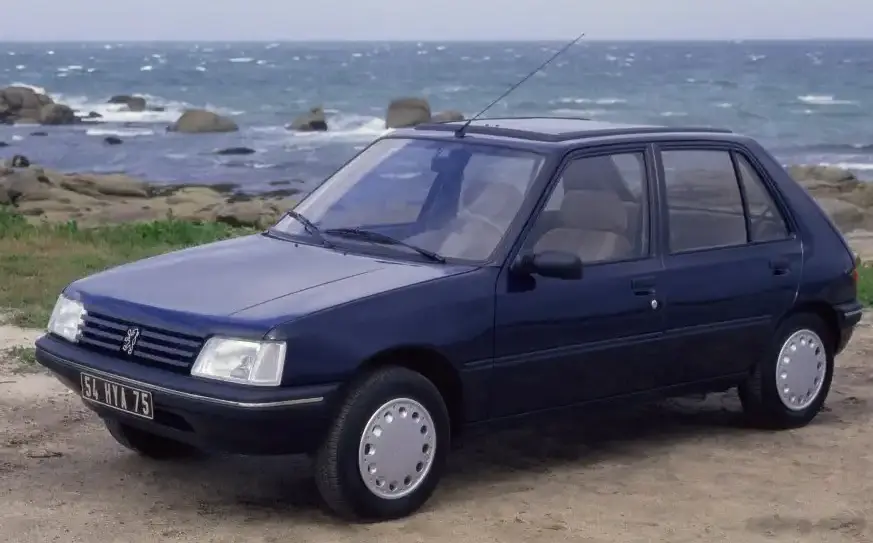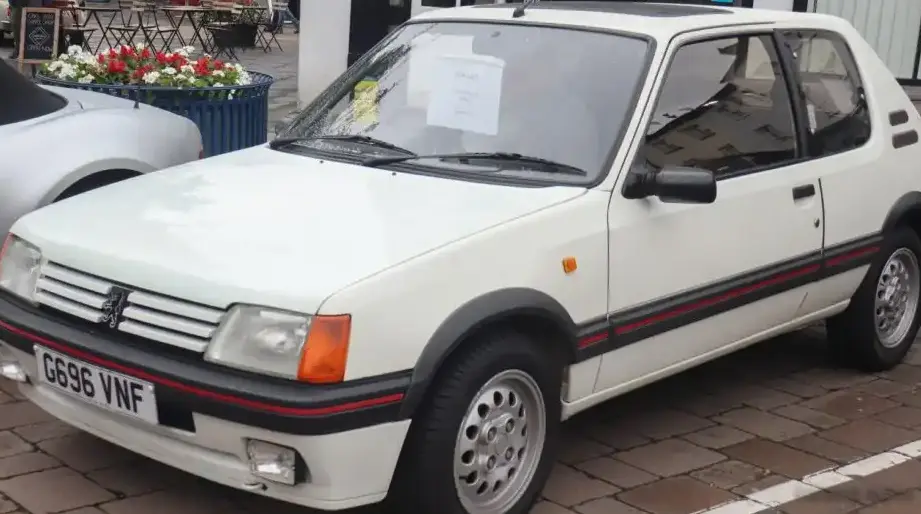
The Peugeot 205 I 1.6 Automatic, produced between 1983 and 1987, represents a significant entry point into the highly successful 205 series. Part of the 741A/C generation, this 3-door hatchback offered a blend of practicality and affordability, aimed at buyers seeking a comfortable and easy-to-drive city car. Positioned as a mid-range offering within the 205 lineup, it sat below the more performance-oriented GTI models and above the base-level engine options. The 1.6 Automatic was designed to appeal to a broader audience, prioritizing convenience over outright speed.
Technical Specifications
| Brand | Peugeot |
| Model | 205 |
| Generation | 205 I (741A/C) 3-door |
| Type (Engine) | 1.6 (80 Hp) Automatic |
| Start of production | 1983 |
| End of production | 1987 |
| Powertrain Architecture | Internal Combustion engine |
| Body type | Hatchback |
| Seats | 4 |
| Doors | 3 |
| Fuel consumption (urban) | 8.5 l/100 km (27.7 US mpg) |
| Fuel consumption (extra urban) | 5.6 l/100 km (42 US mpg) |
| Fuel Type | Petrol (Gasoline) |
| Acceleration 0 – 100 km/h | 13.6 sec |
| Acceleration 0 – 62 mph | 13.6 sec |
| Acceleration 0 – 60 mph | 12.9 sec |
| Maximum speed | 166 km/h (103.15 mph) |
| Weight-to-power ratio | 10.3 kg/Hp |
| Weight-to-torque ratio | 6.3 kg/Nm |
| Power | 80 Hp @ 5600 rpm |
| Torque | 130 Nm @ 2800 rpm (95.88 lb.-ft. @ 2800 rpm) |
| Engine layout | Front, Transverse |
| Engine Model/Code | XU51C |
| Engine displacement | 1580 cm3 (96.42 cu. in.) |
| Number of cylinders | 4 |
| Engine configuration | Inline |
| Cylinder Bore | 83 mm (3.27 in.) |
| Piston Stroke | 73 mm (2.87 in.) |
| Compression ratio | 9.4:1 |
| Number of valves per cylinder | 2 |
| Fuel injection system | Carburettor |
| Engine aspiration | Naturally aspirated |
| Valvetrain | OHC |
| Engine oil capacity | 5 l (5.28 US qt | 4.4 UK qt) |
| Coolant capacity | 6.7 l (7.08 US qt | 5.9 UK qt) |
| Kerb Weight | 825 kg (1818.81 lbs.) |
| Max. weight | 1300 kg (2866.01 lbs.) |
| Max load | 475 kg (1047.2 lbs.) |
| Trunk (boot) space – minimum | 216 l (7.63 cu. ft.) |
| Trunk (boot) space – maximum | 564 l (19.92 cu. ft.) |
| Fuel tank capacity | 50 l (13.21 US gal | 11 UK gal) |
| Permitted trailer load with brakes (12%) | 800 kg (1763.7 lbs.) |
| Length | 3705 mm (145.87 in.) |
| Width | 1572 mm (61.89 in.) |
| Height | 1373 mm (54.06 in.) |
| Wheelbase | 2420 mm (95.28 in.) |
| Front track | 1350 mm (53.15 in.) |
| Rear track | 1300 mm (51.18 in.) |
| Front overhang | 680 mm (26.77 in.) |
| Rear overhang | 605 mm (23.82 in.) |
| Drag coefficient (Cd) | 0.35 |
| Minimum turning circle | 10.5 m (34.45 ft.) |
| Drivetrain | Front wheel drive |
| Number of gears | 4 |
| Gearbox type | Automatic transmission |
| Front suspension | Independent, McPherson with coil spring and anti-roll bar |
| Rear suspension | Torsion |
| Front brakes | Disc |
| Rear brakes | Drum |
| Steering type | Steering rack and pinion |
| Tires size | 165/70 R13 |
| Wheel rims size | 13 |
Powertrain & Engine Architecture
The heart of the 205 I 1.6 Automatic is the XU51C engine, a 1.6-liter inline-four cylinder petrol engine. This engine, a staple in many Peugeot and Citroën vehicles of the era, featured a single overhead camshaft (OHC) valvetrain with two valves per cylinder. Unlike later fuel-injected versions, the 1.6 in the 205 Automatic utilized a carburetor for fuel delivery, specifically a Solex or Weber unit. This carburetor system, while simpler and less expensive than fuel injection, resulted in slightly lower fuel efficiency and less precise control over the air-fuel mixture. The engine produced 80 horsepower at 5600 rpm and 130 Nm (95.88 lb-ft) of torque at 2800 rpm. The automatic transmission was a three-speed unit, designed for smooth, if not particularly sporty, operation. It was a conventional hydraulic automatic, lacking the electronic controls found in more modern transmissions.
Driving Characteristics
The 1.6 Automatic offered a comfortable and relaxed driving experience. Acceleration was modest, taking approximately 13.6 seconds to reach 62 mph (100 km/h). The automatic transmission, while convenient, did detract from the overall performance. Gear changes were not particularly quick, and the transmission tended to ‘hunt’ for gears on inclines. Compared to the manual transmission versions of the 205 1.6, the automatic was noticeably slower. The gear ratios were optimized for fuel economy and ease of driving rather than outright performance. The power delivery was relatively linear, making it predictable and easy to control in urban environments. However, overtaking maneuvers required careful planning.
Equipment & Trim Levels
The 1.6 Automatic trim level typically included features such as cloth upholstery, a basic instrument cluster, and manual windows. Power steering was not standard, but could be added as an option. Other optional extras included a sunroof, upgraded audio systems, and different wheel trims. The interior was functional and relatively spartan, reflecting the car’s affordable positioning. The dashboard layout was straightforward, with clearly labeled controls. The 205 Automatic generally lacked the more luxurious appointments found in higher-spec models like the GTI.
Chassis & Braking
The 205 I featured a front-wheel-drive layout with an independent McPherson strut suspension at the front and a torsion beam suspension at the rear. The front suspension incorporated an anti-roll bar to reduce body roll during cornering. Braking was accomplished via disc brakes at the front and drum brakes at the rear. The braking system was adequate for the car’s performance, but lacked the stopping power of more modern systems. The relatively light weight of the 205 – around 825 kg (1818.81 lbs) – helped to compensate for the less powerful engine and basic braking setup.
Market Reception & Comparison
The Peugeot 205 1.6 Automatic was generally well-received as a practical and affordable city car. Critics praised its comfortable ride and ease of driving, but noted its lack of performance compared to the manual transmission and GTI models. Fuel economy was considered good for the time, with combined fuel consumption around 7.3 l/100 km (32.2 US mpg). Compared to rivals like the Renault 5 and Citroën Visa, the 205 offered a more modern design and a slightly more refined driving experience. However, the automatic transmission did impact fuel economy and performance compared to the manual versions.
Legacy
The Peugeot 205 I 1.6 Automatic, while not the most exciting version of the 205, remains a popular classic car. The XU51C engine is known for its durability and relative simplicity, making it relatively easy to maintain. However, carburetor maintenance is required, and parts availability can be a challenge. Today, these cars are sought after by enthusiasts and collectors, particularly those looking for a nostalgic driving experience. The 205’s enduring appeal lies in its combination of stylish design, practicality, and affordability. Well-maintained examples command reasonable prices in the used car market, and the 205 continues to be celebrated as one of the most iconic French cars of the 1980s.