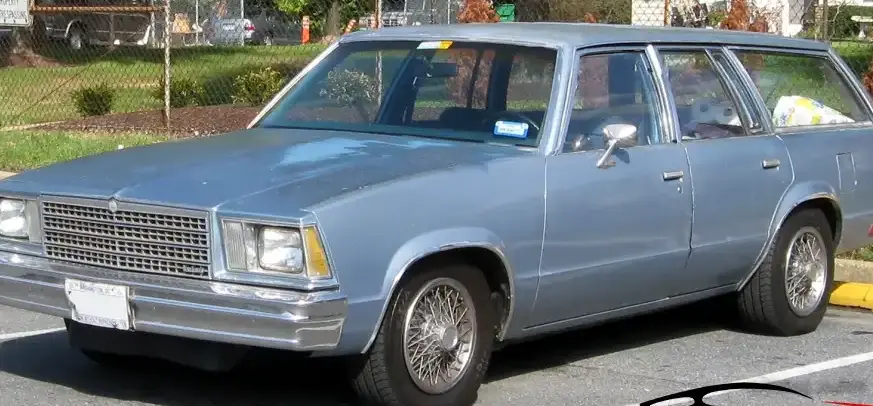
The Chevrolet Malibu IV Station Wagon, produced for a limited run between 1980 and 1981, represented Chevrolet’s entry into the increasingly popular station wagon market. This generation of the Malibu, built on the rear-wheel-drive A-body platform, aimed to provide a practical and spacious vehicle for families. The 3.8 V6 (115 Hp) CAT variant occupied a middle ground in the Malibu IV lineup, offering a balance between performance and fuel economy, though it was often overshadowed by the larger displacement V8 options. It was positioned as a more economical alternative to the higher-powered models, appealing to buyers prioritizing practicality and cost-effectiveness.
Technical Specifications
| Brand | Chevrolet |
| Model | Malibu |
| Generation | Malibu IV Station Wagon |
| Type (Engine) | 3.8 V6 (115 Hp) CAT |
| Start of production | 1980 |
| End of production | 1981 |
| Powertrain Architecture | Internal Combustion engine |
| Body type | Station wagon (estate) |
| Seats | 6 |
| Doors | 5 |
| Fuel Type | Petrol (Gasoline) |
| Weight-to-power ratio | 12.7 kg/Hp, 78.5 Hp/tonne |
| Weight-to-torque ratio | 6.2 kg/Nm, 161.8 Nm/tonne |
| Power | 115 Hp @ 4000 rpm |
| Power per litre | 30.7 Hp/l |
| Torque | 237 Nm @ 2000 rpm, 174.8 lb.-ft. @ 2000 rpm |
| Engine layout | Front, Longitudinal |
| Engine displacement | 3751 cm3, 228.9 cu. in. |
| Number of cylinders | 6 |
| Engine configuration | V-engine |
| Cylinder Bore | 95 mm, 3.74 in. |
| Piston Stroke | 88.4 mm, 3.48 in. |
| Compression ratio | 8.6:1 |
| Number of valves per cylinder | 2 |
| Fuel injection system | Carburettor |
| Engine aspiration | Naturally aspirated engine |
| Valvetrain | OHV |
| Kerb Weight | 1465 kg, 3229.77 lbs |
| Trunk (boot) space – minimum | 1133 l, 40.01 cu. ft |
| Trunk (boot) space – maximum | 2050 l, 72.4 cu. ft |
| Fuel tank capacity | 69 l, 18.23 US gal | 15.18 UK gal |
| Length | 4911 mm, 193.35 in |
| Width | 1816 mm, 71.5 in |
| Height | 1410 mm, 55.51 in |
| Wheelbase | 2745 mm, 108.07 in |
| Front track | 1486 mm, 58.5 in |
| Rear (Back) track | 1467 mm, 57.76 in |
| Front overhang | 915 mm, 36.02 in |
| Rear overhang | 1251 mm, 49.25 in |
| Ride height (ground clearance) | 145 mm, 5.71 in |
| Minimum turning circle (turning diameter) | 13.0 m, 42.65 ft |
| Approach angle | 23° |
| Departure angle | 16° |
| Ramp-over (brakeover) angle | 14° |
| Drivetrain Architecture | The Internal combustion engine (ICE) drives the rear wheels of the vehicle. |
| Drive wheel | Rear wheel drive |
| Number of gears and type of gearbox | 3 gears, manual transmission |
| Front suspension | Independent, type McPherson with coil spring and anti-roll bar |
| Rear suspension | dependent spring suspension, Transverse stabilizer, Trailing arm |
| Front brakes | Ventilated discs |
| Rear brakes | Drum |
| Steering type | Steering rack and pinion |
| Tires size | 195/75 R14 |
| Wheel rims size | 6.0J x 14 |
Powertrain & Engine Architecture
The heart of this Malibu variant was the Chevrolet 3.8-liter (229 cubic inch) V6 engine. Designated with an engine code likely falling within the early stages of the 3.8L V6 family, it utilized a carbureted fuel delivery system, a common feature for the era. The engine employed an overhead valve (OHV) valvetrain, with two valves per cylinder. This configuration, while not particularly advanced, was known for its durability and relatively simple maintenance. The catalytic converter (“CAT” designation) indicated an attempt to meet emerging emissions standards. The 3-speed manual transmission was the standard offering, providing a direct connection to the rear wheels. While not offering the performance of the larger V8s, the 3.8L V6 provided adequate power for everyday driving and hauling, especially considering the weight of the station wagon body style.
Driving Characteristics
The 115 horsepower and 174.8 lb-ft of torque delivered by the 3.8L V6 in the Malibu IV Station Wagon resulted in a driving experience focused on practicality rather than outright speed. Acceleration was modest, and passing maneuvers required planning. The 3-speed manual transmission, while offering driver control, had relatively wide gear ratios, meaning the engine often operated at higher RPMs during highway cruising. Compared to the V8-powered Malibus, this variant felt noticeably less powerful, but it also offered better fuel economy. The rear-wheel-drive layout provided a balanced feel, but the suspension, while adequate, wasn’t particularly sporty. The overall driving experience was typical of American cars of the early 1980s – comfortable and reliable, but not particularly engaging.
Equipment & Trim Levels
The 3.8L V6 Malibu Station Wagon typically came with a fairly basic level of equipment. Standard features included cloth upholstery, a basic AM radio, and manual windows and locks. Air conditioning was often an optional extra, as were power steering and power brakes. The interior was designed for durability and practicality, with a focus on maximizing space. Trim levels were relatively limited, with most variations coming down to optional equipment packages. The station wagon body style itself was considered a premium offering compared to the base Malibu sedan.
Chassis & Braking
The Malibu IV Station Wagon utilized a body-on-frame construction, common for American cars of the time. The front suspension was an independent McPherson strut design, providing a reasonable level of ride comfort. The rear suspension was a more traditional dependent spring setup with a transverse stabilizer bar, which helped to reduce body roll. Braking duties were handled by ventilated discs at the front and drum brakes at the rear. While adequate for the vehicle’s weight and performance, the braking system wasn’t particularly powerful by modern standards. The steering was a rack-and-pinion system, providing reasonably precise control.
Market Reception & Comparison
The 3.8L V6 Malibu Station Wagon received mixed reviews. Critics generally praised its spacious interior and practical design, but noted its lack of performance compared to the V8 models. Fuel economy was considered acceptable for the time, but not exceptional. Compared to other station wagons on the market, such as those from Ford and Chrysler, the Malibu offered a competitive level of space and practicality at a reasonable price. However, it often lacked the refinement and features of some of its European competitors. The V6 version was often seen as a compromise – offering a more affordable entry point into the Malibu lineup, but sacrificing some of the performance and prestige of the V8s.
Legacy
The Chevrolet Malibu IV Station Wagon with the 3.8L V6 engine is now a relatively rare sight on the road. While the engine itself was generally reliable, age and mileage have taken their toll on many examples. Parts availability can be a challenge, but many components are still available through aftermarket suppliers. Today, these Malibus are primarily sought after by collectors and enthusiasts who appreciate their classic American styling and relative simplicity. The 3.8L V6 powertrain, while not a high-performance unit, proved to be durable and relatively easy to maintain, contributing to the long-term viability of these vehicles. The Malibu IV Station Wagon represents a snapshot of American automotive design and engineering from the early 1980s, a time when practicality and affordability were often prioritized over performance and luxury.