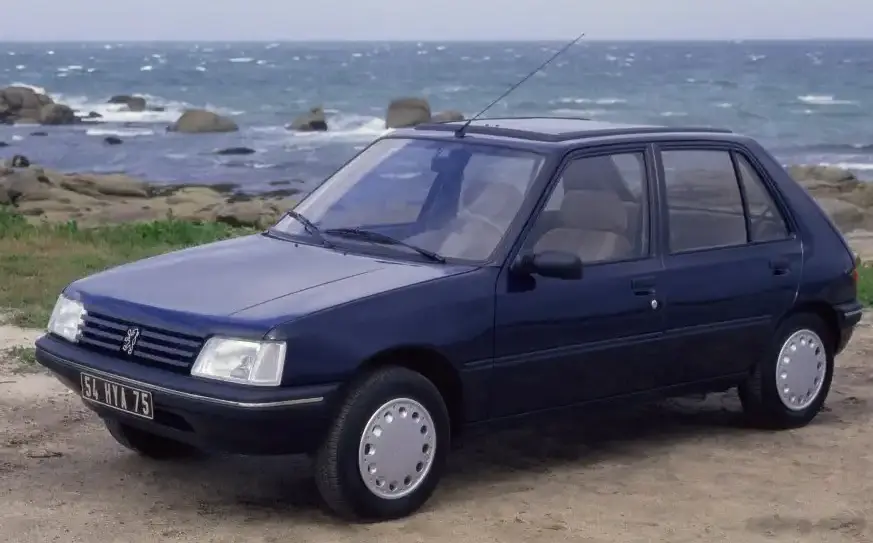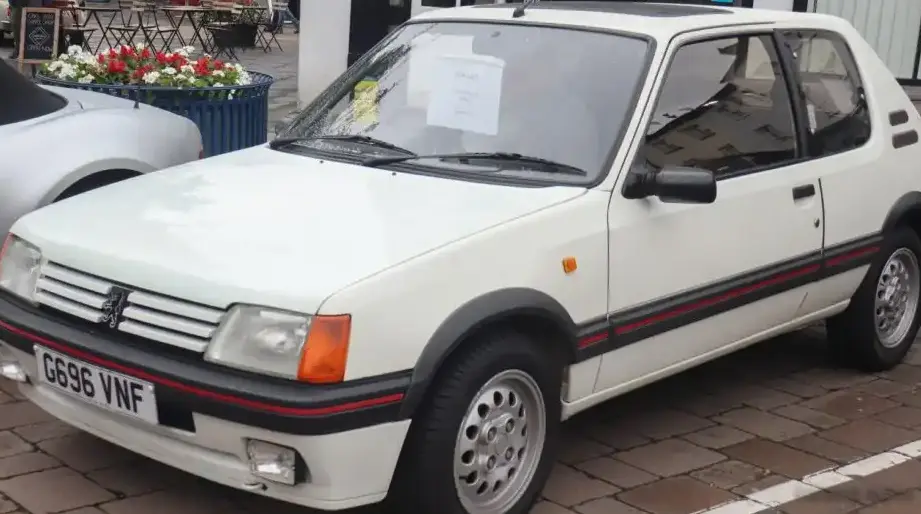
The Peugeot 205 I 1.6 GTI, produced between 1983 and 1987, represents a pivotal moment in the history of hot hatchbacks. Part of the 205 series (internal codes 741A/C), this 3-door variant was designed to offer an engaging driving experience in a compact and affordable package. It quickly became a benchmark in its class, celebrated for its nimble handling and spirited performance. The 1.6 GTI occupied the top performance tier of the 205 range, positioned above the more economical GL and GR models, and served as a precursor to the even more potent 205 GTI 1.9. It was primarily marketed in Europe, where the demand for small, sporty cars was particularly strong.
Technical Specifications
| Brand | Peugeot |
| Model | 205 |
| Generation | 205 I (741A/C) 3-door |
| Type (Engine) | 1.6 GTI (105 Hp) |
| Start of production | 1983 |
| End of production | 1987 |
| Powertrain Architecture | Internal Combustion engine |
| Body type | Hatchback |
| Seats | 4 |
| Doors | 3 |
| Fuel consumption (urban) | 8.7 l/100 km (27 US mpg, 32.5 UK mpg, 11.5 km/l) |
| Fuel consumption (extra urban) | 5.6 l/100 km (42 US mpg, 50.4 UK mpg, 17.9 km/l) |
| Fuel Type | Petrol (Gasoline) |
| Acceleration 0 – 100 km/h | 9.5 sec |
| Acceleration 0 – 62 mph | 9.5 sec |
| Acceleration 0 – 60 mph | 9 sec |
| Maximum speed | 190 km/h (118.06 mph) |
| Weight-to-power ratio | 8.1 kg/Hp, 123.5 Hp/tonne |
| Weight-to-torque ratio | 6.3 kg/Nm, 157.6 Nm/tonne |
| Power | 105 Hp @ 6250 rpm |
| Power per litre | 66.5 Hp/l |
| Torque | 134 Nm @ 4000 rpm (98.83 lb.-ft. @ 4000 rpm) |
| Engine layout | Front, Transverse |
| Engine Model/Code | XU5J |
| Engine displacement | 1580 cm3 (96.42 cu. in.) |
| Number of cylinders | 4 |
| Engine configuration | Inline |
| Cylinder Bore | 83 mm (3.27 in.) |
| Piston Stroke | 73 mm (2.87 in.) |
| Compression ratio | 10.2:1 |
| Number of valves per cylinder | 2 |
| Fuel injection system | Multi-port manifold injection |
| Engine aspiration | Naturally aspirated engine |
| Valvetrain | OHC |
| Engine oil capacity | 4.8 l (5.07 US qt, 4.22 UK qt) |
| Coolant | 6.6 l (6.97 US qt, 5.81 UK qt) |
| Kerb Weight | 850 kg (1873.93 lbs.) |
| Max. weight | 1275 kg (2810.89 lbs.) |
| Max load | 425 kg (936.96 lbs.) |
| Trunk (boot) space – minimum | 246 l (8.69 cu. ft.) |
| Trunk (boot) space – maximum | 564 l (19.92 cu. ft.) |
| Fuel tank capacity | 50 l (13.21 US gal, 11 UK gal) |
| Permitted trailer load with brakes (12%) | 800 kg (1763.7 lbs.) |
| Length | 3705 mm (145.87 in.) |
| Width | 1572 mm (61.89 in.) |
| Height | 1373 mm (54.06 in.) |
| Wheelbase | 2420 mm (95.28 in.) |
| Front track | 1350 mm (53.15 in.) |
| Rear (Back) track | 1300 mm (51.18 in.) |
| Front overhang | 680 mm (26.77 in.) |
| Rear overhang | 605 mm (23.82 in.) |
| Drag coefficient (Cd) | 0.35 |
| Minimum turning circle (turning diameter) | 10.5 m (34.45 ft.) |
| Drivetrain Architecture | The Internal combustion engine (ICE) drives the front wheels of the vehicle. |
| Drive wheel | Front wheel drive |
| Number of gears and type of gearbox | 5 gears, manual transmission |
| Front suspension | Independent, type McPherson with coil spring and anti-roll bar |
| Rear suspension | Torsion |
| Front brakes | Disc |
| Rear brakes | Drum |
| Steering type | Steering rack and pinion |
| Power steering | Hydraulic Steering |
| Tires size | 185/60 R14 |
| Wheel rims size | 14 |
INTRODUCTION
The Peugeot 205 I 1.6 GTI, launched in 1983, quickly established itself as a leader in the burgeoning hot hatch segment. Built on the lightweight 205 platform (741A/C), it offered a compelling blend of performance, handling, and affordability. The 205 range itself was a significant departure for Peugeot, moving away from larger, more traditional designs towards a smaller, more modern aesthetic. The GTI variant, with its more powerful engine and sporty trim, was aimed at drivers seeking a more engaging and dynamic driving experience. Production continued until 1987, paving the way for the later, more refined 205 GTI 1.9.
Powertrain & Engine Architecture
At the heart of the 205 1.6 GTI lies the XU5J engine, a 1.6-liter inline-four cylinder petrol engine. This engine, a staple in many Peugeot and Citroën models of the era, featured a single overhead camshaft (OHC) and two valves per cylinder. The XU5J in the GTI was equipped with Bosch multi-port fuel injection, contributing to its responsive throttle and improved fuel efficiency compared to earlier carbureted engines. The engine produced 105 horsepower at 6250 rpm and 134 Nm (98.83 lb-ft) of torque at 4000 rpm. The engine’s transverse mounting and front-wheel drive configuration were typical for European hatchbacks of the time. The 205 1.6 GTI exclusively came with a five-speed manual transmission, optimized for spirited driving and maximizing the engine’s power band. This transmission was known for its precise shift action and relatively short ratios.
Driving Characteristics
The 205 1.6 GTI offered a remarkably engaging driving experience. Its relatively low weight (around 850 kg or 1874 lbs) combined with the 105 hp engine resulted in a brisk 0-60 mph time of approximately 9 seconds and a top speed of 118 mph. While not blistering by modern standards, these figures were competitive for its time and class. The car’s nimble handling was a key attribute, thanks to its well-tuned suspension – independent McPherson struts at the front and a torsion beam rear axle. The steering, a rack and pinion system with hydraulic assistance, provided precise feedback and a direct connection to the road. Compared to the later 205 GTI 1.9, the 1.6 GTI offered a slightly less aggressive power delivery, making it more accessible and forgiving for everyday driving. The 1.9 version, with its larger engine, provided significantly more torque and a more visceral experience, but at the cost of some low-speed drivability.
Equipment & Trim Levels
The 1.6 GTI was well-equipped for its era, though options were available to further enhance the driving experience. Standard features included sporty cloth seats, a leather-wrapped steering wheel, and a comprehensive instrument cluster. The interior trim was generally functional and focused on providing a driver-centric environment. Optional extras included a sunroof, alloy wheels (often Speedline), and upgraded audio systems. The exterior styling was relatively understated, with subtle GTI badging and a rear spoiler distinguishing it from the lower-spec models. The interior typically featured a dark color scheme with red accents, reflecting the car’s sporty character.
Chassis & Braking
The 205 1.6 GTI’s chassis was designed to maximize handling and minimize weight. The front suspension utilized McPherson struts with coil springs and an anti-roll bar, while the rear employed a simple but effective torsion beam setup. Braking duties were handled by disc brakes at the front and drum brakes at the rear. While adequate for most driving situations, the rear drum brakes were a common point of criticism, particularly for drivers who frequently engaged in spirited driving. The car rode on 185/60 R14 tires, providing a good balance of grip and comfort.
Market Reception & Comparison
The Peugeot 205 1.6 GTI was widely praised by automotive journalists and enthusiasts alike. It was lauded for its engaging handling, responsive engine, and overall fun-to-drive character. Compared to rivals like the Volkswagen Golf GTI and Ford Fiesta XR2, the 205 GTI was often considered to be the more agile and rewarding to drive. Fuel economy was respectable for a performance car of the time, averaging around 35 mpg on the combined cycle. Reliability was generally good, although the XU5J engine could be prone to overheating if not properly maintained. The 1.6 GTI offered a more affordable entry point into the GTI range compared to the later 1.9 version, making it popular with younger drivers and those seeking a more economical hot hatch.
Legacy
The Peugeot 205 1.6 GTI remains a highly sought-after classic car today. Its combination of performance, handling, and affordability has cemented its place in automotive history. Well-maintained examples are increasingly valuable, attracting collectors and enthusiasts who appreciate its unique character and driving experience. The XU5J engine, while not without its quirks, is generally considered to be a robust and reliable unit when properly cared for. The 205 GTI, in all its iterations, helped to define the hot hatch segment and continues to inspire car enthusiasts around the world. Its influence can be seen in many modern performance cars, which strive to replicate its blend of agility, responsiveness, and driver engagement.