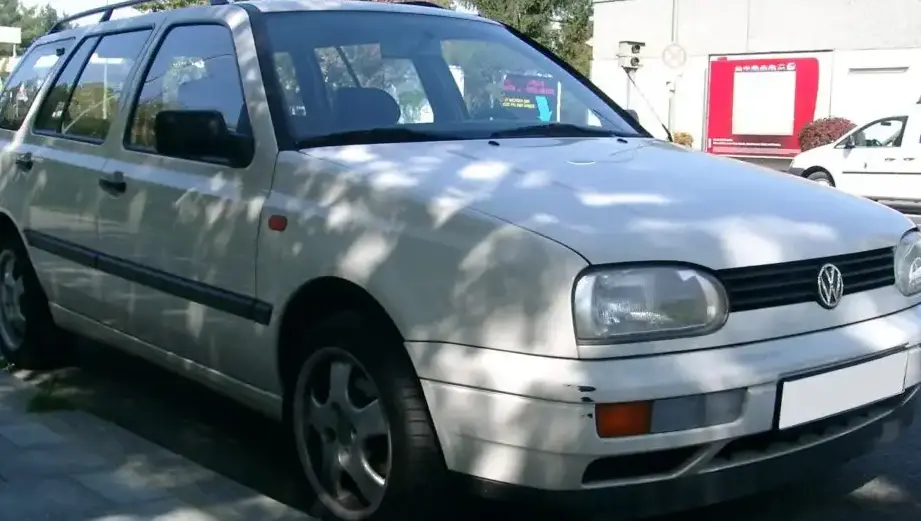
The Volkswagen Golf III Variant 1.9 D, producing 65 horsepower, was a mainstay of the Golf III range from 1993 to 1999. Positioned as the entry-level diesel option within the Variant (estate) body style, it offered practicality and fuel economy for European buyers. This model played a significant role in solidifying the Golf’s reputation as a versatile and affordable family vehicle. It was part of the Golf Mk3 generation (Typ 1H5), which represented a substantial leap forward in terms of refinement, safety, and technology compared to its predecessor.
Technical Specifications
| Brand | Volkswagen |
| Model | Golf |
| Generation | Golf III Variant |
| Type (Engine) | 1.9 D (65 Hp) |
| Start of production | 1993 |
| End of production | 1999 |
| Powertrain Architecture | Internal Combustion engine |
| Body type | Station wagon (estate) |
| Seats | 5 |
| Doors | 5 |
| Fuel consumption (combined) | 5.9 l/100 km (39.9 US mpg, 47.9 UK mpg, 16.9 km/l) |
| Fuel Type | Diesel |
| Acceleration 0 – 100 km/h | 18.6 sec |
| Acceleration 0 – 62 mph | 18.6 sec |
| Acceleration 0 – 60 mph | 17.7 sec |
| Maximum speed | 154 km/h (95.69 mph) |
| Weight-to-power ratio | 19 kg/Hp, 52.6 Hp/tonne |
| Weight-to-torque ratio | 10 kg/Nm, 100.4 Nm/tonne |
| Power | 65 Hp @ 4400 rpm |
| Power per litre | 34.3 Hp/l |
| Torque | 124 Nm @ 2000 rpm (91.46 lb.-ft. @ 2000 rpm) |
| Engine layout | Front, Transverse |
| Engine Model/Code | 1Y |
| Engine displacement | 1896 cm3 (115.7 cu. in.) |
| Number of cylinders | 4 |
| Engine configuration | Inline |
| Cylinder Bore | 79.5 mm (3.13 in.) |
| Piston Stroke | 95.5 mm (3.76 in.) |
| Compression ratio | 22.5:1 |
| Number of valves per cylinder | 2 |
| Fuel injection system | Precombustion chamber injection |
| Engine aspiration | Naturally aspirated engine |
| Valvetrain | OHC |
| Engine oil capacity | 4.3 l (4.54 US qt | 3.78 UK qt) |
| Coolant | 6.3 l (6.66 US qt | 5.54 UK qt) |
| Kerb Weight | 1235 kg (2722.71 lbs.) |
| Max. weight | 1660 kg (3659.67 lbs.) |
| Max load | 425 kg (936.96 lbs.) |
| Trunk (boot) space – minimum | 466 l (16.46 cu. ft.) |
| Trunk (boot) space – maximum | 1425 l (50.32 cu. ft.) |
| Fuel tank capacity | 60 l (15.85 US gal | 13.2 UK gal) |
| Length | 4340 mm (170.87 in.) |
| Width | 1695 mm (66.73 in.) |
| Height | 1430 mm (56.3 in.) |
| Wheelbase | 2475 mm (97.44 in.) |
| Front track | 1478 mm (58.19 in.) |
| Rear (Back) track | 1462 mm (57.56 in.) |
| Drivetrain Architecture | The Internal combustion engine (ICE) drives the front wheels of the vehicle. |
| Drive wheel | Front wheel drive |
| Number of gears and type of gearbox | 5 gears, manual transmission |
| Front suspension | Wishbone |
| Rear suspension | Suspension with traction connecting levers |
| Front brakes | Disc |
| Rear brakes | Drum |
| Assisting systems | ABS (Anti-lock braking system) |
| Steering type | Steering rack and pinion |
| Power steering | Hydraulic Steering |
| Tires size | 185/60 R14 |
| Wheel rims size | 14 |
Powertrain & Engine Architecture
The 1.9 D engine, identified by the code 1Y, was a naturally aspirated, inline-four cylinder diesel engine. It utilized a precombustion chamber injection system, a common technology for diesel engines of the era. This system involved injecting fuel into a precombustion chamber connected to the main cylinder, promoting more complete combustion and reducing noise. The engine featured an overhead camshaft (OHC) valvetrain operating two valves per cylinder. The 1.9 D was known for its robust construction and relative simplicity, contributing to its longevity. The five-speed manual transmission was the standard offering, providing a fairly wide range of gear ratios designed to maximize fuel efficiency and manage the engine’s limited power output.
Driving Characteristics
The 65 hp 1.9 D engine in the Golf III Variant delivered modest performance. Acceleration was slow, with 0-60 mph taking around 17.7 seconds. The focus was clearly on fuel economy rather than outright speed. The engine produced usable torque at low RPMs, making it adequate for everyday driving and hauling loads, but overtaking required careful planning. Compared to the more powerful gasoline variants (like the 1.8 or VR6) or even the 1.9 TDI, the 1.9 D felt significantly underpowered. The manual transmission’s gear ratios were optimized for efficiency, meaning that frequent downshifts were necessary when climbing hills or accelerating.
Equipment & Trim Levels
The 1.9 D Variant typically came with a basic level of equipment. Standard features generally included power steering, central locking, and a basic stereo system. Interior upholstery was typically cloth, and the dashboard featured a functional but utilitarian design. Optional extras included power windows, air conditioning, and alloy wheels. The trim level was generally considered entry-level, appealing to buyers prioritizing affordability and practicality over luxury features. The Variant body style itself added to the practicality, offering a significantly larger cargo area than the hatchback version.
Chassis & Braking
The Golf III Variant 1.9 D utilized a front independent suspension with wishbones and a rear suspension with traction connecting levers. This setup provided a reasonable balance between ride comfort and handling. Braking was accomplished via front disc brakes and rear drum brakes. ABS (Anti-lock Braking System) was often included as standard equipment, enhancing safety. The suspension was tuned for comfort, and stabilizer bars were present to reduce body roll during cornering, though the overall handling characteristics were geared towards safe and predictable driving rather than sporty performance.
Market Reception & Comparison
The Golf III Variant 1.9 D was well-received in European markets as an affordable and economical estate car. Critics praised its fuel efficiency and practicality, but noted its lack of performance. Compared to the gasoline-powered Golfs, the 1.9 D offered significantly better fuel economy but considerably slower acceleration. The 1.9 TDI diesel variant, introduced later in the Golf III’s lifecycle, offered a compelling alternative with more power and torque, but at a higher price point. The 1.9 D appealed to buyers who prioritized running costs and reliability over driving excitement.
Legacy
The 1.9 D engine proved to be remarkably durable and reliable. Many examples are still on the road today, testament to its robust construction. In the used car market, the Golf III Variant 1.9 D is often sought after by those looking for a simple, affordable, and economical vehicle. Maintenance costs are generally low, and parts availability remains good. While not a performance icon, the 1.9 D Variant represents a practical and enduring example of Volkswagen’s commitment to building versatile and reliable family cars.