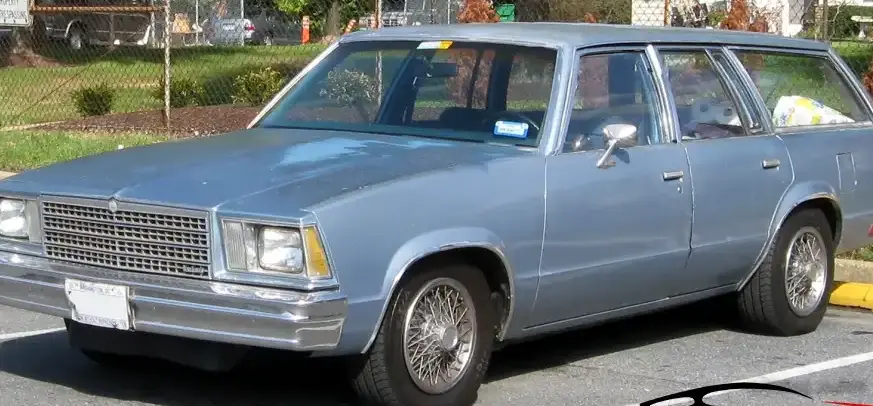
The Chevrolet Malibu IV Station Wagon, produced for the 1980 and 1981 model years, represented Chevrolet’s entry into the increasingly popular station wagon market. This generation of the Malibu, built on the A-body platform, offered a practical and spacious alternative to sedans, appealing to families and those needing substantial cargo capacity. The 5.0 V8 (155 hp) CAT Automatic variant occupied a unique position within the Malibu IV lineup, offering a blend of performance and convenience not found in the smaller-engined models. It was positioned as a step up from the six-cylinder options, providing more power for towing or highway cruising, while the automatic transmission catered to drivers prioritizing ease of use over outright driver engagement.
Technical Specifications
| Brand | Chevrolet |
| Model | Malibu |
| Generation | Malibu IV Station Wagon |
| Type (Engine) | 5.0 V8 (155 Hp) CAT Automatic |
| Start of production | 1980 year |
| End of production | 1981 year |
| Powertrain Architecture | Internal Combustion engine |
| Body type | Station wagon (estate) |
| Seats | 6 |
| Doors | 5 |
| Fuel Type | Petrol (Gasoline) |
| Weight-to-power ratio | 10 kg/Hp, 100.4 Hp/tonne |
| Weight-to-torque ratio | 4.7 kg/Nm, 215 Nm/tonne |
| Power | 155 Hp @ 4000 rpm |
| Power per litre | 31 Hp/l |
| Torque | 332 Nm @ 1600 rpm, 244.87 lb.-ft. @ 1600 rpm |
| Engine layout | Front, Longitudinal |
| Engine displacement | 5001 cm3, 305.18 cu. in. |
| Number of cylinders | 8 |
| Engine configuration | V-engine |
| Cylinder Bore | 95 mm, 3.74 in. |
| Piston Stroke | 88.4 mm, 3.48 in. |
| Compression ratio | 8.6:1 |
| Number of valves per cylinder | 2 |
| Fuel injection system | Carburettor |
| Engine aspiration | Naturally aspirated engine |
| Valvetrain | OHV |
| Kerb Weight | 1544 kg, 3403.94 lbs |
| Trunk (boot) space – minimum | 1133 l, 40.01 cu. ft |
| Trunk (boot) space – maximum | 2050 l, 72.4 cu. ft |
| Fuel tank capacity | 69 l, 18.23 US gal | 15.18 UK gal |
| Length | 4911 mm, 193.35 in |
| Width | 1816 mm, 71.5 in |
| Height | 1384 mm, 54.49 in |
| Wheelbase | 2745 mm, 108.07 in |
| Front track | 1486 mm, 58.5 in |
| Rear (Back) track | 1467 mm, 57.76 in |
| Front overhang | 915 mm, 36.02 in |
| Rear overhang | 1251 mm, 49.25 in |
| Ride height (ground clearance) | 145 mm, 5.71 in |
| Minimum turning circle (turning diameter) | 13.0 m, 42.65 ft |
| Approach angle | 20° |
| Departure angle | 15° |
| Ramp-over (brakeover) angle | 14° |
| Drivetrain Architecture | The Internal combustion engine (ICE) drives the rear wheels of the vehicle. |
| Drive wheel | Rear wheel drive |
| Number of gears and type of gearbox | 3 gears, automatic transmission |
| Front suspension | Independent, type McPherson with coil spring and anti-roll bar |
| Rear suspension | dependent spring suspension, Transverse stabilizer, Trailing arm |
| Front brakes | Ventilated discs |
| Rear brakes | Drum |
| Steering type | Steering rack and pinion |
| Tires size | 195/75 R14 |
| Wheel rims size | 6.0J x 14 |
Powertrain & Engine Architecture
The heart of this Malibu variant was Chevrolet’s 305 cubic inch (5.0 liter) small-block V8 engine. Designated with the “Q” code, this engine was equipped with a two-barrel carburetor and a catalytic converter (hence the “CAT” designation), reflecting the growing emphasis on emissions control in the late 1970s and early 1980s. The engine utilized an overhead valve (OHV) valvetrain with two valves per cylinder. While not a high-performance engine by any means, it provided adequate power for the Malibu’s size and weight. The three-speed Turbo-Hydramatic automatic transmission was standard, offering smooth and relatively efficient gear changes. This transmission was known for its durability, but its three-speed configuration meant that the engine often operated at higher RPMs during highway cruising compared to more modern transmissions.
Driving Characteristics
The 155 hp V8 and three-speed automatic combination delivered a comfortable, if not particularly exhilarating, driving experience. Acceleration was adequate for merging onto highways and passing slower traffic, but it wasn’t a sporty car. The automatic transmission’s gear ratios were optimized for cruising, resulting in a relaxed driving experience on the open road. However, the lack of overdrive meant that engine speeds were higher at highway speeds, impacting fuel economy. Compared to the manual transmission versions of the Malibu, the automatic offered less driver control and a slightly slower 0-60 mph time. The rear-wheel-drive layout provided a balanced feel, but the suspension, while comfortable, wasn’t designed for aggressive cornering.
Equipment & Trim Levels
The 5.0 V8 Automatic Malibu Station Wagon typically included features such as cloth upholstery, a basic AM radio, and full wheel covers. Power steering and power brakes were often standard. Options included air conditioning, a more advanced stereo system, and upgraded interior trim. The station wagon body style itself added practicality with its large cargo area and fold-flat rear seats. The interior design was typical of American cars of the era – functional and spacious, but not particularly luxurious. The dashboard layout was straightforward, with clearly marked gauges and easy-to-use controls.
Chassis & Braking
The Malibu IV Station Wagon utilized a body-on-frame construction, which was common for American cars of this period. The front suspension was independent, employing McPherson struts with coil springs and an anti-roll bar. The rear suspension was a traditional solid axle setup with coil springs and a transverse stabilizer bar. This suspension configuration prioritized ride comfort over handling precision. The braking system featured ventilated disc brakes at the front and drum brakes at the rear. While adequate for normal driving conditions, the braking performance wasn’t particularly strong by modern standards.
Market Reception & Comparison
The 5.0 V8 Automatic Malibu Station Wagon was generally well-received by consumers looking for a practical and spacious family vehicle. Critics noted the engine’s adequate power and the automatic transmission’s convenience. However, fuel economy was a concern, especially as gasoline prices began to rise in the early 1980s. Compared to the six-cylinder Malibu models, the V8 offered more power but at the cost of increased fuel consumption. Compared to competing station wagons from Ford and Chrysler, the Malibu offered a similar level of practicality and comfort, but often at a slightly lower price point.
Legacy
The Chevrolet Malibu IV Station Wagon 5.0 V8 Automatic, while not a particularly rare or collectible vehicle today, represents a significant chapter in Chevrolet’s history. The 305 small-block V8 engine proved to be remarkably durable and is still highly regarded by enthusiasts. While the automatic transmission is generally reliable, it may require occasional servicing to maintain optimal performance. In the used car market, these Malibus are often sought after by those looking for a classic American car with a comfortable ride and a spacious interior. Their relative simplicity makes them relatively easy to maintain and repair, appealing to DIY mechanics. The combination of a V8 engine and a station wagon body style provides a unique blend of practicality and nostalgia that continues to attract a dedicated following.