
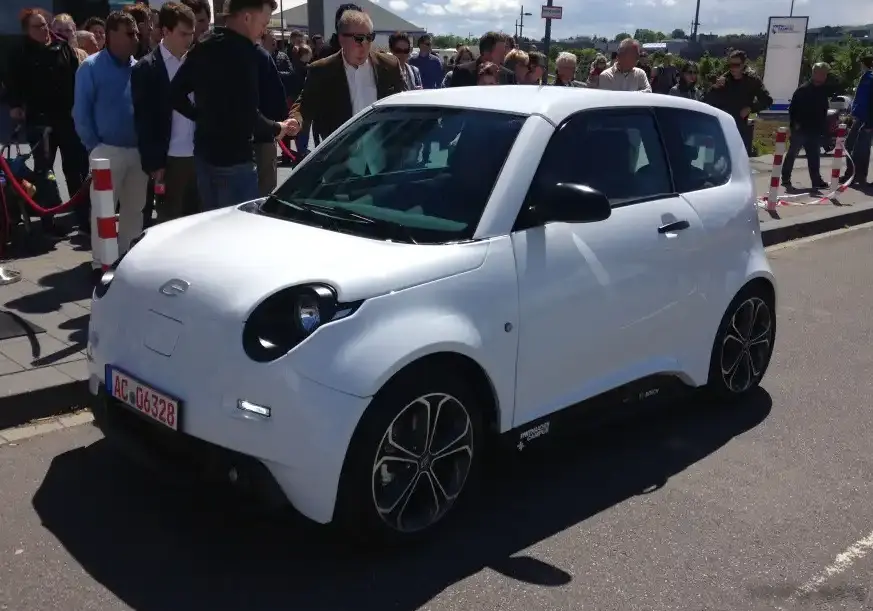
The e.GO Life 40 17.9 kWh (54 hp) is a city-focused electric hatchback produced by the German manufacturer e.GO Mobile from 2018 onwards. Positioned as an entry-level electric vehicle, the Life 40 aimed to provide affordable and practical transportation for urban environments. It was a key model in e.GO’s initial lineup, representing the company’s commitment to accessible electric mobility. The “40” designation refers to the model’s approximate real-world range, while the 17.9 kWh battery capacity and 54 horsepower output define its core specifications. The e.GO Life was designed with a focus on lightweight construction and functional design, prioritizing efficiency over outright performance.
Technical Specifications
| Brande | e.GO |
| Model | Life |
| Generation | Life |
| Type (Engine) | Life 40 17.9 kWh (54 Hp) Electric |
| Start of production | 2018 |
| Powertrain Architecture | BEV (Electric Vehicle) |
| Body type | Hatchback |
| Seats | 4 |
| Doors | 3 |
| Fuel Type | Electricity |
| Maximum speed | 130 km/h (80.78 mph) |
| Weight-to-power ratio | 16.7 kg/Hp, 60 Hp/tonne |
| Gross battery capacity | 17.9 kWh |
| All-electric range | 124 km (77.05 mi) |
| Average Energy consumption | 12.1 kWh/100 km (19.47 kWh/100 mi) |
| MPGe | 173 |
| km/kWh | 8.3 |
| mi/kWh | 5.1 |
| Electric motor power | 54 Hp |
| System power | 54 Hp |
| Kerb Weight | 900 kg (1984.16 lbs.) |
| Max. weight | 1300 kg (2866.01 lbs.) |
| Max load | 400 kg (881.85 lbs.) |
| Length | 3348 mm (131.81 in.) |
| Width | 1700 mm (66.93 in.) |
| Height | 1567 mm (61.69 in.) |
| Wheelbase | 2200 mm (86.61 in.) |
| Front track | 1475 mm (58.07 in.) |
| Rear (Back) track | 1483 mm (58.39 in.) |
| Minimum turning circle | 9.0 m (29.53 ft.) |
| Drive wheel | Front wheel drive |
| Number of gears | 1 |
| Gearbox type | automatic transmission |
| Front brakes | Ventilated discs |
| Rear brakes | Drum |
| Assisting systems | ABS (Anti-lock braking system) |
| Tires size | 205/45 R17 |
| Wheel rims size | 17 |
Powertrain & Engine Architecture
The e.GO Life 40 utilizes a single electric motor, producing 54 horsepower. This motor is directly coupled to the front wheels, providing front-wheel drive. The powertrain is built around a 17.9 kWh lithium-ion battery pack, which is mounted low in the vehicle’s chassis to contribute to a lower center of gravity and improved stability. The electric motor doesn’t have a traditional valvetrain or fuel injection system; instead, it relies on an inverter to convert DC power from the battery into AC power for the motor. The single-speed automatic transmission simplifies the driving experience, offering seamless acceleration without the need for gear changes. The battery management system (BMS) plays a crucial role in optimizing battery performance, longevity, and safety, monitoring cell voltages, temperatures, and current flow. The BMS is a sophisticated system that prevents overcharging, deep discharging, and thermal runaway, all of which can damage the battery pack.
Driving Characteristics
The e.GO Life 40’s driving experience is geared towards urban practicality rather than spirited performance. With only 54 horsepower, acceleration is modest, but sufficient for navigating city streets. The single-speed automatic transmission provides smooth and linear power delivery. The car’s relatively light weight (900 kg) helps to mitigate the lack of power, making it feel reasonably nimble in traffic. The limited range of 124 km (77 miles) makes it best suited for daily commutes and short trips within the city. Compared to potential future higher-powered e.GO models, the Life 40 prioritizes efficiency and affordability over outright speed and range. The regenerative braking system helps to recapture energy during deceleration, extending the range slightly and reducing wear on the brake pads. The regenerative braking isn’t adjustable, offering a single level of deceleration when lifting off the accelerator.
Equipment & Trim Levels
The e.GO Life 40 was offered with a relatively basic level of standard equipment, reflecting its position as an entry-level EV. Standard features typically included air conditioning, power windows, central locking, and an infotainment system with basic connectivity options. The interior was characterized by a functional and minimalist design, with durable materials. Optional extras included features such as a rearview camera, parking sensors, and upgraded upholstery. The trim levels were fairly limited, with most customization options revolving around exterior colors and interior finishes. The focus was on providing a practical and affordable electric vehicle, rather than a luxury experience. The dashboard layout is simple and straightforward, prioritizing ease of use over aesthetic complexity.
Chassis & Braking
The e.GO Life 40 features a MacPherson strut front suspension and a twist-beam rear suspension. The front brakes are ventilated discs, providing adequate stopping power, while the rear brakes are drums, a cost-saving measure. The car’s relatively lightweight construction contributes to its handling characteristics. The ABS (Anti-lock Braking System) is standard, enhancing safety during emergency braking situations. The 17-inch wheels and 205/45 R17 tires provide a balance between ride comfort and handling. The suspension is tuned for comfort, prioritizing a smooth ride over sporty handling. The steering is electrically assisted, providing light and easy maneuverability, particularly useful in tight urban environments.
Market Reception & Comparison
The e.GO Life 40 received mixed reviews from automotive critics. While praised for its affordability and practicality, it was often criticized for its limited range, modest performance, and basic interior. Compared to other EVs on the market at the time, such as the Renault Zoe or the Nissan Leaf, the e.GO Life 40 offered a lower price point but also a significantly shorter range and less refined driving experience. Its fuel economy, measured in kWh/100km, was competitive with other small EVs, but its overall range was a key limitation. The car’s target audience was primarily urban dwellers seeking an affordable and eco-friendly mode of transportation for short commutes. Some reviewers noted the car’s unique styling and its commitment to sustainable manufacturing practices as positive attributes.
Legacy
The e.GO Life 40 played a significant role in establishing e.GO Mobile as a player in the emerging electric vehicle market. While the company faced financial challenges and production delays, the Life 40 demonstrated the potential for affordable electric mobility. The powertrain, while not particularly powerful, proved to be relatively reliable in real-world use. On the used car market, the e.GO Life 40 remains an affordable option for those seeking a basic electric vehicle for city driving. However, potential buyers should be aware of the limited range and the potential for battery degradation over time. Battery health is a key consideration for prospective buyers, and a battery capacity test is recommended before purchase. The e.GO Life 40 represents an early attempt to democratize electric vehicle ownership, paving the way for more affordable and accessible EVs in the future.
