Technical Specifications
| Brand | Audi |
| Model | A6 |
| Generation | A6 Sedan (C8, facelift 2023) |
| Type (Engine) | 55 TFSI V6 (340 Hp) Mild Hybrid quattro ultra S tronic |
| Start of production | June, 2023 |
| End of production | March, 2025 |
| Powertrain Architecture | MHEV (Mild Hybrid Electric Vehicle) |
| Body type | Sedan |
| Seats | 5 |
| Doors | 4 |
| Combined fuel consumption (WLTP) | 7.9-8.8 l/100 km (29.8 – 26.7 US mpg, 35.8 – 32.1 UK mpg, 12.7 – 11.4 km/l) |
| CO2 emissions (WLTP) | 179-200 g/km |
| Fuel Type | Petrol (Gasoline) |
| Acceleration 0 – 100 km/h | 4.9 sec |
| Acceleration 0 – 62 mph | 4.9 sec |
| Acceleration 0 – 60 mph | 4.7 sec |
| Maximum speed | 250 km/h (155.34 mph), Electronically limited |
| Emission standard | Euro 6e |
| Weight-to-power ratio | 5.2 kg/Hp, 192.1 Hp/tonne |
| Weight-to-torque ratio | 3.5 kg/Nm, 282.5 Nm/tonne |
| Gross battery capacity | 0.5 kWh |
| Battery voltage | 48 V |
| Battery technology | Lithium-ion (Li-Ion) |
| Battery weight | 10 kg (22.05 lbs) |
| Battery location | Under the trunk |
| Recuperation output | 14 kW |
| Electric motor power | 8 Hp |
| Electric motor Torque | 60 Nm (44.25 lb.-ft.) |
| Electric motor location | Front, Longitudinal |
| Power | 340 Hp @ 5200-6400 rpm |
| Torque | 500 Nm @ 1370-4500 rpm (368.78 lb.-ft. @ 1370-4500 rpm) |
| Engine layout | Front, Longitudinal |
| Engine Model/Code | EA839 |
| Engine displacement | 2995 cm3 (182.77 cu. in.) |
| Number of cylinders | 6 |
| Engine configuration | V-engine |
| Cylinder Bore | 84.5 mm (3.33 in.) |
| Piston Stroke | 89 mm (3.5 in.) |
| Compression ratio | 11.2:1 |
| Number of valves per cylinder | 4 |
| Fuel injection system | Direct injection |
| Engine aspiration | Turbocharger, Intercooler |
| Valvetrain | DOHC |
| Engine oil capacity | 7.6 l (8.03 US qt | 6.69 UK qt) |
| Coolant | 11.5 l (12.15 US qt | 10.12 UK qt) |
| Kerb Weight | 1770 kg (3902.18 lbs) |
| Max. weight | 2400 kg (5291.09 lbs) |
| Max load | 630 kg (1388.91 lbs) |
| Trunk (boot) space – minimum | 520 l (18.36 cu. ft.) |
| Fuel tank capacity | 63 l (16.64 US gal | 13.86 UK gal) |
| Max. roof load | 90 kg (198.42 lbs) |
| Permitted trailer load with brakes (8%) | 2000 kg (4409.25 lbs) |
| Permitted trailer load with brakes (12%) | 2000 kg (4409.25 lbs) |
| Permitted trailer load without brakes | 750 kg (1653.47 lbs) |
| Permitted towbar download | 95 kg (209.44 lbs) |
| Length | 4939 mm (194.45 in.) |
| Width | 1886 mm (74.25 in.) |
| Width including mirrors | 2110 mm (83.07 in.) |
| Height | 1457 mm (57.36 in.) |
| Wheelbase | 2924 mm (115.12 in.) |
| Front track | 1630 mm (64.17 in.) |
| Rear (Back) track | 1617 mm (63.66 in.) |
| Front overhang | 920 mm (36.22 in.) |
| Rear overhang | 1095 mm (43.11 in.) |
| Drag coefficient (Cd) | 0.26 |
| Minimum turning circle (turning diameter) | 12.1 m (39.7 ft.) |
| Approach angle | 13.7° |
| Departure angle | 16.9° |
| Drive wheel | All wheel drive (4×4) |
| Number of gears and type of gearbox | 7 gears, automatic transmission S tronic |
| Front suspension | Independent multi-link suspension |
| Rear suspension | Independent multi-link suspension |
| Front brakes | Ventilated discs, 375 mm |
| Rear brakes | Ventilated discs, 330 mm |
| Tires size | 225/55 R18; 245/45 R19; 255/40 R20; 255/35 R21 |
| Wheel rims size | 8J x 18; 8.5J x 19; 8.5J x 20; 8.5J x 21 |
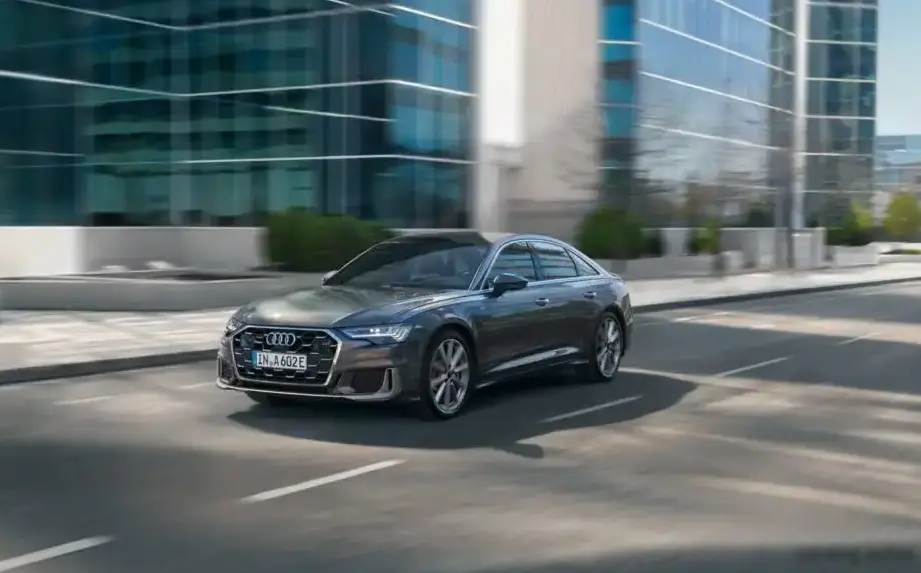
The Audi A6 Sedan (C8) facelift’s 55 TFSI V6 Mild Hybrid quattro ultra S tronic model, produced from June 2023 to March 2025, represents a significant offering in the mid-size luxury sedan market. Positioned as a higher-performance alternative to the base A6 trims, it caters to buyers seeking a blend of spirited driving dynamics and refined comfort. The “55 TFSI” designation indicates the engine’s power output according to Audi’s internal naming convention, while “quattro ultra” signifies the on-demand all-wheel-drive system. The S tronic transmission is Audi’s dual-clutch gearbox, known for its quick and smooth shifts. This variant is primarily aimed at the European and Asian markets, where demand for sophisticated, technologically advanced sedans remains strong.
Powertrain & Engine Architecture
At the heart of the A6 55 TFSI lies the EA839 3.0-liter V6 engine. This engine utilizes a direct injection system and is coupled with a single twin-scroll turbocharger and an intercooler to deliver 340 horsepower at 5200-6400 rpm and 500 Nm (368.78 lb-ft) of torque between 1370-4500 rpm. The mild hybrid system, operating at 48 volts, incorporates a belt-driven starter generator (BSG) and a small lithium-ion battery. This system enables features like extended engine-off coasting, smoother start-stop operation, and a slight power boost during acceleration. The seven-speed S tronic dual-clutch transmission provides rapid gear changes and contributes to the car’s overall efficiency. The transmission is designed to work seamlessly with the quattro all-wheel-drive system, distributing power between the front and rear axles as needed to optimize traction and handling.
Driving Characteristics
The 55 TFSI V6 Automatic delivers a noticeably more engaging driving experience than the lower-powered A6 variants. The readily available torque from the turbocharged V6 provides strong acceleration, with a 0-60 mph time of around 4.7 seconds. The S tronic transmission shifts quickly and decisively, enhancing the sense of responsiveness. The quattro all-wheel-drive system provides excellent grip in various conditions, inspiring confidence during cornering. While not as overtly sporty as the S6, the 55 TFSI strikes a good balance between performance and comfort. The mild hybrid system contributes to improved fuel economy, particularly in city driving, without significantly compromising performance.
Equipment & Trim Levels
The A6 55 TFSI typically comes well-equipped as standard. Features generally include Audi’s Virtual Cockpit digital instrument cluster, a touchscreen infotainment system with navigation, leather upholstery, tri-zone automatic climate control, and a suite of advanced driver-assistance systems such as adaptive cruise control, lane-keeping assist, and automatic emergency braking. Optional extras often include a premium sound system (Bang & Olufsen), massaging front seats, a head-up display, and various cosmetic enhancements. Interior trim options range from brushed aluminum to wood veneers, allowing buyers to personalize the cabin to their preferences.
Chassis & Braking
The A6 55 TFSI utilizes an independent multi-link suspension setup at both the front and rear axles, providing a comfortable and controlled ride. The suspension is tuned to balance handling precision with ride quality. Braking duties are handled by ventilated discs on all four wheels, with larger discs (375mm front, 330mm rear) fitted to this variant to cope with the increased performance. The car is equipped with ABS, electronic stability control, and other safety systems as standard.
Market Reception & Comparison
The Audi A6 55 TFSI V6 Mild Hybrid quattro ultra S tronic was generally well-received by automotive critics. It was praised for its refined engine, smooth transmission, comfortable ride, and advanced technology. Compared to the base A6 45 TFSI models, the 55 TFSI offers a significant performance upgrade. Against rivals like the BMW 540i and Mercedes-Benz E450, the A6 55 TFSI holds its own in terms of performance, technology, and overall refinement. Fuel economy is competitive within its class, and the mild hybrid system helps to reduce emissions.
Legacy
The EA839 V6 engine, in various iterations, has proven to be a reliable and durable powerplant. The combination of this engine with the S tronic transmission and quattro all-wheel-drive system has established a strong reputation for performance and dependability. While long-term reliability data for the 2023-2025 facelift models is still emerging, the underlying technology has been refined over several years. On the used car market, these models are expected to hold their value well due to their desirable combination of performance, luxury, and technology. Regular maintenance, including oil changes and adherence to Audi’s recommended service intervals, will be crucial to ensuring the long-term health of the powertrain.