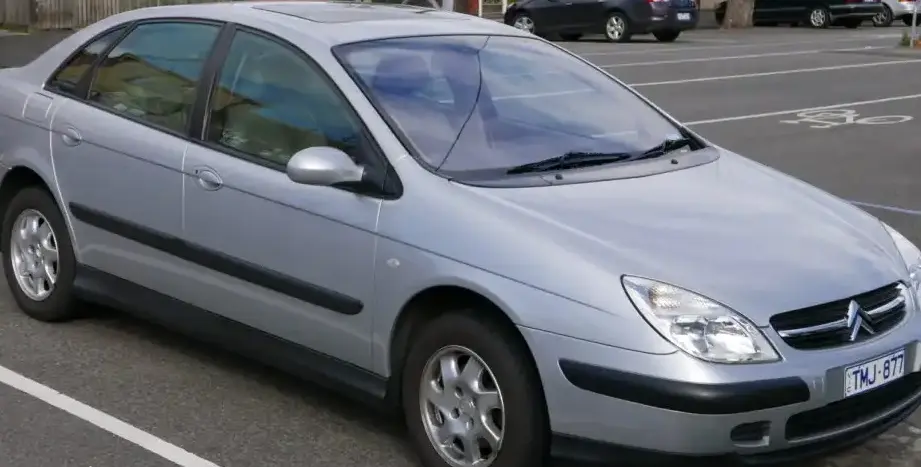
The Citroën C5 I, launched in 2000, represented a significant step forward for the French automaker, aiming to compete directly with established players in the mid-size executive car segment. The Phase I models, produced from 2000 to 2004, offered a range of engine options, with the 2.0 HDi 90 hp variant occupying an important position as an entry-level diesel offering. This version, characterized by its fuel efficiency and relatively low running costs, was particularly popular in European markets where diesel engines held a strong preference. It was offered exclusively as a four-door sedan, and served as a practical and comfortable option for families and business users alike.
Technical Specifications
| Brand | Citroen |
| Model | C5 |
| Generation | C5 I (Phase I, 2000) |
| Type (Engine) | 2.0 HDi (90 Hp) |
| Start of production | 2000 year |
| End of production | 2004 year |
| Powertrain Architecture | Internal Combustion engine |
| Body type | Sedan |
| Seats | 5 |
| Doors | 4 |
| Fuel consumption (economy) – urban | 7.7 l/100 km (30.5 US mpg, 36.7 UK mpg, 13 km/l) |
| Fuel consumption (economy) – extra urban | 4.7 l/100 km (50 US mpg, 60.1 UK mpg, 21.3 km/l) |
| Fuel consumption (economy) – combined | 5.7 l/100 km (41.3 US mpg, 49.6 UK mpg, 17.5 km/l) |
| CO2 emissions | 155 g/km |
| Fuel Type | Diesel |
| Acceleration 0 – 100 km/h | 14.7 sec |
| Acceleration 0 – 62 mph | 14.7 sec |
| Acceleration 0 – 60 mph | 14 sec |
| Maximum speed | 180 km/h (111.85 mph) |
| Emission standard | Euro 3 |
| Weight-to-power ratio | 15.1 kg/Hp, 66.2 Hp/tonne |
| Weight-to-torque ratio | 5.8 kg/Nm, 173.5 Nm/tonne |
| Power | 90 Hp @ 4000 rpm |
| Power per litre | 45.1 Hp/l |
| Torque | 236 Nm @ 1900 rpm (174.06 lb.-ft. @ 1900 rpm) |
| Maximum engine speed | 5300 rpm |
| Engine layout | Front, Transverse |
| Engine Model/Code | RHY DW10TD |
| Engine displacement | 1997 cm3 (121.86 cu. in.) |
| Number of cylinders | 4 |
| Engine configuration | Inline |
| Cylinder Bore | 85 mm (3.35 in.) |
| Piston Stroke | 88 mm (3.46 in.) |
| Compression ratio | 18:1 |
| Number of valves per cylinder | 2 |
| Fuel injection system | Diesel Commonrail |
| Engine aspiration | Turbocharger |
| Engine oil capacity | 4.8 l (5.07 US qt | 4.22 UK qt) |
| Coolant | 8.5 l (8.98 US qt | 7.48 UK qt) |
| Kerb Weight | 1360 kg (2998.29 lbs.) |
| Max. weight | 1880 kg (4144.69 lbs.) |
| Max load | 520 kg (1146.4 lbs.) |
| Trunk (boot) space – minimum | 456 l (16.1 cu. ft.) |
| Fuel tank capacity | 68 l (17.96 US gal | 14.96 UK gal) |
| Max. roof load | 75 kg (165.35 lbs.) |
| Permitted trailer load with brakes (8%) | 1600 kg (3527.4 lbs.) |
| Permitted trailer load with brakes (12%) | 1500 kg (3306.93 lbs.) |
| Permitted trailer load without brakes | 715 kg (1576.31 lbs.) |
| Permitted towbar download | 75 kg (165.35 lbs.) |
| Length | 4618 mm (181.81 in.) |
| Width | 1770 mm (69.69 in.) |
| Width including mirrors | 2100 mm (82.68 in.) |
| Height | 1476 mm (58.11 in.) |
| Wheelbase | 2750 mm (108.27 in.) |
| Front track | 1544 mm (60.79 in.) |
| Rear (Back) track | 1509 mm (59.41 in.) |
| Front overhang | 971 mm (38.23 in.) |
| Rear overhang | 897 mm (35.31 in.) |
| Minimum turning circle (turning diameter) | 11.39 m (37.37 ft.) |
| Drivetrain Architecture | The Internal combustion engine (ICE) drives the front wheels of the vehicle. |
| Drive wheel | Front wheel drive |
| Number of gears and type of gearbox | 5 gears, manual transmission |
| Front suspension | Independent type McPherson |
| Rear suspension | Semi-independent, coil spring |
| Front brakes | Ventilated discs |
| Rear brakes | Disc |
| Assisting systems | ABS (Anti-lock braking system) |
| Steering type | Steering rack and pinion |
| Power steering | Hydraulic Steering |
| Tires size | 195/65 R15 |
| Wheel rims size | 6J x 15 |
Powertrain & Engine Architecture
The heart of this C5 variant is the DW10TD engine, specifically the RHY variant. This 2.0-liter, four-cylinder diesel engine utilizes a common rail direct injection system, a technology that was becoming increasingly prevalent in the early 2000s. The RHY engine produced 90 horsepower at 4000 rpm and 236 Nm (174 lb-ft) of torque at a relatively low 1900 rpm. This torque curve provided good low-end responsiveness, making it suitable for everyday driving. The engine featured a single overhead camshaft (SOHC) design with two valves per cylinder. The turbocharger, a key component in boosting power output, was typically a variable geometry turbo (VGT) to optimize performance across a wider range of engine speeds. The engine was transversely mounted in the front of the vehicle, driving the front wheels. The transmission was a five-speed manual gearbox, chosen for its simplicity and efficiency.
Driving Characteristics
The 2.0 HDi 90 hp C5 offered a comfortable, if not particularly sporty, driving experience. Acceleration was modest, with a 0-60 mph time of around 14 seconds. The focus was on fuel economy and relaxed cruising rather than outright performance. The relatively low horsepower meant that overtaking maneuvers required careful planning. Compared to the more powerful 2.0 HDi 110 hp version, or the petrol-powered options, this variant felt noticeably slower. However, the strong low-end torque made it easy to navigate city traffic and maintain a steady pace on the highway. The five-speed gearbox was well-matched to the engine’s characteristics, providing adequate spacing between gears.
Equipment & Trim Levels
The 2.0 HDi 90 hp C5 typically came with a reasonable level of standard equipment, positioning it as a mid-range offering. Standard features often included power steering, central locking, electric front windows, and an RDS radio. Air conditioning was often an optional extra. Interior upholstery was typically cloth, with a functional and durable design. Higher trim levels, available at an additional cost, could add features such as alloy wheels, rear electric windows, a sunroof, and upgraded audio systems. Safety features included ABS brakes and driver and passenger airbags.
Chassis & Braking
The C5 I featured independent front suspension with McPherson struts, providing a comfortable ride quality. The rear suspension utilized a semi-independent torsion beam setup, which was a cost-effective solution for maintaining a reasonable level of comfort and handling. The braking system consisted of ventilated discs on the front wheels and solid discs on the rear. ABS (Anti-lock Braking System) was standard, enhancing braking performance and stability. The steering was a hydraulic power-assisted rack and pinion system, offering a good balance of feel and assistance.
Market Reception & Comparison
The Citroën C5 I 2.0 HDi 90 hp was well-received in European markets as a practical and economical family car. Critics praised its comfortable ride, spacious interior, and fuel efficiency. However, some reviewers noted its lack of outright performance compared to competitors. Compared to the 2.0 HDi 110 hp version, the 90 hp model offered lower running costs but sacrificed some performance. The petrol-powered versions provided more responsive acceleration but were less fuel-efficient. The C5 competed with models such as the Ford Mondeo, Volkswagen Passat, and Peugeot 406.
Legacy
The DW10TD engine, in its various iterations, proved to be a reliable and durable powerplant. The 2.0 HDi 90 hp version, while not the most powerful variant, has a reputation for longevity and relatively low maintenance costs. In the used car market today, these C5s are often sought after by buyers looking for an affordable and dependable diesel car. Common issues, if any, typically relate to wear and tear on components such as the turbocharger and fuel injectors, but these are generally manageable with regular maintenance. The C5 I 2.0 HDi 90 hp remains a testament to Citroën’s commitment to comfort, practicality, and fuel efficiency.