
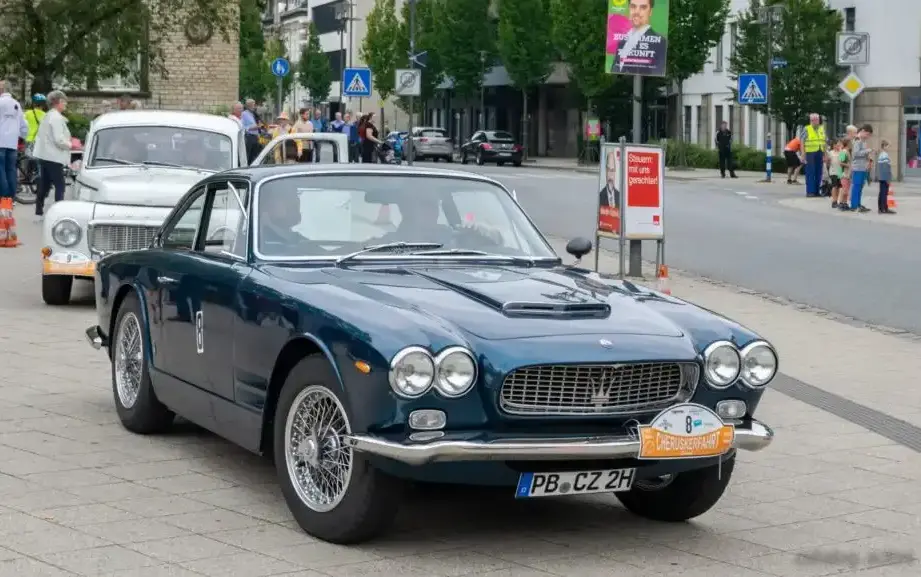
The Maserati Sebring Series I (Tipo AM 101/S) 3.7, produced between 1962 and 1965, represents a pivotal moment in Maserati’s history, bridging the gap between hand-built, coachbuilt exclusivity and the emerging market for high-performance grand tourers. This model, designed by Carrozzeria Ellena, was intended to be a more accessible, yet still luxurious, alternative to Maserati’s more expensive offerings. It was built on a shortened version of the 3500 GT chassis, designated the AM 101/S, and aimed to provide a sporting driving experience combined with the comfort expected of a Maserati. The 3.7-liter variant, producing 245 horsepower, was the flagship of the initial Sebring lineup, establishing the car’s reputation for performance and Italian style.
Technical Specifications
| Brand | Maserati |
| Model | Sebring |
| Generation | Sebring Series I (Tipo AM 101/S) |
| Type (Engine) | 3.7 (245 Hp) |
| Start of production | 1962 |
| End of production | 1965 |
| Powertrain Architecture | Internal Combustion engine |
| Body type | Grand Tourer |
| Seats | 4 |
| Doors | 2 |
| Fuel consumption (economy) – combined | 15 l/100 km (15.7 US mpg, 18.8 UK mpg, 6.7 km/l) |
| Fuel Type | Petrol (Gasoline) |
| Power | 245 Hp @ 5500 rpm |
| Power per litre | 66.4 Hp/l |
| Engine layout | Front, Longitudinal |
| Engine Model/Code | Tipo AM106 |
| Engine displacement | 3692 cm3 (225.3 cu. in.) |
| Number of cylinders | 6 |
| Engine configuration | Inline |
| Cylinder Bore | 86 mm (3.39 in.) |
| Piston Stroke | 106 mm (4.17 in.) |
| Compression ratio | 8.8:1 |
| Number of valves per cylinder | 4 |
| Fuel injection system | Multi-port manifold injection |
| Engine aspiration | Naturally aspirated engine |
| Valvetrain | DOHC |
| Trunk (boot) space – minimum | 340 l (12.01 cu. ft.) |
| Fuel tank capacity | 70 l (18.49 US gal | 15.4 UK gal) |
| Length | 4470 mm (175.98 in.) |
| Width | 1650 mm (64.96 in.) |
| Height | 1300 mm (51.18 in.) |
| Wheelbase | 2500 mm (98.43 in.) |
| Front track | 1390 mm (54.72 in.) |
| Rear (Back) track | 1380 mm (54.33 in.) |
| Drivetrain Architecture | The Internal combustion engine (ICE) drives the rear wheels of the vehicle. |
| Drive wheel | Rear wheel drive |
| Number of gears and type of gearbox | 5 gears, manual transmission |
| Front suspension | Independent coil spring, Transverse stabilizer |
| Rear suspension | Transverse stabilizer, Leaf spring |
| Front brakes | Disc |
| Rear brakes | Disc |
Powertrain & Engine Architecture
The heart of the Sebring 3.7 is the Tipo AM106 engine, a 3.7-liter inline-six cylinder powerplant. This engine is derived from the earlier 3500 GT engine, but with increased displacement and refined internals. It features a dual overhead camshaft (DOHC) valvetrain operating four valves per cylinder, a relatively advanced design for the early 1960s. The engine utilizes a multi-port manifold fuel injection system, contributing to its responsive performance. The 8.8:1 compression ratio was a compromise between performance and reliability, allowing the engine to run on the available fuel grades of the time. The engine’s longitudinal front-engine layout and rear-wheel drive configuration were typical of grand touring cars of the era. The Sebring 3.7 was exclusively offered with a 5-speed manual transmission, providing drivers with precise control over the engine’s power delivery.
Driving Characteristics
The Sebring 3.7 offered a compelling blend of performance and comfort. With 245 horsepower on tap, the car could achieve a top speed approaching 155 mph (250 km/h). Acceleration was brisk, though not overwhelming by modern standards. The 5-speed manual transmission allowed drivers to keep the engine in its optimal power band, maximizing performance. The car’s relatively long wheelbase and sophisticated suspension – independent coil springs at the front and a leaf spring setup at the rear – provided a comfortable ride, even on less-than-perfect road surfaces. Compared to later, more affordable Sebring variants with smaller engines, the 3.7 offered a significantly more engaging and rewarding driving experience. The smaller engines, while more economical, lacked the outright power and responsiveness of the flagship 3.7.
Equipment & Trim Levels
The Sebring Series I was well-equipped for its time, reflecting Maserati’s commitment to luxury. Standard features included leather upholstery, wood trim on the dashboard and door panels, and a comprehensive instrument panel. The interior was designed to be both elegant and functional, providing a comfortable environment for long-distance driving. Optional extras included air conditioning, a radio, and power windows. The exterior was typically finished in a vibrant color, often red or metallic blue, and complemented by brightwork and chrome detailing. The overall aesthetic was one of understated elegance and Italian flair.
Chassis & Braking
The Sebring’s chassis was a steel monocoque construction, providing a strong and rigid platform. The suspension system, as mentioned previously, featured independent coil springs at the front and a leaf spring arrangement at the rear. This setup aimed to balance ride comfort with handling precision. The car was equipped with disc brakes on all four wheels, a significant upgrade over the drum brakes found on many contemporary vehicles. The braking system provided ample stopping power, although it lacked the sophistication of modern anti-lock braking systems. The steering was a traditional recirculating ball system, offering a direct and communicative feel.
Market Reception & Comparison
The Maserati Sebring 3.7 was generally well-received by automotive critics. It was praised for its performance, handling, and luxurious interior. However, its relatively high price tag limited its appeal to a select clientele. Compared to other grand tourers of the era, such as the Ferrari 250 GT and the Aston Martin DB5, the Sebring offered a compelling value proposition, providing similar levels of performance and luxury at a lower cost. The smaller-engined Sebring variants, introduced later, broadened the car’s appeal to a wider audience, but they lacked the prestige and performance of the original 3.7.
Legacy
The Maserati Sebring Series I 3.7 holds a significant place in automotive history as a stylish and capable grand tourer. The Tipo AM106 engine proved to be a robust and reliable powerplant, and many examples are still on the road today. The car’s elegant design and engaging driving experience have made it a favorite among collectors and enthusiasts. In the used car market, the Sebring 3.7 commands a premium price, reflecting its rarity and desirability. While maintenance can be expensive due to the car’s age and complexity, the rewards of owning and driving a classic Maserati Sebring are considerable. The Sebring laid the groundwork for future Maserati grand touring models, establishing a tradition of performance, luxury, and Italian design that continues to this day.
