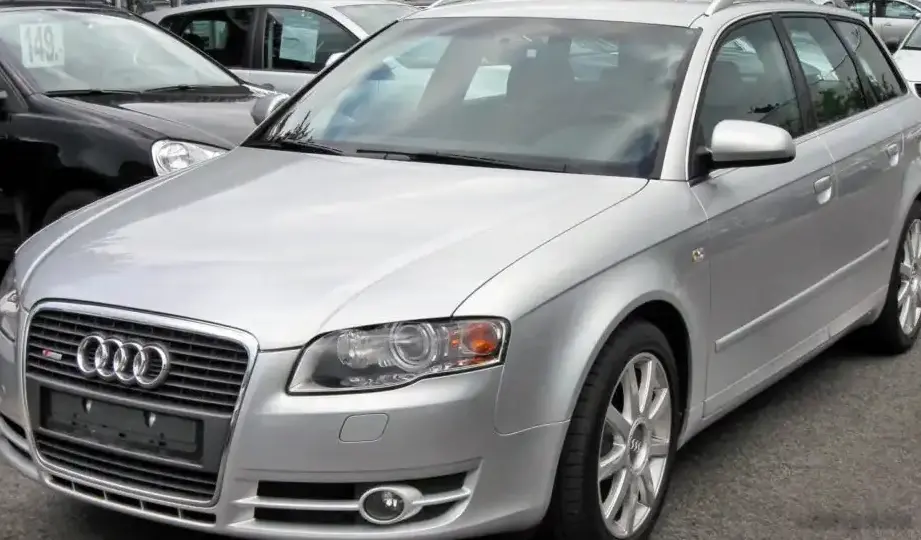
The Audi A4 Avant (B7 8E) 3.2 FSI V6 with the Multitronic transmission represents a compelling blend of performance and practicality within the broader B7 A4 range, produced between 2004 and 2008. Positioned as a near-premium offering, it sat above the 1.8T and 2.0T models, providing a significant power upgrade without reaching the higher price point of the S4. This variant catered to buyers seeking a refined driving experience coupled with the versatility of a station wagon (estate) body style. It was a key model for Audi in the European market, where wagons remain highly popular, and also saw moderate sales in North America.
Technical Specifications
| Brand | Audi |
| Model | A4 |
| Generation | A4 Avant (B7 8E) |
| Type (Engine) | 3.2 FSI V6 (256 Hp) Multitronic |
| Start of production | 2004 |
| End of production | 2008 |
| Powertrain Architecture | Internal Combustion engine |
| Body type | Station wagon (estate) |
| Seats | 5 |
| Doors | 5 |
| Fuel consumption (economy) – urban | 13.6 l/100 km (17.3 US mpg, 20.8 UK mpg, 7.4 km/l) |
| Fuel consumption (economy) – extra urban | 7 l/100 km (33.6 US mpg, 40.4 UK mpg, 14.3 km/l) |
| Fuel consumption (economy) – combined | 9.4 l/100 km (25 US mpg, 30.1 UK mpg, 10.6 km/l) |
| CO2 emissions | 226 g/km |
| Fuel Type | Petrol (Gasoline) |
| Acceleration 0 – 100 km/h | 7 sec |
| Acceleration 0 – 62 mph | 7 sec |
| Acceleration 0 – 60 mph | 6.7 sec |
| Maximum speed | 245 km/h (152.24 mph) |
| Emission standard | Euro 4 |
| Weight-to-power ratio | 6.1 kg/Hp, 165.2 Hp/tonne |
| Weight-to-torque ratio | 4.7 kg/Nm, 212.9 Nm/tonne |
| Power | 256 Hp @ 6500 rpm |
| Power per litre | 82 Hp/l |
| Torque | 330 Nm @ 3250 rpm (243.4 lb.-ft. @ 3250 rpm) |
| Engine layout | Front, Longitudinal |
| Engine Model/Code | AUK, BKH |
| Engine displacement | 3123 cm3 (190.58 cu. in.) |
| Number of cylinders | 6 |
| Engine configuration | V-engine |
| Cylinder Bore | 84.5 mm (3.33 in.) |
| Piston Stroke | 92.8 mm (3.65 in.) |
| Compression ratio | 12.5:1 |
| Number of valves per cylinder | 4 |
| Fuel injection system | Direct injection |
| Engine aspiration | Naturally aspirated engine |
| Valvetrain | DOHC |
| Engine oil capacity | 6.2 l (6.55 US qt | 5.46 UK qt) |
| Coolant | 12 l (12.68 US qt | 10.56 UK qt) |
| Kerb Weight | 1550 kg (3417.17 lbs.) |
| Max. weight | 2100 kg (4629.71 lbs.) |
| Max load | 550 kg (1212.54 lbs.) |
| Trunk (boot) space – minimum | 442 l (15.61 cu. ft.) |
| Trunk (boot) space – maximum | 1184 l (41.81 cu. ft.) |
| Fuel tank capacity | 70 l (18.49 US gal | 15.4 UK gal) |
| Max. roof load | 75 kg (165.35 lbs.) |
| Permitted trailer load with brakes (8%) | 1800 kg (3968.32 lbs.) |
| Permitted trailer load with brakes (12%) | 1700 kg (3747.86 lbs.) |
| Permitted trailer load without brakes | 750 kg (1653.47 lbs.) |
| Permitted towbar download | 80 kg (176.37 lbs.) |
| Length | 4586 mm (180.55 in.) |
| Width | 1772 mm (69.76 in.) |
| Width including mirrors | 1937 mm (76.26 in.) |
| Height | 1427 mm (56.18 in.) |
| Wheelbase | 2648 mm (104.25 in.) |
| Front track | 1522 mm (59.92 in.) |
| Rear (Back) track | 1522 mm (59.92 in.) |
| Drag coefficient (Cd) | 0.31 |
| Minimum turning circle (turning diameter) | 11.1 m (36.42 ft.) |
| Drivetrain Architecture | The Internal combustion engine (ICE) drives the front wheels of the vehicle. |
| Drive wheel | Front wheel drive |
| Number of gears and type of gearbox | automatic transmission Multitronic |
| Front suspension | Independent multi-link suspension |
| Rear suspension | Independent multi-link suspension |
| Front brakes | Ventilated discs |
| Rear brakes | Disc |
| Assisting systems | ABS (Anti-lock braking system) |
| Steering type | Steering rack and pinion |
| Power steering | Hydraulic Steering |
| Tires size | 215/55 R16 |
| Wheel rims size | 7J x 16 |
Powertrain & Engine Architecture
The heart of this A4 Avant is the 3.2-liter V6 engine, designated as either AUK or BKH depending on minor variations and production date. This engine is a naturally aspirated, 24-valve (four valves per cylinder) powerplant featuring direct fuel injection (FSI – Fuel Stratified Injection). FSI technology allowed for precise fuel delivery, improving both power and fuel efficiency compared to traditional port fuel injection. The engine boasts a high compression ratio of 12.5:1, contributing to its responsive nature. The engine’s longitudinal mounting and front-wheel-drive configuration were standard for Audi’s at the time. Paired with this engine is Audi’s Multitronic continuously variable transmission (CVT). Unlike traditional automatic transmissions with fixed gear ratios, the Multitronic utilizes a chain-driven system to provide a virtually infinite number of ratios, optimizing engine speed for efficiency or performance.
Driving Characteristics
The 3.2 FSI V6 with the Multitronic transmission delivers a smooth and refined driving experience. Acceleration from 0-60 mph takes approximately 6.7 seconds, making it noticeably quicker than the 1.8T and 2.0T variants. The Multitronic transmission contributes to seamless acceleration, avoiding the shift shock often associated with conventional automatics. While the Multitronic doesn’t offer the outright engagement of a manual gearbox, it allows the driver to select specific “gear” ratios or utilize a sport mode for more aggressive shifting. The engine’s torque curve is relatively flat, providing ample power throughout the rev range. However, the front-wheel-drive configuration can lead to some torque steer under hard acceleration, particularly on less-than-ideal road surfaces.
Equipment & Trim Levels
The 3.2 FSI Avant typically came well-equipped, reflecting its position as a higher-end trim level. Standard features generally included leather upholstery, automatic climate control, a premium audio system, and alloy wheels. Optional extras included sunroof, navigation system, parking sensors, and upgraded interior trim packages. The interior design was typical of Audi’s B7 generation, characterized by a clean, functional layout and high-quality materials.
Chassis & Braking
The A4 Avant B7 utilizes an independent multi-link suspension system at both the front and rear axles, providing a comfortable ride and good handling characteristics. The 3.2 FSI model typically featured slightly stiffer springs and dampers compared to lower-spec variants to better manage the increased power. Braking duties are handled by ventilated discs at the front and solid discs at the rear, equipped with ABS (Anti-lock Braking System). The suspension setup was tuned to balance comfort and handling, making it suitable for both daily commuting and spirited driving.
Market Reception & Comparison
The 3.2 FSI Avant was generally well-received by automotive critics, who praised its powerful engine, refined transmission, and practical wagon body style. However, the Multitronic transmission was sometimes criticized for its lack of engagement compared to a traditional manual gearbox. Compared to the 1.8T and 2.0T models, the 3.2 FSI offered a significant performance advantage but at the cost of increased fuel consumption. The 1.8T was favored by those prioritizing fuel economy, while the 2.0T offered a good balance of performance and efficiency. The 3.2 FSI appealed to buyers who wanted a more luxurious and powerful A4 Avant.
Legacy
The 3.2 FSI V6 engine, while robust, is known to require diligent maintenance, particularly regarding oil changes. The Multitronic transmission, while innovative, can be prone to issues if not serviced correctly, with fluid changes being critical. Today, well-maintained examples of the A4 Avant 3.2 FSI are becoming increasingly sought after by enthusiasts. The combination of a powerful V6 engine, a practical wagon body style, and Audi’s reputation for build quality makes it a compelling choice in the used car market. However, potential buyers should be aware of the potential maintenance costs associated with the engine and transmission.