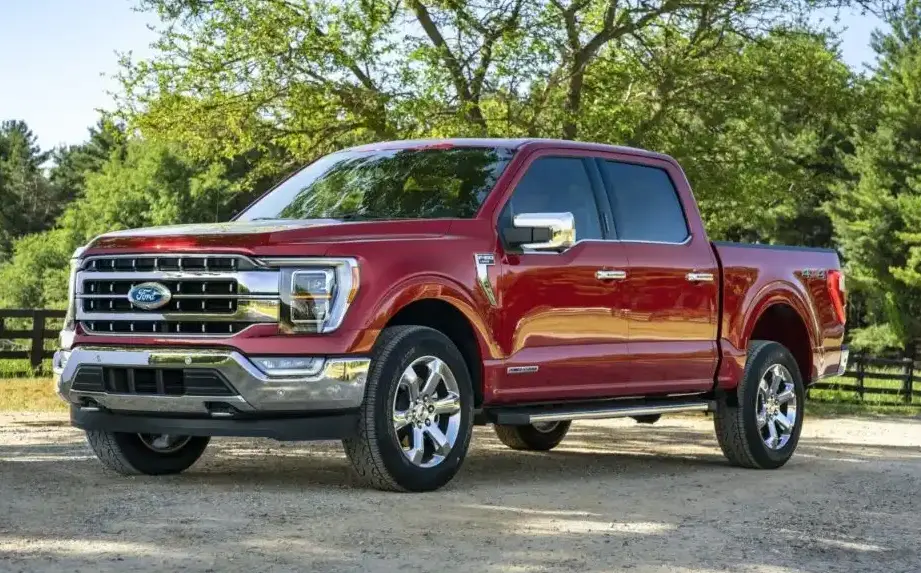
The Ford F-150 XIV SuperCrew 3.5 PowerBoost V6 (430 Hp) FHEV 4×4 Automatic, produced from October 2020 through 2023, represents a significant step in the evolution of America’s best-selling vehicle. This variant, part of the fourteenth generation (F-150 XIV) of the F-Series, introduced Ford’s first full hybrid powertrain to the full-size pickup truck segment. Positioned as a premium offering within the F-150 lineup, it aimed to deliver both substantial power and improved fuel efficiency, appealing to buyers seeking capability without compromising environmental considerations. The SuperCrew configuration designates a four-door cab with ample rear passenger space, making it a popular choice for families and those needing to transport multiple occupants alongside cargo.
Technical Specifications
| Brand | Ford |
| Model | F-Series F-100/F-150 |
| Generation | F-Series F-150 XIV SuperCrew |
| Type (Engine) | 3.5 PowerBoost V6 (430 Hp) FHEV 4×4 Automatic |
| Start of production | October, 2020 |
| End of production | 2023 |
| Powertrain Architecture | FHEV (Full Hybrid Electric Vehicle) |
| Body type | Pick-up |
| Seats | 5-6 |
| Doors | 4 |
| Fuel consumption (economy) – urban | 9.8 l/100 km (24 US mpg, 28.8 UK mpg, 10.2 km/l) |
| Fuel consumption (economy) – extra urban | 9.8 l/100 km (24 US mpg, 28.8 UK mpg, 10.2 km/l) |
| Fuel consumption (economy) – combined | 9.8 l/100 km (24 US mpg, 28.8 UK mpg, 10.2 km/l) |
| Fuel Type | Petrol (Gasoline) |
| Weight-to-power ratio | 5.8 kg/Hp, 171.9 Hp/tonne |
| Weight-to-torque ratio | 3.2 kg/Nm, 309 Nm/tonne |
| Gross battery capacity | 1.5 kWh |
| Battery technology | Lithium-ion (Li-Ion) |
| Battery location | Below the floor, Under the trunk |
| Electric motor power | 48 Hp |
| Electric motor location | Between the combustion engine and the transmission |
| System power | 430 Hp @ 6000 rpm |
| System torque | 773 Nm @ 3000 rpm (570.14 lb.-ft. @ 3000 rpm) |
| Engine layout | Front, Longitudinal |
| Engine displacement | 3497 cm3 (213.4 cu. in.) |
| Number of cylinders | 6 |
| Engine configuration | V-engine |
| Cylinder Bore | 92.46 mm (3.64 in.) |
| Piston Stroke | 86.61 mm (3.41 in.) |
| Compression ratio | 10.5:1 |
| Fuel injection system | Direct injection and Multi-port manifold injection |
| Engine aspiration | Twin-Turbo, Intercooler |
| Engine oil capacity | 5.7 l (6.02 US qt | 5.02 UK qt) |
| Coolant | 14.5 l (15.32 US qt | 12.76 UK qt) |
| Kerb Weight | 2502-2513 kg (5515.97 – 5540.22 lbs.) |
| Max. weight | 3334 kg (7350.21 lbs.) |
| Max load | 821-832 kg (1810 – 1834.25 lbs.) |
| Trunk (boot) space – minimum | 1495-1764 l (52.8 – 62.3 cu. ft.) |
| Fuel tank capacity | 116 l (30.64 US gal | 25.52 UK gal) |
| Permitted trailer load with brakes (12%) | 5625 kg (12401 lbs.) |
| Length | 5885-6185 mm (231.69 – 243.5 in.) |
| Width | 2029 mm (79.88 in.) |
| Width with mirrors folded | 2123 mm (83.58 in.) |
| Width including mirrors | 2431 mm (95.71 in.) |
| Height | 1961-1971 mm (77.2 – 77.6 in.) |
| Wheelbase | 3693-3993 mm (145.39 – 157.2 in.) |
| Front track | 1725 mm (67.91 in.) |
| Rear (Back) track | 1735 mm (68.31 in.) |
| Front overhang | 955 mm (37.6 in.) |
| Rear overhang | 1234 mm (48.58 in.) |
| Ride height (ground clearance) | 224-239 mm (8.82 – 9.41 in.) |
| Minimum turning circle (turning diameter) | 14.6-15.6 m (47.9 – 51.18 ft.) |
| Approach angle | 24-24.3° |
| Departure angle | 25.3-26.3° |
| Ramp-over (brakeover) angle | 19-20° |
| Drivetrain Architecture | The Internal combustion engine (ICE) and the electric motor permanently drive the rear wheels of the vehicle, capable of running in full electric or mixed mode, and if necessary through the electrically or mechanically controlled clutch, the front wheels are driven. |
| Drive wheel | All wheel drive (4×4) |
| Number of gears and type of gearbox | 10 gears, automatic transmission |
| Front suspension | Double wishbone |
| Rear suspension | Rigid axle suspension, Leaf spring |
| Front brakes | Ventilated discs, 350×34 mm |
| Rear brakes | Ventilated discs, 336×20 mm |
| Assisting systems | ABS (Anti-lock braking system) |
| Steering type | Steering rack and pinion |
| Power steering | Electric Steering |
| Tires size | 245/70 R17 110T; 265/70 R17 115T; 265/60 R18 110T; 275/65 R18 116T; 275/60 R20 115T; 275/50 R22 115T |
| Wheel rims size | 7.5J x 17; 7.5J x 18; 8.5J x 20; 9J x 22 |
INTRODUCTION
The Ford F-150 XIV SuperCrew 3.5 PowerBoost V6 FHEV 4×4 Automatic, launched in late 2020, marked a pivotal moment for the F-150, America’s best-selling truck for over four decades. Built on the F-150 XIV platform, this variant combined a 3.5-liter EcoBoost V6 engine with a 47-horsepower electric motor and a 1.5 kWh lithium-ion battery pack, creating a full hybrid system. This configuration delivered a combined output of 430 horsepower and 570 lb-ft of torque. The SuperCrew body style, offering a spacious four-door cabin, catered to buyers prioritizing passenger comfort and versatility. This model aimed to bridge the gap between traditional gasoline-powered F-150s and the upcoming fully electric F-150 Lightning, offering a taste of electrification with proven truck capability.
Powertrain & Engine Architecture
At the heart of the 3.5 PowerBoost lies Ford’s third-generation 3.5-liter EcoBoost V6 engine. This engine, designated as the “GE” engine family, features a compact graphite iron (CGI) cylinder block for increased strength and reduced weight. It utilizes direct fuel injection combined with port fuel injection, optimizing combustion efficiency and power delivery. The engine is equipped with two turbochargers, an intercooler, and variable valve timing. The electric motor is integrated between the engine and the 10-speed automatic transmission, allowing for electric-only driving at low speeds and providing supplemental power during acceleration. The 1.5 kWh lithium-ion battery is located under the floor of the truck, minimizing impact on cargo space. The transmission itself is a sophisticated 10-speed automatic, known for its smooth shifting and wide gear ratios, contributing to both fuel efficiency and performance.
Driving Characteristics
The 3.5 PowerBoost FHEV delivers a unique driving experience. The electric motor provides instant torque, resulting in brisk acceleration, particularly from a standstill. The hybrid system allows for seamless transitions between electric, gasoline, and combined power modes. In typical driving scenarios, the truck operates in electric mode at lower speeds, providing a quiet and fuel-efficient experience. When more power is needed, the gasoline engine seamlessly engages. Compared to the non-hybrid 3.5 EcoBoost, the PowerBoost offers a noticeable improvement in low-end torque and fuel economy. While not as overtly powerful as the higher-output 3.5 EcoBoost variants, the PowerBoost provides ample power for towing, hauling, and everyday driving. The 10-speed automatic transmission contributes to smooth and efficient power delivery, with well-chosen gear ratios for various driving conditions.
Equipment & Trim Levels
The 3.5 PowerBoost was typically offered in higher trim levels, such as Lariat, King Ranch, and Platinum. Standard features included a large touchscreen infotainment system with Apple CarPlay and Android Auto compatibility, Ford’s Co-Pilot360 suite of driver-assistance technologies (including automatic emergency braking, lane-keeping assist, and adaptive cruise control), and premium interior materials. Higher trims added features like leather upholstery, heated and ventilated seats, a panoramic sunroof, and a premium sound system. The Pro Power Onboard generator system, utilizing the truck’s battery pack to provide exportable power, was a standout feature, offering up to 2.4 kW of power through outlets in the bed and cabin. Optional extras included a tow package, off-road suspension upgrades, and various appearance packages.
Chassis & Braking
The F-150 XIV SuperCrew utilizes a high-strength steel frame and an aluminum-alloy body, contributing to its overall durability and reduced weight. The front suspension features independent double wishbones, while the rear suspension employs a solid axle with leaf springs. This configuration provides a balance between ride comfort and load-carrying capacity. Braking duties are handled by ventilated disc brakes on all four wheels, providing ample stopping power. The anti-lock braking system (ABS) is standard, along with electronic stability control. The PowerBoost variant’s added weight due to the hybrid system necessitated slightly stiffer suspension tuning compared to some other F-150 trims.
Market Reception & Comparison
The F-150 PowerBoost was generally well-received by critics and consumers. It was praised for its fuel efficiency, smooth power delivery, and innovative features like Pro Power Onboard. Compared to the standard 3.5 EcoBoost, the PowerBoost offered a modest fuel economy improvement, particularly in city driving. Compared to the 5.0-liter V8, the PowerBoost provided comparable power with better fuel efficiency. However, the hybrid system added to the truck’s overall cost. Reliability reports have been generally positive, with few major issues reported related to the hybrid powertrain. The PowerBoost appealed to buyers seeking a capable and efficient full-size truck with a touch of modern technology.
Legacy
The Ford F-150 PowerBoost represents a significant step towards electrification in the full-size truck segment. It demonstrated that hybrid technology could be successfully integrated into a workhorse vehicle without sacrificing capability. The powertrain has proven to be relatively reliable, and the PowerBoost continues to hold its value in the used car market. It paved the way for the fully electric F-150 Lightning, showcasing Ford’s commitment to sustainable transportation. The PowerBoost’s success has also encouraged other manufacturers to explore hybrid and electric options for their full-size trucks, ultimately benefiting consumers with more choices and improved fuel efficiency.