Technical Specifications
| Brand | Citroen |
| Model | C5 |
| Generation | C5 I (Phase II, 2004) |
| Type (Engine) | 1.8i 16V (116 Hp) |
| Start of production | 2004 |
| End of production | 2005 |
| Powertrain Architecture | Internal Combustion engine |
| Body type | Sedan |
| Seats | 5 |
| Doors | 4 |
| Fuel consumption (urban) | 11.3 l/100 km (20.8 US mpg, 25 UK mpg, 8.8 km/l) |
| Fuel consumption (extra urban) | 6 l/100 km (39.2 US mpg, 47.1 UK mpg, 16.7 km/l) |
| Fuel consumption (combined) | 7.3 l/100 km (32.2 US mpg, 38.7 UK mpg, 13.7 km/l) |
| Fuel Type | Petrol (Gasoline) |
| Acceleration 0 – 100 km/h | 11.3 sec |
| Acceleration 0 – 62 mph | 11.3 sec |
| Acceleration 0 – 60 mph | 10.7 sec |
| Maximum speed | 196 km/h (121.79 mph) |
| Emission standard | Euro 3 |
| Weight-to-power ratio | 11.9 kg/Hp, 84.2 Hp/tonne |
| Weight-to-torque ratio | 8.6 kg/Nm, 116.2 Nm/tonne |
| Power | 116 Hp @ 5500 rpm |
| Power per litre | 66.3 Hp/l |
| Torque | 160 Nm @ 4000 rpm (118.01 lb.-ft. @ 4000 rpm) |
| Engine layout | Front, Transverse |
| Engine Model/Code | 6FZ EW7J4 |
| Engine displacement | 1749 cm3 (106.73 cu. in.) |
| Number of cylinders | 4 |
| Engine configuration | Inline |
| Cylinder Bore | 82.7 mm (3.26 in.) |
| Piston Stroke | 81.4 mm (3.2 in.) |
| Compression ratio | 10.8:1 |
| Number of valves per cylinder | 4 |
| Fuel injection system | Multi-port manifold injection |
| Engine aspiration | Naturally aspirated engine |
| Engine oil capacity | 4.25 l (4.49 US qt | 3.74 UK qt) |
| Coolant | 8.8 l (9.3 US qt | 7.74 UK qt) |
| Kerb Weight | 1377 kg (3035.77 lbs.) |
| Max. weight | 1897 kg (4182.17 lbs.) |
| Max load | 520 kg (1146.4 lbs.) |
| Trunk (boot) space – minimum | 471 l (16.63 cu. ft.) |
| Trunk (boot) space – maximum | 1315 l (46.44 cu. ft.) |
| Fuel tank capacity | 66 l (17.44 US gal | 14.52 UK gal) |
| Max. roof load | 75 kg (165.35 lbs.) |
| Permitted towbar download | 75 kg (165.35 lbs.) |
| Length | 4745 mm (186.81 in.) |
| Width | 1780 mm (70.08 in.) |
| Height | 1476 mm (58.11 in.) |
| Wheelbase | 2750 mm (108.27 in.) |
| Front track | 1528 mm (60.16 in.) |
| Rear (Back) track | 1495 mm (58.86 in.) |
| Front overhang | 1033 mm (40.67 in.) |
| Rear overhang | 962 mm (37.87 in.) |
| Minimum turning circle | 12.43 m (40.78 ft.) |
| Drivetrain Architecture | The Internal combustion engine (ICE) drives the front wheels of the vehicle. |
| Drive wheel | Front wheel drive |
| Number of gears and type of gearbox | 5 gears, manual transmission |
| Front suspension | Independent, type McPherson with coil spring and anti-roll bar |
| Rear suspension | Semi-independent, coil spring |
| Front brakes | Ventilated discs |
| Rear brakes | Disc |
| Assisting systems | ABS (Anti-lock braking system) |
| Tires size | 215/55 R15 |
| Wheel rims size | 15 |
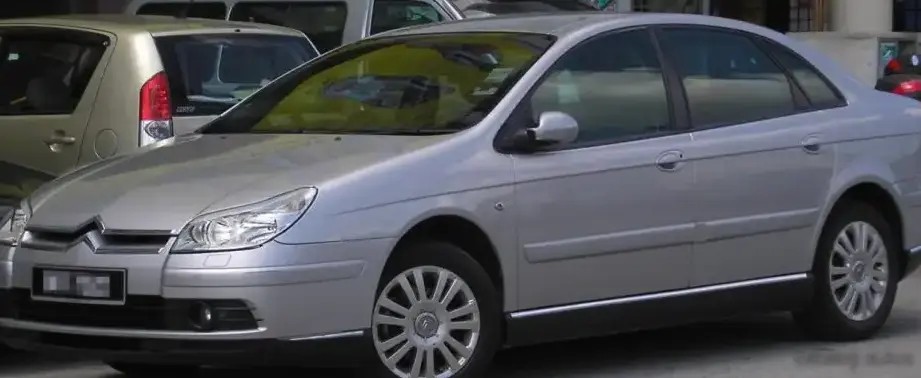
The Citroën C5 I (Phase II), specifically the 1.8i 16V variant produced between 2004 and 2005, represented a significant offering in Citroën’s mid-size sedan lineup. Positioned as a comfortable and practical family vehicle, this iteration of the C5 aimed to balance affordability with a reasonable level of equipment and performance. It falls within the first generation (X3/X4) of the C5, benefitting from the mid-life refresh known as Phase II, which included styling updates and minor mechanical improvements. This model primarily targeted European markets where comfort and ride quality were highly valued, competing with vehicles like the Ford Mondeo, Peugeot 407, and Volkswagen Passat.
Powertrain & Engine Architecture
The heart of this C5 variant is the 6FZ (EW7J4) 1.8-liter inline-four cylinder engine. This engine, a product of the PSA Peugeot Citroën and Renault collaboration, is a naturally aspirated unit featuring a multi-point fuel injection system. The 16-valve cylinder head, with four valves per cylinder, contributes to improved breathing and a broader powerband. The engine produces 116 horsepower at 5500 rpm and 160 Nm (118 lb-ft) of torque at 4000 rpm. The engine’s design prioritizes smoothness and refinement over outright performance. The transmission paired with this engine is a 5-speed manual gearbox, offering a relatively conventional driving experience. While an automatic transmission was available on other C5 models, it wasn’t commonly paired with this specific engine.
Driving Characteristics
The 1.8i 16V C5 offers a comfortable, rather than sporty, driving experience. Acceleration from 0-60 mph takes around 10.7 seconds, and top speed is approximately 122 mph. The engine feels adequate for everyday driving, providing sufficient power for highway cruising and overtaking, but it’s not particularly quick. The manual transmission allows for reasonable control, but the gear ratios are tuned for fuel efficiency and smooth operation rather than aggressive acceleration. Compared to the more powerful 2.0L or V6 variants, this 1.8L model feels noticeably less responsive. However, it offers a lighter front end, which can contribute to slightly more agile handling in certain situations.
Equipment & Trim Levels
The 1.8i 16V C5 typically came equipped with a reasonable level of standard features. These included power windows, central locking, air conditioning, and an audio system. Interior upholstery was generally cloth, with options for upgraded materials available. Trim levels varied depending on the market, but generally, this engine was found in the base or mid-range trims. Optional extras could include alloy wheels, a sunroof, and more advanced audio systems. Safety features such as ABS were standard, reflecting Citroën’s commitment to passenger protection.
Chassis & Braking
The C5 I utilizes a McPherson strut front suspension and a semi-independent coil spring rear suspension. This setup prioritizes ride comfort, absorbing bumps and imperfections in the road effectively. The front brakes are ventilated discs, providing adequate stopping power, while the rear brakes are solid discs. The suspension is tuned for a softer ride, which can result in some body roll during cornering. The steering is power-assisted, offering light and easy maneuverability.
Market Reception & Comparison
The 1.8i 16V C5 was generally well-received as a practical and comfortable family car. Critics praised its ride quality and spacious interior, but noted that its performance was not particularly exciting. Compared to the higher-output engines in the C5 range, the 1.8L model offered better fuel economy, making it an attractive option for drivers prioritizing cost-effectiveness. The 1.8L engine also tended to be more reliable than some of the more complex engine options, reducing the potential for expensive repairs. However, the lack of an automatic transmission option for this engine was a drawback for some buyers.
Legacy
The 1.8i 16V C5 I (Phase II) remains a relatively affordable and reliable used car option today. The 6FZ engine is known for its durability, and parts availability is generally good. While not a performance icon, this variant offers a comfortable and practical driving experience, making it a suitable choice for those seeking a well-rounded family sedan. Its reputation for reliability and relatively low running costs has helped it maintain a steady presence in the used car market.