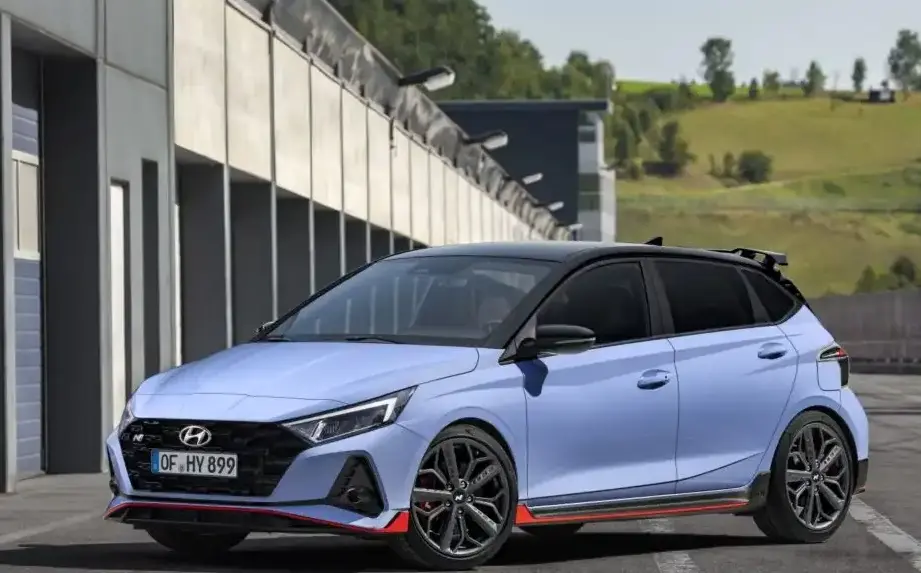
The Hyundai i20 III N 1.6 T-GDi, produced from April 2021 to August 2023, represents the high-performance variant of the third-generation i20 (PB) subcompact hatchback. Positioned as the flagship model within the i20 lineup, the ‘N’ designation signifies its development under Hyundai’s high-performance division, mirroring similar ‘N’ models like the Elantra N and Kona N. This variant aimed to deliver a genuinely sporty driving experience in a segment typically focused on economy and practicality, primarily targeting the European market with limited availability in other regions. It’s built on the PB platform, shared with the standard i20, but extensively modified for enhanced performance.
| Brand | Hyundai |
| Model | i20 |
| Generation | i20 III |
| Type (Engine) | N 1.6 T-GDi (204 Hp) |
| Start of production | April, 2021 |
| End of production | August, 2023 |
| Powertrain Architecture | Internal Combustion engine |
| Body type | Hatchback |
| Seats | 5 |
| Doors | 5 |
| Fuel consumption at Low speed (WLTP) | 8.6 l/100 km (27.4 US mpg, 32.8 UK mpg, 11.6 km/l) |
| Fuel consumption at Medium speed (WLTP) | 6.7 l/100 km (35.1 US mpg, 42.2 UK mpg, 14.9 km/l) |
| Fuel consumption at high speed (WLTP) | 6.0 l/100 km (39.2 US mpg, 47.1 UK mpg, 16.7 km/l) |
| Fuel consumption at very high speed (WLTP) | 7.4 l/100 km (31.8 US mpg, 38.2 UK mpg, 13.5 km/l) |
| Combined fuel consumption (WLTP) | 7.0 l/100 km (33.6 US mpg, 40.4 UK mpg, 14.3 km/l) |
| CO2 emissions (WLTP) | 158 g/km |
| Fuel Type | Petrol (Gasoline) |
| Acceleration 0 – 100 km/h | 6.7 sec |
| Acceleration 0 – 62 mph | 6.7 sec |
| Acceleration 0 – 60 mph | 6.4 sec |
| Maximum speed | 229 km/h (142.29 mph) |
| Weight-to-power ratio | 5.8 kg/Hp, 171.4 Hp/tonne |
| Weight-to-torque ratio | 4.3 kg/Nm, 231.1 Nm/tonne |
| Power | 204 Hp @ 5500-6000 rpm |
| Torque | 275 Nm @ 1750-4500 rpm (202.83 lb.-ft. @ 1750-4500 rpm) |
| Engine layout | Front, Transverse |
| Engine Model/Code | G4FP |
| Engine displacement | 1598 cm3 (97.52 cu. in.) |
| Number of cylinders | 4 |
| Engine configuration | Inline |
| Cylinder Bore | 75.6 mm (2.98 in.) |
| Piston Stroke | 89 mm (3.5 in.) |
| Compression ratio | 10:1 |
| Number of valves per cylinder | 4 |
| Fuel injection system | Direct injection |
| Engine aspiration | Turbocharger, Intercooler |
| Valvetrain | DOHC, D-CVVT |
| Kerb Weight | 1190-1220 kg (2623.5 – 2689.64 lbs.) |
| Max. weight | 1650 kg (3637.63 lbs.) |
| Max load | 430-460 kg (947.99 – 1014.13 lbs.) |
| Trunk (boot) space – minimum | 352 l (12.43 cu. ft.) |
| Trunk (boot) space – maximum | 1165 l (41.14 cu. ft.) |
| Fuel tank capacity | 40 l (10.57 US gal | 8.8 UK gal) |
| Max. roof load | 70 kg (154.32 lbs.) |
| Permitted trailer load with brakes (12%) | 1110 kg (2447.13 lbs.) |
| Permitted trailer load without brakes | 450 kg (992.08 lbs.) |
| Permitted towbar download | 70 kg (154.32 lbs.) |
| Length | 4075 mm (160.43 in.) |
| Width | 1775 mm (69.88 in.) |
| Height | 1440 mm (56.69 in.) |
| Wheelbase | 2580 mm (101.57 in.) |
| Front track | 1544 mm (60.79 in.) |
| Rear (Back) track | 1541 mm (60.67 in.) |
| Minimum turning circle | 10.54 m (34.58 ft.) |
| Drivetrain Architecture | Front wheel drive |
| Drive wheel | Front wheel drive |
| Number of gears and type of gearbox | 6 gears, manual transmission |
| Front suspension | Independent type McPherson |
| Rear suspension | Torsion |
| Front brakes | Disc, 320 mm |
| Rear brakes | Disc, 262 mm |
| Assisting systems | ABS (Anti-lock braking system) |
| Steering type | Steering rack and pinion |
| Power steering | Electric Steering |
| Tires size | 215/40 R18 |
| Wheel rims size | 7.5J x 18 |
Powertrain & Engine Architecture
The i20 N is powered by Hyundai’s 1.6-liter turbocharged gasoline direct injection (TGDI) engine, internally designated as the G4FP. This engine produces 204 horsepower at 5500-6000 rpm and 275 Nm (202.83 lb-ft) of torque between 1750 and 4500 rpm. The engine features a single-scroll turbocharger, intercooler, and a 10:1 compression ratio. Hyundai’s D-CVVT (Dual Continuous Variable Valve Timing) technology is employed for both intake and exhaust valves, optimizing engine performance and efficiency across the rev range. The engine utilizes direct fuel injection for precise fuel delivery and improved combustion. The sole transmission option is a six-speed manual gearbox, specifically tuned for the ‘N’ model with shorter ratios for quicker acceleration.
Driving Characteristics
The i20 N delivers a noticeably more engaging driving experience than the standard i20. The 6-speed manual transmission provides precise shifts, and the shorter gear ratios contribute to brisk acceleration. The 0-60 mph sprint is achieved in approximately 6.4 seconds, and the car reaches a top speed of 142.29 mph. The suspension is significantly stiffer than the standard i20, with revised dampers and springs, and a reinforced torsion beam rear axle. This results in reduced body roll and improved handling, particularly during cornering. While the ride quality is firmer, it remains acceptable for daily driving. The steering is also weighted more heavily, providing better feedback and a more connected feel to the road. Compared to other i20 variants, the N model offers a much more direct and responsive driving experience, prioritizing performance over comfort.
Equipment & Trim Levels
The i20 N came with a comprehensive list of standard equipment focused on performance and driver engagement. Key features included sport seats with reinforced bolstering, a leather-wrapped steering wheel with ‘N’ badging, aluminum pedals, and a unique ‘N’ specific instrument cluster display. Infotainment was provided by an 8-inch touchscreen with Apple CarPlay and Android Auto compatibility. Safety features included autonomous emergency braking, lane keeping assist, and a driver attention warning system. Optional extras included a sunroof, premium sound system, and various exterior styling enhancements. The interior trim was generally dark-themed with red accents, emphasizing the car’s sporty character.
Chassis & Braking
The i20 N features a McPherson strut front suspension and a coupled torsion beam rear suspension, but with significant upgrades over the standard i20. The springs are stiffer, and the dampers are specifically tuned for performance. The front brakes are upgraded to 320mm discs, while the rear brakes utilize 262mm discs. The car is equipped with ABS (Anti-lock Braking System) and Electronic Stability Control (ESC). The ESC system features a dedicated ‘N’ mode that allows for a greater degree of wheel slip, catering to more experienced drivers. The steering system is a rack and pinion type with electric power assistance, providing precise and responsive steering feel.
Market Reception & Comparison
The Hyundai i20 N was generally well-received by automotive critics, praised for its engaging driving dynamics and affordability. It was often compared to rivals such as the Ford Fiesta ST and Volkswagen Polo GTI. While the i20 N didn’t quite match the refinement of the Polo GTI, it offered a more raw and visceral driving experience, appealing to enthusiasts. Fuel economy was respectable for a performance hatchback, averaging around 33.6 US mpg in combined driving. Reliability reports have been generally positive, with few major issues reported. The i20 N offered a compelling value proposition, providing a significant performance upgrade over the standard i20 at a competitive price point.
Legacy
The i20 N marked a significant step forward for Hyundai’s ‘N’ performance division, demonstrating the brand’s commitment to creating genuinely sporty vehicles. The 1.6 T-GDi engine and six-speed manual transmission proved to be a reliable and engaging powertrain combination. On the used car market, the i20 N holds its value well, particularly well-maintained examples with low mileage. It remains a popular choice for drivers seeking an affordable and fun-to-drive subcompact hatchback. The success of the i20 N paved the way for further ‘N’ models from Hyundai, solidifying the brand’s reputation as a serious player in the performance car segment.