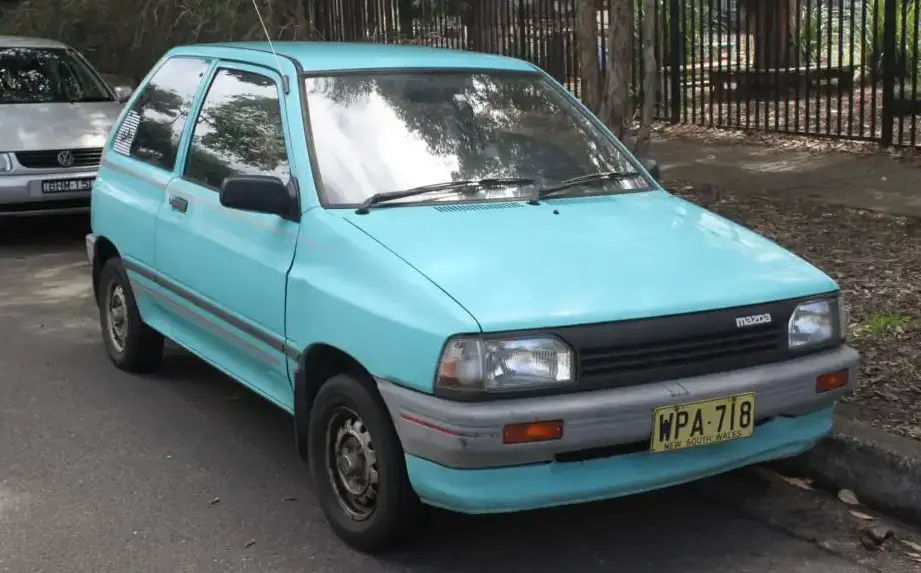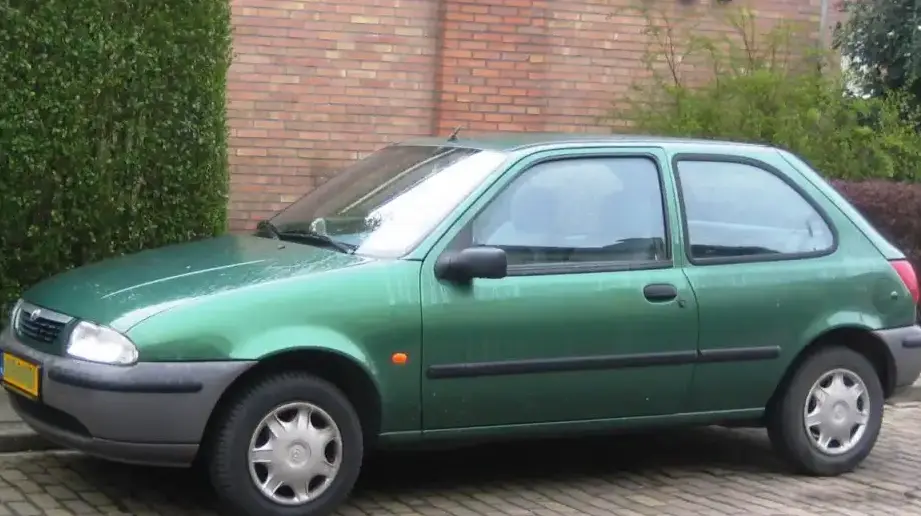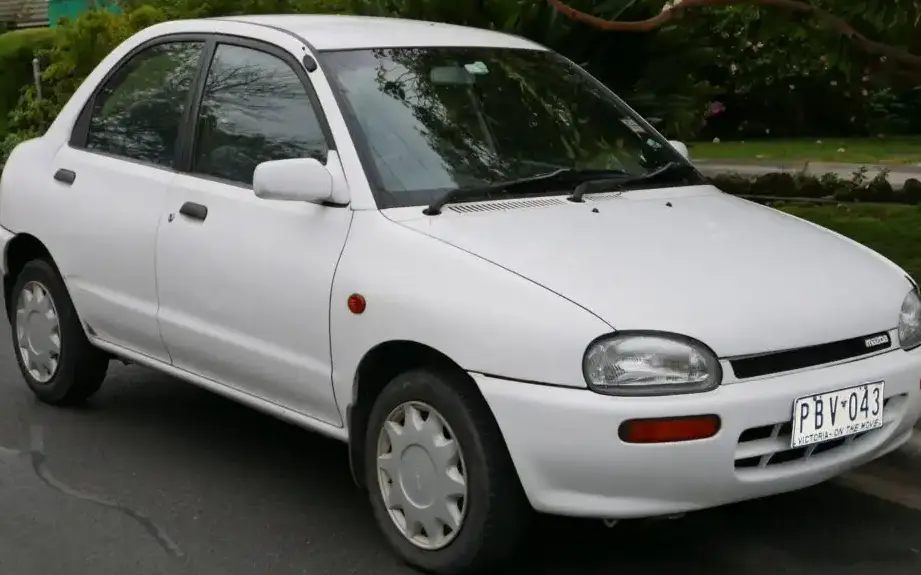
The Mazda 121 II, known as the Mazda Metro in some markets, represents Mazda’s entry into the subcompact hatchback and sedan segment during the early to mid-1990s. Produced from 1990 to 1996 (DB chassis code), it was a collaborative effort with Ford, sharing its platform with the Ford Fiesta Mark III. The 1.3 16V variant, producing 72 horsepower, was a key offering within the 121 II range, positioned as an affordable and economical option for buyers seeking a practical and reliable vehicle. This model aimed to provide a balance between fuel efficiency and acceptable performance for everyday driving.
Technical Specifications
| Brand | Mazda |
| Model | 121 |
| Generation | 121 II (DB) |
| Type (Engine) | 1.3 16V (72 Hp) |
| Start of production | 1990 |
| End of production | 1996 |
| Powertrain Architecture | Internal Combustion engine |
| Body type | Sedan |
| Seats | 5 |
| Doors | 4 |
| Fuel consumption (combined) | 6.9 l/100 km (34.1 US mpg, 40.9 UK mpg, 14.5 km/l) |
| Fuel Type | Petrol (Gasoline) |
| Acceleration 0 – 100 km/h | 11.4 sec |
| Acceleration 0 – 62 mph | 11.4 sec |
| Acceleration 0 – 60 mph | 10.8 sec |
| Maximum speed | 155 km/h (96.31 mph) |
| Weight-to-power ratio | 11.3 kg/Hp |
| Weight-to-torque ratio | 7.8 kg/Nm |
| Power | 72 Hp @ 6000 rpm |
| Power per litre | 54.4 Hp/l |
| Torque | 104 Nm @ 3700 rpm (76.71 lb.-ft. @ 3700 rpm) |
| Engine layout | Front, Longitudinal |
| Engine displacement | 1324 cm3 (80.8 cu. in.) |
| Number of cylinders | 4 |
| Engine configuration | Inline |
| Cylinder Bore | 71 mm (2.8 in.) |
| Piston Stroke | 83.6 mm (3.29 in.) |
| Compression ratio | 9.4:1 |
| Number of valves per cylinder | 4 |
| Fuel injection system | Single-point injection |
| Engine aspiration | Naturally aspirated engine |
| Valvetrain | OHC |
| Kerb Weight | 815 kg (1796.77 lbs.) |
| Max. weight | 1300 kg (2866.01 lbs.) |
| Max load | 485 kg (1069.24 lbs.) |
| Trunk (boot) space – minimum | 290 l (10.24 cu. ft.) |
| Fuel tank capacity | 43 l (11.36 US gal | 9.46 UK gal) |
| Length | 3810 mm (150 in.) |
| Width | 1655 mm (65.16 in.) |
| Height | 1495 mm (58.86 in.) |
| Wheelbase | 2390 mm (94.09 in.) |
| Front track | 1420 mm (55.91 in.) |
| Rear (Back) track | 1400 mm (55.12 in.) |
| Drivetrain Architecture | The Internal combustion engine (ICE) drives the front wheels of the vehicle. |
| Drive wheel | Front wheel drive |
| Number of gears and type of gearbox | 5 gears, manual transmission |
| Front suspension | Wishbone |
| Rear suspension | Spring Strut |
| Front brakes | Disc |
| Rear brakes | Drum |
| Assisting systems | ABS (Anti-lock braking system) |
| Steering type | Steering rack and pinion |
| Tires size | 165/70 R13 |
| Wheel rims size | 4.5J x 13 ET45 |
INTRODUCTION
The Mazda 121 II (DB) was introduced as a replacement for the original 121, offering a more modern design and improved mechanicals. Built in collaboration with Ford, the DB series was intended to appeal to a broad audience seeking an affordable and reliable subcompact. The 1.3 16V model, with its 72 horsepower engine, occupied a middle ground in the lineup, offering a step up in performance from the base 1.3L engine while remaining more accessible than the higher-spec models. Production spanned from 1990 to 1996, with the sedan body style being a popular choice in many markets.
Powertrain & Engine Architecture
The heart of the 1.3 16V Mazda 121 II is the Mazda B3 engine, specifically the variant producing 72 horsepower. This engine features a 1324cc inline-four cylinder configuration with a single overhead camshaft (OHC) operating four valves per cylinder. The engine utilizes a single-point fuel injection system, a common feature for vehicles of this era, which delivers fuel into the intake manifold rather than directly into the combustion chamber. This system, while less efficient than modern multi-point injection, was cost-effective and relatively reliable. The engine’s 9.4:1 compression ratio contributed to its modest power output and reasonable fuel economy. The 121 II utilized a five-speed manual transmission as standard, designed to maximize the engine’s efficiency and provide adequate acceleration. The transmission’s gear ratios were tuned for everyday driving, prioritizing fuel economy over outright performance.
Driving Characteristics
The 1.3 16V Mazda 121 II offered a predictable and undemanding driving experience. With 72 horsepower and 104 Nm of torque, acceleration was adequate for urban and highway driving, though not particularly brisk. The 0-60 mph time of around 10.8 seconds reflects this. The five-speed manual transmission allowed drivers to keep the engine in its optimal power band, but the engine lacked significant low-end torque, requiring frequent downshifts when encountering hills or overtaking. Compared to higher-output versions of the 121 II, the 1.3 16V felt noticeably less powerful, but it also offered better fuel economy and a more relaxed driving experience. The steering was light and precise, making it easy to maneuver in tight spaces, and the suspension provided a comfortable ride, albeit with some body roll during cornering.
Equipment & Trim Levels
The 1.3 16V trim of the Mazda 121 II typically included basic amenities such as cloth upholstery, a simple dashboard layout, and manual windows and door locks. Power steering was often standard, but air conditioning and central locking were usually optional extras. The interior was functional and durable, prioritizing practicality over luxury. Depending on the market, different trim packages were available, offering upgrades such as upgraded audio systems, alloy wheels, and body-colored bumpers. The overall focus was on providing a no-frills, affordable vehicle that met the basic transportation needs of its owners.
Chassis & Braking
The Mazda 121 II featured a front-wheel-drive layout with a relatively simple chassis design. The front suspension utilized a wishbone configuration, while the rear suspension employed a spring strut setup. This combination provided a reasonable balance between ride comfort and handling. The braking system consisted of disc brakes on the front wheels and drum brakes on the rear wheels, a common configuration for vehicles in this price range. Anti-lock braking system (ABS) was often available as an option, enhancing safety by preventing wheel lockup during hard braking. The 121 II’s relatively light weight (around 815 kg) contributed to its decent handling and braking performance.
Market Reception & Comparison
The 1.3 16V Mazda 121 II was generally well-received by critics as an affordable and reliable subcompact car. It was praised for its fuel efficiency, ease of driving, and low running costs. However, it was also criticized for its lack of power and somewhat basic interior. Compared to other trims in the 121 II lineup, the 1.3 16V offered a good balance between price and performance. It was more economical to run than the higher-output models, but it also provided more power than the base 1.3L engine. In terms of competition, the 121 II faced rivals such as the Ford Fiesta, Volkswagen Polo, and Nissan Micra. The 121 II often stood out for its value for money and its reputation for reliability.
Legacy
The Mazda 121 II, particularly the 1.3 16V variant, has developed a reputation as a durable and dependable used car. The B3 engine is known for its longevity, and with proper maintenance, it can provide many years of reliable service. Parts availability is generally good, and repair costs are relatively low. While not a particularly exciting vehicle to drive, the 121 II remains a popular choice for budget-conscious buyers seeking a practical and economical mode of transportation. Today, well-maintained examples are becoming increasingly sought after by enthusiasts and collectors, recognizing the car’s simplicity, reliability, and nostalgic appeal.