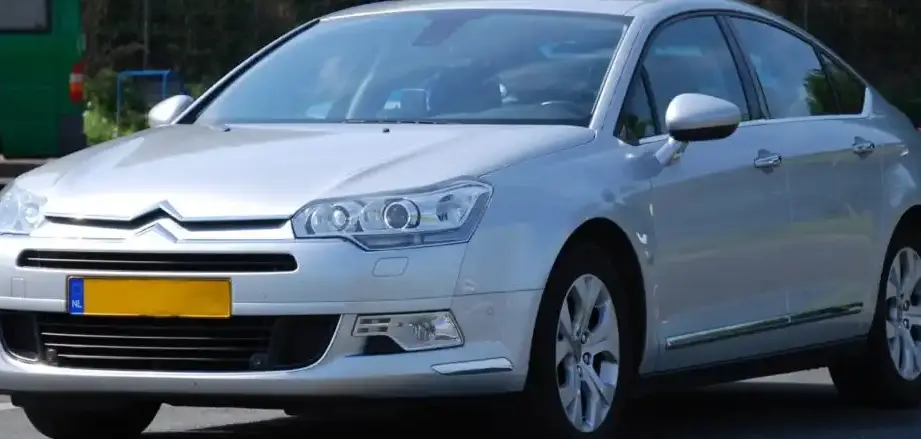
The Citroën C5 II, specifically the 1.6 e-HDi (110 hp) FAP EGS variant produced between 2010 and 2012, represents a significant step in the evolution of Citroën’s large family car. Positioned as an entry-level to mid-range offering within the second generation C5 range (introduced in 2008), this model aimed to balance fuel efficiency with acceptable performance and comfort. It was primarily marketed in Europe, where diesel engines and automatic transmissions were increasingly popular, and represented Citroën’s attempt to cater to a broader customer base seeking lower running costs. This variant utilized Citroën’s e-HDi technology, combining a diesel engine with stop-start functionality and an electronically controlled gearbox.
Technical Specifications
| Brand | Citroën |
| Model | C5 |
| Generation | C5 II (Phase I, 2008) |
| Type (Engine) | 1.6 e-HDi (110 Hp) FAP EGS |
| Start of production | 2010 |
| End of production | 2012 |
| Powertrain Architecture | Internal Combustion engine |
| Body type | Sedan |
| Seats | 5 |
| Doors | 4 |
| Fuel consumption (urban) | 5.5 l/100 km (42.8 US mpg, 51.4 UK mpg, 18.2 km/l) |
| Fuel consumption (extra urban) | 4.1 l/100 km (57.4 US mpg, 68.9 UK mpg, 24.4 km/l) |
| Fuel consumption (combined) | 4.6 l/100 km (51.1 US mpg, 61.4 UK mpg, 21.7 km/l) |
| CO2 emissions | 120 g/km |
| Fuel Type | Diesel |
| Acceleration 0 – 100 km/h | 12.6 sec |
| Acceleration 0 – 62 mph | 12.6 sec |
| Acceleration 0 – 60 mph | 12 sec |
| Maximum speed | 190 km/h (118.06 mph) |
| Emission standard | Euro 5 |
| Weight-to-power ratio | 13.9 kg/Hp, 72.1 Hp/tonne |
| Weight-to-torque ratio | 5.6 kg/Nm, 177 Nm/tonne |
| Power | 110 Hp @ 3500 rpm |
| Power per litre | 70.5 Hp/l |
| Torque | 270 Nm @ 1750 rpm (199.14 lb.-ft. @ 1750 rpm) |
| Engine layout | Front, Transverse |
| Engine Model/Code | 9HL DV6C |
| Engine displacement | 1560 cm3 (95.2 cu. in.) |
| Number of cylinders | 4 |
| Engine configuration | Inline |
| Cylinder Bore | 75 mm (2.95 in.) |
| Piston Stroke | 88.3 mm (3.48 in.) |
| Compression ratio | 18:1 |
| Number of valves per cylinder | 4 |
| Fuel injection system | Diesel Commonrail |
| Engine aspiration | Turbocharger, Intercooler |
| Engine oil capacity | 3.75 l (3.96 US qt, 3.3 UK qt) |
| Coolant | 7.8 l (8.24 US qt, 6.86 UK qt) |
| Kerb Weight | 1525 kg (3362.05 lbs.) |
| Max. weight | 2062 kg (4545.93 lbs.) |
| Max load | 537 kg (1183.88 lbs.) |
| Trunk (boot) space – minimum | 439 l (15.5 cu. ft.) |
| Fuel tank capacity | 71 l (18.76 US gal, 15.62 UK gal) |
| Max. roof load | 80 kg (176.37 lbs.) |
| Permitted trailer load with brakes (12%) | 1100 kg (2425.08 lbs.) |
| Permitted trailer load without brakes | 750 kg (1653.47 lbs.) |
| Permitted towbar download | 55 kg (121.25 lbs.) |
| Length | 4779 mm (188.15 in.) |
| Width | 1860 mm (73.23 in.) |
| Width including mirrors | 2096 mm (82.52 in.) |
| Height | 1451-1458 mm (57.13 – 57.4 in.) |
| Wheelbase | 2815 mm (110.83 in.) |
| Front track | 1586 mm (62.44 in.) |
| Rear (Back) track | 1557 mm (61.3 in.) |
| Front overhang | 1054 mm (41.5 in.) |
| Rear overhang | 910 mm (35.83 in.) |
| Minimum turning circle | 11.7 m (38.39 ft.) |
| Drivetrain Architecture | Front wheel drive |
| Number of gears and type of gearbox | 6 gears, automatic transmission EGS |
| Front suspension | Double wishbone |
| Rear suspension | Independent multi-link suspension |
| Front brakes | Ventilated discs |
| Rear brakes | Disc |
| Assisting systems | ABS (Anti-lock braking system) |
| Steering type | Steering rack and pinion |
| Power steering | Hydraulic Steering |
| Tires size | 225/60 R16 |
| Wheel rims size | 16 |
Powertrain & Engine Architecture
The heart of this C5 variant is the 1.6-liter, four-cylinder diesel engine, specifically the PSA Group’s DV6C engine family, identified by the code 9HL. This engine is a turbocharged common rail direct injection diesel. The turbocharger, coupled with an intercooler, helps to boost power and torque output. The common rail system, operating at high pressure, ensures precise fuel delivery for optimized combustion. The engine features four valves per cylinder and a compression ratio of 18:1. The ‘e-HDi’ designation signifies the inclusion of Stop & Start technology, which automatically shuts off the engine when the vehicle is stationary (e.g., at traffic lights) to reduce fuel consumption and emissions. The engine is transversely mounted at the front of the vehicle.
The EGS (Electronically Controlled Gearbox) transmission is a six-speed automated manual transmission. Unlike a traditional automatic with a torque converter, the EGS uses actuators to shift gears, offering a degree of efficiency but sometimes exhibiting less smoothness than a conventional automatic. It’s essentially a manual gearbox operated by computer control.
Driving Characteristics
The 1.6 e-HDi engine, producing 110 horsepower and 270 Nm (199 lb-ft) of torque, provides adequate, but not exhilarating, performance. Acceleration from 0-100 km/h (0-62 mph) takes around 12.6 seconds, and the top speed is 190 km/h (118 mph). The EGS transmission, while contributing to fuel economy, can feel somewhat hesitant during gear changes, particularly at lower speeds. Compared to the more powerful 2.0-liter HDi variants, this 1.6L engine feels noticeably less responsive, especially when overtaking. However, the torque delivery is relatively strong at lower RPMs, making it suitable for everyday driving. The gear ratios are tuned for fuel efficiency rather than outright performance.
Equipment & Trim Levels
The 1.6 e-HDi FAP EGS typically came equipped with a reasonable level of standard features. These included air conditioning, electric front windows, a CD stereo system, and ABS brakes. Higher trim levels, such as Exclusive, added features like automatic climate control, alloy wheels, rear parking sensors, and a more luxurious interior trim. Interior upholstery was generally cloth, with options for leather upgrades. The dashboard layout was typical of Citroëns of the era, with a focus on ergonomics and functionality.
Chassis & Braking
The C5 II utilizes a double wishbone front suspension and an independent multi-link rear suspension, providing a comfortable ride quality. The suspension is tuned to prioritize comfort over sporty handling. The braking system consists of ventilated discs at the front and solid discs at the rear. ABS (Anti-lock Braking System) is standard. The steering is hydraulic power-assisted, offering a reasonable level of feedback.
Market Reception & Comparison
The 1.6 e-HDi variant was generally well-received for its fuel efficiency and low running costs. Critics praised the engine’s economy, particularly in urban driving conditions, thanks to the Stop & Start system. However, the EGS transmission received mixed reviews, with some finding it jerky and slow to respond. Compared to the 2.0-liter HDi models, the 1.6L offered lower performance but significantly better fuel economy. It was often seen as a sensible choice for drivers prioritizing practicality and affordability over driving excitement.
Legacy
The 1.6 e-HDi engine, while not known for being exceptionally durable, has proven reasonably reliable in many applications. Common issues include potential problems with the diesel particulate filter (DPF) if the vehicle is primarily used for short journeys, and occasional glitches with the EGS transmission. On the used car market, these C5s represent a relatively affordable option for those seeking a comfortable and economical family car. However, potential buyers should be aware of the potential maintenance costs associated with the DPF and EGS system. The C5 II, in general, is remembered for its comfortable ride and innovative features, and the 1.6 e-HDi variant played a role in making that comfort accessible to a wider range of buyers.