Technical Specifications
| Brand | Jaguar |
| Model | XF |
| Generation | XF (X250) |
| Type (Engine) | 3.0d V6 (211 Hp) Automatic |
| Start of production | 2010 |
| End of production | 2011 |
| Powertrain Architecture | Internal Combustion engine |
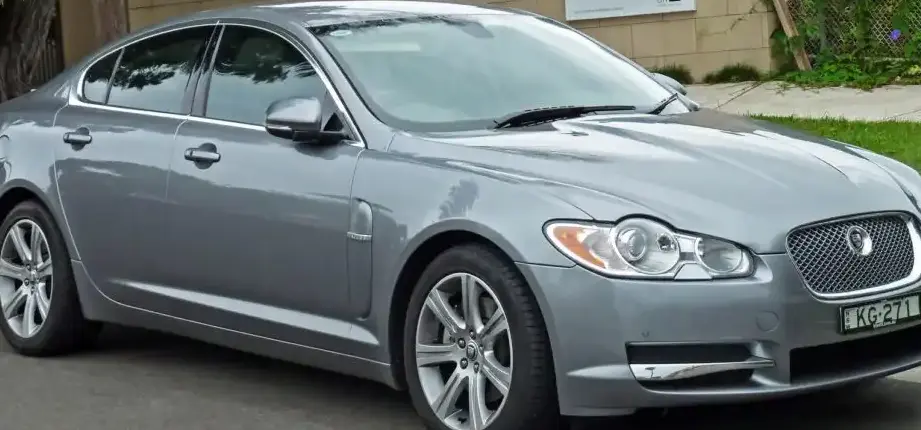
| Body type | Sedan |
| Seats | 5 |
| Doors | 4 |
| Fuel consumption (economy) – urban (NEDC) | 9.5 l/100 km (24.8 US mpg, 29.7 UK mpg, 10.5 km/l) |
| Fuel consumption (economy) – extra urban (NEDC) | 5.5 l/100 km (42.8 US mpg, 51.4 UK mpg, 18.2 km/l) |
| Fuel consumption (economy) – combined (NEDC) | 6.8 l/100 km (34.6 US mpg, 41.5 UK mpg, 14.7 km/l) |
| CO2 emissions (NEDC) | 179 g/km |
| Fuel Type | Diesel |
| Acceleration 0 – 100 km/h | 8.1 sec |
| Acceleration 0 – 62 mph | 8.1 sec |
| Acceleration 0 – 60 mph | 7.7 sec |
| Maximum speed | 240 km/h (149.13 mph) |
| Emission standard | Euro 5 |
| Weight-to-power ratio | 8.6 kg/Hp, 115.9 Hp/tonne |
| Weight-to-torque ratio | 4 kg/Nm, 247.3 Nm/tonne |
| Power | 211 Hp @ 4000 rpm |
| Power per litre | 70.5 Hp/l |
| Torque | 450 Nm @ 2000 rpm (331.9 lb.-ft. @ 2000 rpm) |
| Engine layout | Front, Longitudinal |
| Engine Model/Code | AJTDV6, 306DT |
| Engine displacement | 2993 cm3 (182.64 cu. in.) |
| Number of cylinders | 6 |
| Engine configuration | V-engine |
| Cylinder Bore | 84 mm (3.31 in.) |
| Piston Stroke | 90 mm (3.54 in.) |
| Compression ratio | 16:1 |
| Number of valves per cylinder | 4 |
| Fuel injection system | Diesel Commonrail |
| Engine aspiration | BiTurbo, Intercooler |
| Valvetrain | DOHC |
| Engine oil capacity | 6.6 l (6.97 US qt, 5.81 UK qt) |
| Coolant | 12.5 l (13.21 US qt, 11 UK qt) |
| Kerb Weight | 1820 kg (4012.41 lbs.) |
| Max. weight | 2360 kg (5202.91 lbs.) |
| Max load | 540 kg (1190.5 lbs.) |
| Trunk (boot) space – minimum | 540 l (19.07 cu. ft.) |
| Trunk (boot) space – maximum | 963 l (34.01 cu. ft.) |
| Fuel tank capacity | 69.5 l (18.36 US gal, 15.29 UK gal) |
| Permitted trailer load with brakes (12%) | 1850 kg (4078.55 lbs.) |
| Permitted trailer load without brakes | 750 kg (1653.47 lbs.) |
| Permitted towbar download | 75 kg (165.35 lbs.) |
| Length | 4961 mm (195.31 in.) |
| Width | 1877 mm (73.9 in.) |
| Width including mirrors | 2053 mm (80.83 in.) |
| Height | 1460 mm (57.48 in.) |
| Wheelbase | 2909 mm (114.53 in.) |
| Front track | 1559 mm (61.38 in.) |
| Rear (Back) track | 1605 mm (63.19 in.) |
| Drag coefficient (Cd) | 0.29 |
| Minimum turning circle (turning diameter) | 11.48 m (37.66 ft.) |
| Drivetrain Architecture | The Internal combustion engine (ICE) drives the rear wheels of the vehicle. |
| Drive wheel | Rear wheel drive |
| Number of gears and type of gearbox | 6 gears, automatic transmission |
| Front suspension | Coil spring, Double wishbone, Transverse stabilizer |
| Rear suspension | Independent multi-link spring suspension with stabilizer |
| Front brakes | Ventilated discs |
| Rear brakes | Ventilated discs |
| Assisting systems | ABS (Anti-lock braking system) |
| Steering type | Steering rack and pinion |
| Power steering | Hydraulic Steering |
| Tires size | 245/45 R18; 245/40 R19; 255/35 R20 |
| Wheel rims size | 8.5J x 18; 8.5J x 19; 8.5J x 20 |
The Jaguar XF (X250) 3.0d V6 Automatic, launched in 2010 and produced through 2011, was a strategically important model for Jaguar. It aimed to expand the XF’s market reach by offering a diesel-powered alternative to the gasoline engines, particularly appealing to European buyers where diesel fuel was favored. Positioned as a mid-to-upper trim level, the 3.0d V6 sought to deliver a blend of performance, luxury, and improved fuel economy. Built on the X250 platform – shared with the first-generation XJ – it provided a more dynamic driving experience than traditional luxury sedans.
Powertrain & Engine Architecture
The core of the XF 3.0d was the Jaguar AJTDV6 engine, identified by the code 306DT. This 3.0-liter V6 diesel engine employed a sophisticated bi-turbocharger system, utilizing two variable geometry turbos to deliver a broad torque curve and strong power output. A common rail direct injection system, operating at high pressure, ensured efficient fuel delivery and combustion. The engine featured a Double Overhead Camshaft (DOHC) valvetrain with four valves per cylinder, enhancing its responsiveness. The engine was mated to a six-speed automatic transmission, calibrated to complement the engine’s torque characteristics for smooth and efficient gear changes. A diesel particulate filter (DPF) was included to meet Euro 5 emissions regulations.
Driving Characteristics
The 3.0d V6 Automatic offered a different driving experience compared to the higher-horsepower gasoline XF variants. The engine produced 450 Nm (331.9 lb-ft) of torque at 2000 rpm, providing strong acceleration and effortless cruising. While the six-speed automatic transmission was smooth, it wasn’t particularly quick-shifting, prioritizing comfort over sporty responsiveness. Acceleration from 0-60 mph took around 7.7 seconds, and the car had a top speed of 149.13 mph. Compared to manual transmission versions, the automatic offered convenience but reduced driver engagement. The transmission’s gear ratios were optimized for relaxed highway driving and fuel efficiency. The rear-wheel-drive layout and balanced weight distribution contributed to stable handling, though it wasn’t as agile as some competitors.
Equipment & Trim Levels
The 3.0d V6 Automatic typically came well-equipped, reflecting its position in the XF lineup. Standard features included leather upholstery, automatic climate control, a premium audio system, and parking sensors. Optional extras included a panoramic sunroof, heated seats, an upgraded navigation system, and adaptive cruise control. Interior trim options allowed for customization with wood veneers and aluminum accents. The XF’s interior was known for its luxurious feel, high-quality materials, and refined design, highlighted by the signature rotary gear selector.
Chassis & Braking
The XF 3.0d V6 featured a suspension system designed to balance ride comfort and handling. The front suspension utilized coil springs and a double wishbone setup, while the rear employed an independent multi-link spring suspension. Transverse stabilizer bars were fitted at both ends to minimize body roll. Ventilated discs were used for braking on all four wheels, providing ample stopping power. An Anti-lock Braking System (ABS) was standard for enhanced safety. The steering system was a rack and pinion design with hydraulic power assistance, offering precise control and a responsive feel.
Market Reception & Comparison
The Jaguar XF 3.0d V6 Automatic received generally positive reviews from automotive critics. It was praised for its refined engine, comfortable ride, and luxurious interior. Some reviewers noted the automatic transmission’s somewhat sluggish response and that the driving experience wasn’t as engaging as competitors like the BMW 5 Series or Audi A6. Fuel economy was a strong point, achieving around 34.6 US mpg on the combined cycle. Reliability was generally good, although the diesel particulate filter required periodic maintenance. Compared to the XF 2.2d, the 3.0d offered a noticeable performance increase, justifying its higher price.
Legacy
The Jaguar XF 3.0d V6 Automatic remains a desirable used car today, appealing to buyers seeking a blend of luxury, performance, and fuel efficiency. The AJTDV6 engine, with proper maintenance, is considered a robust and reliable unit. The XF’s elegant design and well-appointed interior have aged well. Potential buyers should be aware of the maintenance costs associated with a modern luxury vehicle, including the diesel particulate filter and other complex systems. The 3.0d V6 represents a compelling combination of attributes that continue to make it an attractive option in the used car market.