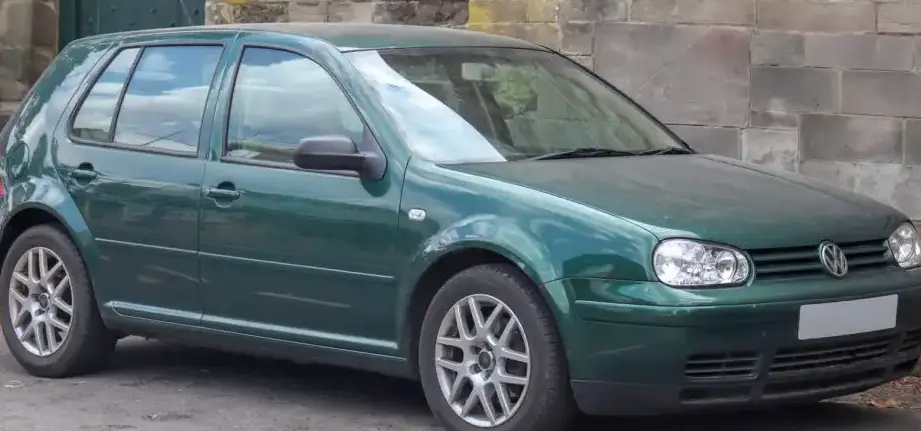
The Volkswagen Golf IV 2.3 V5 20V, produced between 1997 and 2000, represents a unique offering within the fourth generation Golf (Mk IV) lineup. Positioned as a mid-range option, it distinguished itself from the more common inline-four cylinder engines and the performance-oriented VR6. Built on the Volkswagen Group’s A4 (or 1HX0) platform, shared with models like the Audi A3, SEAT Leon, and Škoda Octavia, the Golf IV aimed to refine the Golf’s reputation for practicality, build quality, and everyday usability. The V5 engine was intended to bridge the gap between affordability and a more premium driving experience, offering a smoother and more refined power delivery than the base engines.
Technical Specifications
| Brand | Volkswagen |
| Model | Golf |
| Generation | Golf IV |
| Type (Engine) | 2.3 V5 20V (150 Hp) |
| Start of production | 1997 |
| End of production | 2000 |
| Powertrain Architecture | Internal Combustion engine |
| Body type | Hatchback |
| Seats | 5 |
| Doors | 3-5 |
| Fuel consumption (urban) | 13.2 l/100 km (17.8 US mpg, 21.4 UK mpg, 7.6 km/l) |
| Fuel consumption (extra urban) | 7.2 l/100 km (32.7 US mpg, 39.2 UK mpg, 13.9 km/l) |
| Fuel consumption (combined) | 9.3 l/100 km (25.3 US mpg, 30.4 UK mpg, 10.8 km/l) |
| Fuel Type | Petrol (Gasoline) |
| Acceleration 0 – 100 km/h | 8.8 sec |
| Acceleration 0 – 62 mph | 8.8 sec |
| Acceleration 0 – 60 mph | 8.4 sec |
| Maximum speed | 216 km/h (134.22 mph) |
| Weight-to-power ratio | 8.3 kg/Hp, 120.7 Hp/tonne |
| Weight-to-torque ratio | 6.1 kg/Nm, 164.9 Nm/tonne |
| Power | 150 Hp @ 6000 rpm |
| Power per litre | 64.5 Hp/l |
| Torque | 205 Nm @ 3200 rpm (151.2 lb.-ft. @ 3200 rpm) |
| Engine layout | Front, Transverse |
| Engine Model/Code | AQN |
| Engine displacement | 2324 cm3 (141.82 cu. in.) |
| Number of cylinders | 5 |
| Engine configuration | V-engine |
| Cylinder Bore | 81 mm (3.19 in.) |
| Piston Stroke | 90.2 mm (3.55 in.) |
| Compression ratio | 10.1:1 |
| Number of valves per cylinder | 2 |
| Fuel injection system | Multi-port manifold injection |
| Engine aspiration | Naturally aspirated engine |
| Valvetrain | DOHC |
| Engine oil capacity | 4.6 l (4.86 US qt | 4.05 UK qt) |
| Coolant capacity | 8.5 l (8.98 US qt | 7.48 UK qt) |
| Kerb Weight | 1243 kg (2740.35 lbs.) |
| Max. weight | 1760 kg (3880.14 lbs.) |
| Max load | 517 kg (1139.79 lbs.) |
| Trunk (boot) space – minimum | 330 l (11.65 cu. ft.) |
| Trunk (boot) space – maximum | 1185 l (41.85 cu. ft.) |
| Fuel tank capacity | 55 l (14.53 US gal | 12.1 UK gal) |
| Length | 4149 mm (163.35 in.) |
| Width | 1735 mm (68.31 in.) |
| Height | 1439 mm (56.65 in.) |
| Wheelbase | 2511 mm (98.86 in.) |
| Front track | 1513 mm (59.57 in.) |
| Rear (Back) track | 1494 mm (58.82 in.) |
| Drivetrain Architecture | The Internal combustion engine (ICE) drives the front wheels of the vehicle. |
| Drive wheel | Front wheel drive |
| Number of gears and type of gearbox | 5 gears, manual transmission |
| Front suspension | Wishbone |
| Rear suspension | Coil spring |
| Front brakes | Ventilated discs |
| Rear brakes | Disc |
| Assisting systems | ABS (Anti-lock braking system) |
| Steering type | Steering rack and pinion |
| Power steering | Hydraulic Steering |
| Tires size | 205/55 R16 |
| Wheel rims size | 6J x 16 |
Powertrain & Engine Architecture
The heart of the Golf IV 2.3 V5 20V is the AQN engine code, a 2.3-liter, naturally aspirated V5 engine. This engine is notable for its unusual five-cylinder configuration, which aimed to provide a balance between smoothness and power. The engine utilizes a 10.1:1 compression ratio and multi-port fuel injection to deliver 150 horsepower at 6000 rpm and 205 Nm (151.2 lb-ft) of torque at 3200 rpm. The dual overhead camshafts (DOHC) and four valves per cylinder (20V) contribute to its relatively high specific output. The engine’s firing order is designed to minimize vibrations, offering a smoother experience compared to inline-four engines. The five-speed manual transmission was standard, providing a direct connection to the engine’s power. A four-speed automatic transmission was also available, though it impacted acceleration slightly.
Driving Characteristics
The Golf IV 2.3 V5 20V offered a comfortable and refined driving experience. The V5 engine provided ample power for everyday driving, with a noticeable improvement in acceleration compared to the base 1.6 or 1.8-liter inline-four engines. The 0-60 mph time of around 8.4 seconds (manual transmission) was respectable for its time. The automatic transmission, while offering convenience, resulted in a slightly slower 0-60 mph time and a less engaging driving experience. The gear ratios were tuned for a balance of fuel economy and performance, with a focus on providing smooth and predictable power delivery. Compared to the more powerful VR6 variant, the V5 lacked the outright performance, but it offered a more fuel-efficient and less expensive alternative.
Equipment & Trim Levels
The Golf IV 2.3 V5 20V typically came equipped with a reasonable level of standard features. This included power windows, central locking, power steering, and an anti-lock braking system (ABS). Interior upholstery was typically cloth, with options for upgraded materials. Trim levels varied depending on the market, but generally included features like alloy wheels, a sunroof, and upgraded audio systems. Optional extras included climate control, heated seats, and a CD changer. The dashboard layout was typical of the Mk IV Golf, with a functional and ergonomic design.
Chassis & Braking
The Golf IV 2.3 V5 20V utilized a MacPherson strut front suspension and a multi-link rear suspension, providing a comfortable ride and good handling characteristics. The front brakes were ventilated discs, while the rear brakes were solid discs. The ABS system helped to maintain control during hard braking. The suspension was tuned to provide a balance between comfort and handling, making it suitable for both city driving and longer journeys. Stabilizer bars were fitted to both the front and rear axles to reduce body roll during cornering.
Market Reception & Comparison
The Golf IV 2.3 V5 20V received mixed reviews. Critics praised its smooth engine and refined driving experience, but some found it to be somewhat underpowered compared to the VR6. Fuel economy was generally considered to be acceptable, but not exceptional. Reliability was generally good, although the V5 engine was known to be more complex than the inline-four engines, potentially leading to higher maintenance costs. Compared to the 1.8-liter turbocharged engine, the V5 offered a more linear power delivery but lacked the same level of performance. The V5 was often seen as a compromise between affordability and performance, appealing to buyers who wanted something more than the base models but didn’t want to pay the premium for the VR6.
Legacy
Today, the Golf IV 2.3 V5 20V is considered a relatively rare and interesting variant of the Mk IV Golf. The V5 engine, while not as common as other engines in the lineup, has developed a cult following among enthusiasts. The powertrain is generally considered to be reliable, although regular maintenance is essential. Parts availability can be a challenge, as some components are specific to the V5 engine. Well-maintained examples are becoming increasingly sought after by collectors and enthusiasts who appreciate the unique character and smooth power delivery of the V5 engine. The Golf IV 2.3 V5 20V represents a unique chapter in the Golf’s history, offering a blend of practicality, refinement, and distinctive engineering.